Heat Pumps vs Biomass Boilers – How to Choose the Right Sustainable Heating Solution
Are you wondering whether a heat pump or biomass boiler is the right fit for your project? Eco heating expert David Hilton compares these low-carbon heating contenders, and looks at which will best suit your home
Over the past couple of years, the choices we’re faced with when deciding on a new or replacement heating system have become ever more complex. Products and technologies that were previously deemed to be at the cutting edge of sustainability and energy-saving have now become mainstream – even encouraged.
This whole new world has been rapidly thrust upon us. In that context, it can be very difficult to know whether we’re being sold to or advised when we speak to installers and suppliers. So, where can you go for the cold, hard facts that will help you make informed decisions? Right here. Two of the main contenders in the eco debate are heat pumps and biomass. But what exactly are these technologies, how do they work and how can you tell which is best for you and your home?
Here, I’m taking an in-depth look at how both heat pumps and biomass boilers work, and comparing the different options to help inform your eco heating choice.
What are heat pumps & how do they work?
Let’s start with heat pumps. As the name suggests, they pump heat – moving it from one place to another and enhancing it to a more usable form. A heat pump uses electricity to power a refrigeration process that extracts heat energy from its local environment and transfers it to the water in your home’s central heating system.
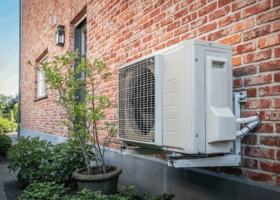
A heat pump is named after the environment that it gets its heat from. So, an air source heat pump (ASHP) extracts energy from the ambient air around the outdoor fan unit. The colder the air, the harder the heat pump needs to work and the lower its efficiency. An ASHP can extract up to 12°C’s worth of thermal energy, which it then concentrates for space heating and domestic hot water.
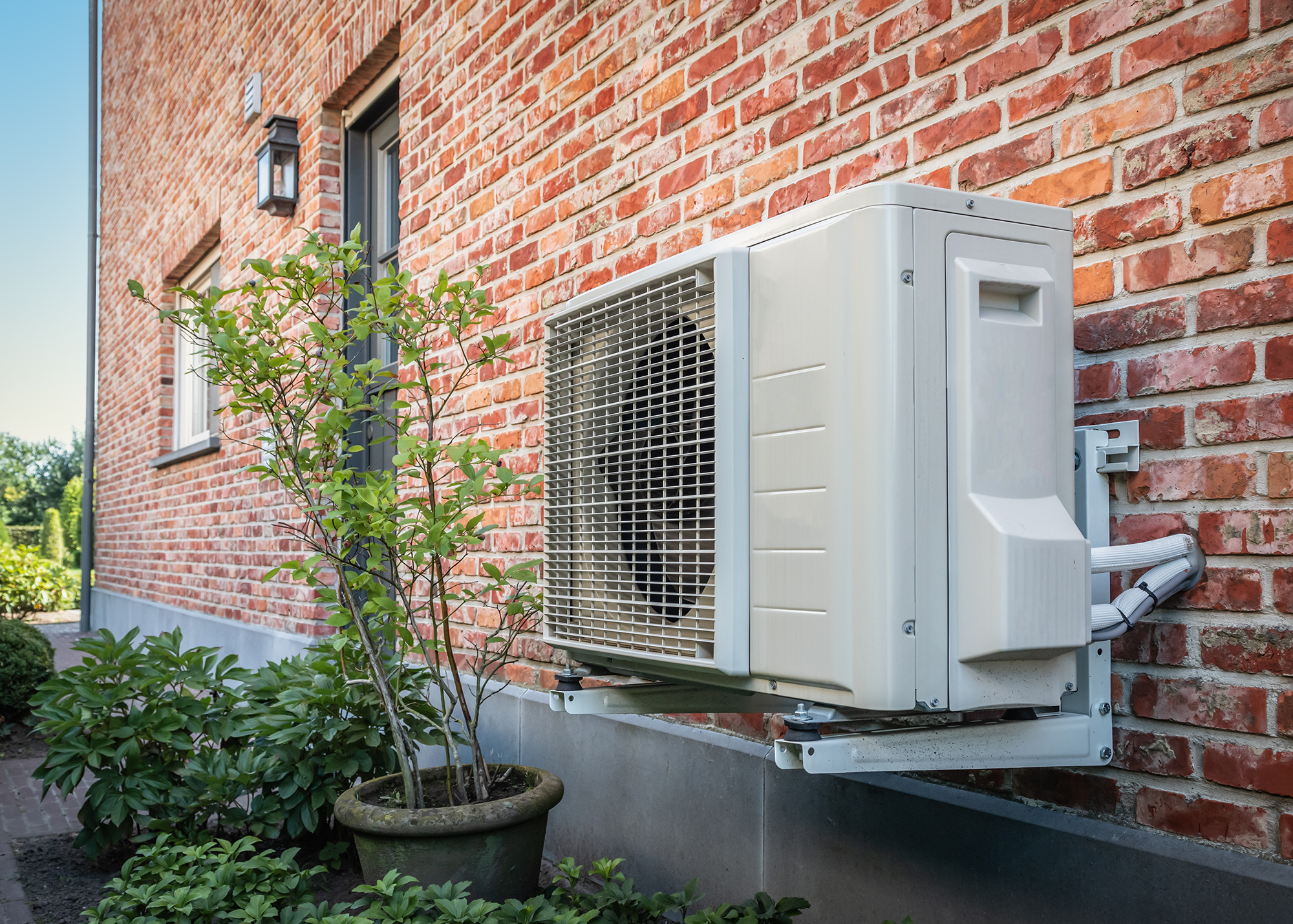
Air source heat pumps can be suitable for a range of new build and existing homes – depending on the heat loads, emitter type and insulation levels. Photo: iSTOCK.COM/NANCY PAUWELS
The outside fan unit needs space around it to avoid impeding the air flow. The cold air that comes out the front of the heat pump must not be deflected into the back of the unit, as this could severely lower efficiency and potentially cause the system to freeze.
You guessed it: a ground source heat pump (GSHP) extracts its energy from the earth, via collector pipes buried either horizontally or in vertical bore holes. For the horizontal collector, assuming damp and cohesive soil, you would typically need around two or three times the floor area of the home. So, a 200m² house requires between 400m² and 600m² of suitable ground. If you are on chalk, shale or any other aerated, porous soil, the collector could be double that size. If you have a digger – or a friend with one – then digging your own trenches will save a large portion of the up front cost.
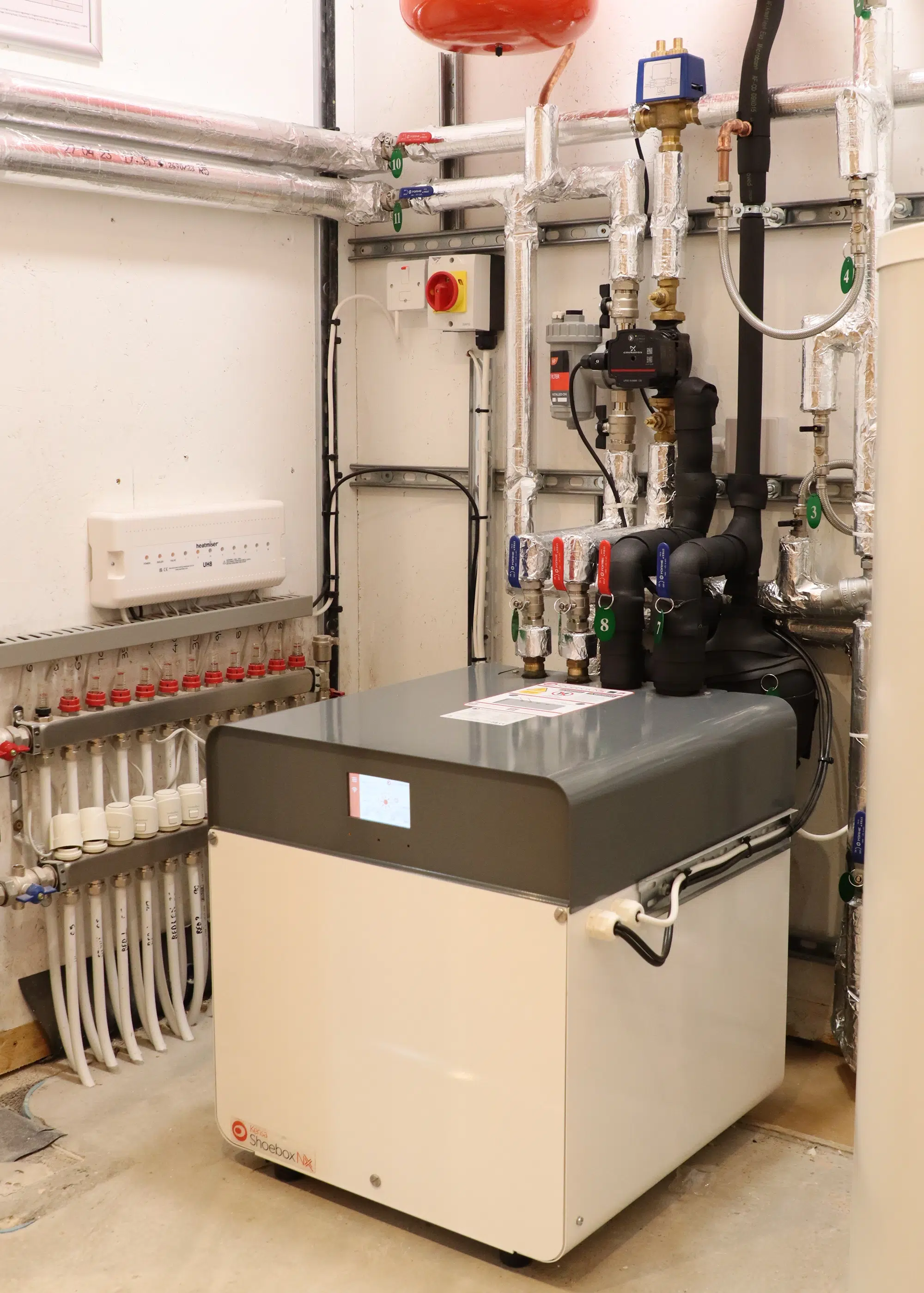
Rated at an output of 5.8kW, UK manufacturer Kensa’s Shoebox NX ground source heat pump offers a compact, high-performance option for space heating and hot water in flats and smaller homes up to five bedrooms
The borehole solution is more expensive to install, and slightly more efficient in use, but requires a far smaller garden. Either way, consult a geologist or take advice from a reputable engineer to confirm the true magnitude of collector you’ll need.
A GSHP unit is roughly the size of a fridge and is usually installed in a plant room or garage. You may also need two cylinders, each around that same size, plus a similar area to accommodate the manifolds and pipework. That’s a total indoor plant area requirement equivalent to roughly four fridges.
How much can you get towards the cost of a heat pump in the UK?
Heat pumps are currently supported by a £7,500Boiler Upgrade Scheme (BUS) grant for existing or self build homes in England and Wales. This is issued as a voucher against the installation of an ASHP or GSHP in eligible properties. To qualify, the heat pump must be installed by an MCS-certified (Microgeneration Certification Scheme) installer. Existing homes must have a valid Energy Performance Certificate (EPC).
Next up I’m going to look at biomass boilers. Rather than move heat, biomass systems burn fuel. This can be any organic combustible material, but it usually refers to wood logs, chips or pellets. Other options include grass-based fuels – typically pellets or compressed logs made from miscanthus – although these have a higher ash content and aren’t suitable for many high-end models.
An advantage of biomass boilers for some homes is that they produce high temperature heat. They can deliver up to 4-5kW of heat per kg of wood, although the yield will be lower if it’s burned wet or at a low temperature. The most efficient burn occurs at gasification temperatures of over 1,000°C. Cooler temperatures mean not all the fuel is fully combusted, so some calorific value remains in soot or ash rather than being converted into heat
Not all biomass burners are the same. Log versions are usually batch systems. A chamber in the boiler is loaded with logs, which are all the same length and split to similar sizes. The chamber is closed, fuel ignited and the burn temperature lifted to gasification level.
The heat is then transferred to a large water store, typically sized at a ratio of around 50 litres of water per kilowatt rating of the boiler. So, a 20kW boiler would need to be coupled with a thermal store of at least 1,000 litres. Depending on the property’s heat load, you may need a daily burn in midwinter, stretching to weekly in the warmer months.
Woodchip boilers
These are a little more versatile than log boilers, as the woodchip is fed in and burned in real time rather than batch-burned for thermal storage. The main issue is the woodchips themselves, which are often inconsistent in size and density, and can contain bark, leaves or other waste products. For the best burn and to ensure safe storage, it’s essential to use low-moisture, low-dust chips stored in regularly turned and well-ventilated piles.
The requirement for bulk fuel storage and handling equipment – along with high heat outputs – make woodchip boilers best suited to large properties with heat loads of over 40kW (so, not your average home).
Did you know?
Some manufacturers offer biomass boilers capable of burning several fuel types
One example would be a log burner that can, with a simply user-managed change of the grate, switch to burning pellets. This gives you flexibility, for instance if a given fuel type is more affordable when you come to order.
Pellet boilers
Wood pellet systems are probably the closest low-carbon alternative to a traditional gas or fossil fuel boiler. Pellets can be loaded manually in a single room burner, much like a woodburning stove. Alternatively, they can be used in a central heating system boiler with automatic feed and near on-demand heat production. Ignition takes longer than gas but the pellets are a very consistent size, density and quality, ensuring even combustion and minimal waste.
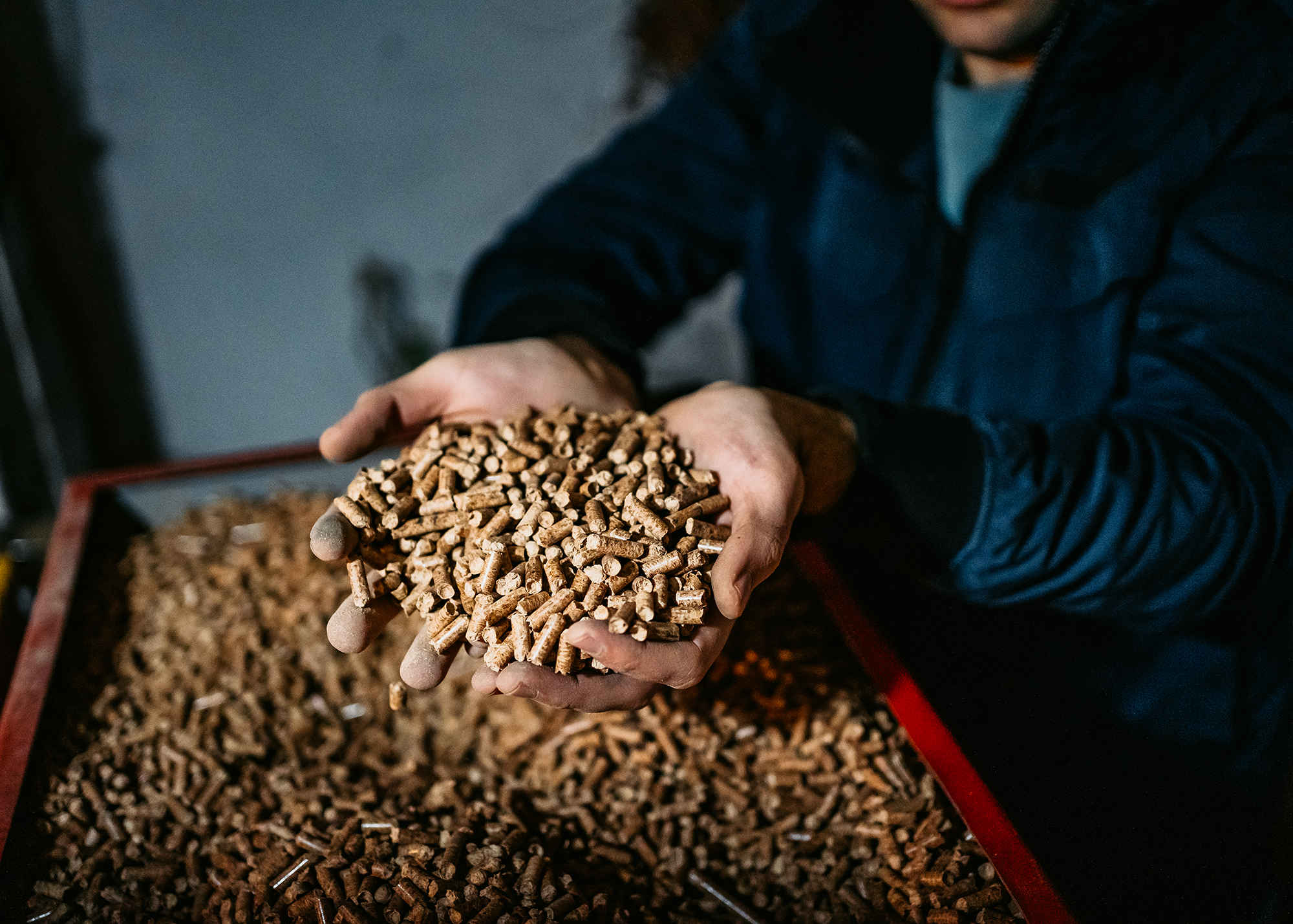
Pellets are the most common form of biomass fuel for domestic homes. Photo: iSTOCK.COM/urbazon
The biggest challenge is storage. Pellets can be purchased in manageable bags but are more commonly delivered by a blower truck in bulk. You’ll typically need a store big enough to hold at least one or two tonnes of pellets, fed into a hopper that in turn supplies the boiler. They must not get wet or be allowed to sweat, as moisture will damage the pellets and cause issues with fuel feed and combustion.
How much can you get towards the cost of a biomass system in the UK?
Biomass boilers are also supported by the Boiler Upgrade Scheme, with a £5,000 grant (smaller than for heat pumps) available for eligible installations carried out by a registered MCS installer. To qualify, the boiler must deliver the heat to the home via a wet (water-based) central heating system. The property must also be in a rural location with no mains gas connection.
So, heat pump or biomass? Here’s a helpful summary to help you decide
When it comes to comparing heat pumps and biomass boilers, the evaluation isn’t too difficult. As we’ve seen, each technology has its own nuances. These differences – combined with the scope of your project and what you want out of the system – are the deciding factors that will help you identify the right fit for your specific needs and property type. Here’s where to start:
Log biomass
Best suited to larger properties that require a high-temperature emitter circuit. Can be very low-bills and low-carbon if you have enough land to grow your own coppice for a sustainable fuel source.
Wood chip
Excellent for buildings with a heat load of over 40kW. Examples could include several cottages connected via a district heat network, a hospitality venue or a very large home. If you have access to wood waste that can be chipped, this will lower running costs.
Pellet boilers
Strong choice for homes with high heat loads and radiator-based heating – but you’ll need enough space to construct a conveniently-located pellet store for deliveries and to accommodate the hopper.
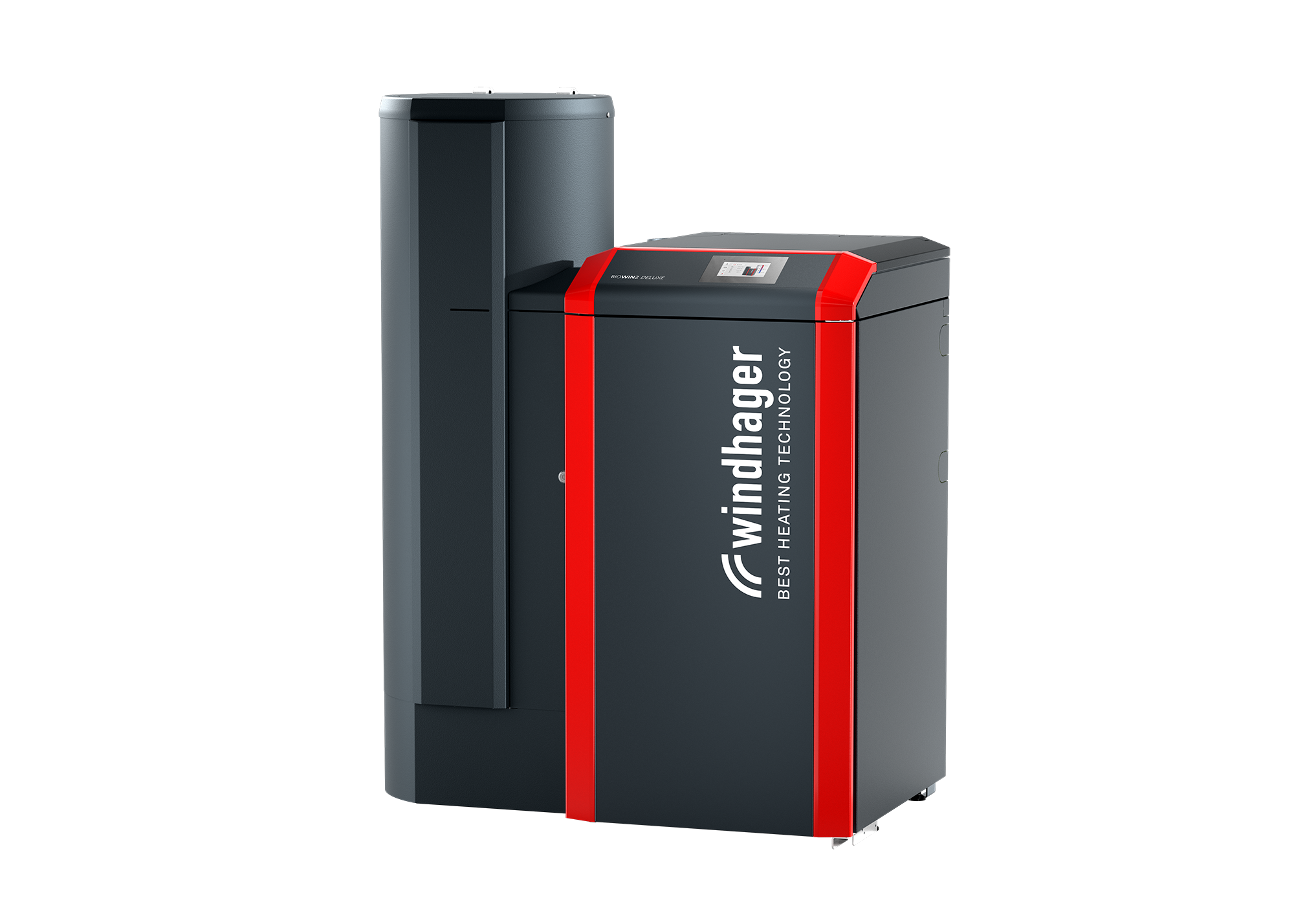
The Biowin2 Deluxe from Windhager is a modern, easy-install and low-maintenance pellet heating system, requiring ash removal just once or twice per year and servicing every two years
Ground source heat pump
Can suit some smaller properties, but the scale of the installation typically works best for well-insulated and draughtproofed larger properties, (250m² or bigger) with enough land for the ground collector and an indoor plant room for the equipment. Check the capacity of your electric supply, as GSHPs over about 16kW may not be suitable for single-phase systems (requiring an upgrade to three-phase).
Air source heat pump
Great for a wide range of homes up to around 200m² (existing buildings/retrofits) or up to 300m² (well-insulated new builds) on a single-phase electricity supply. Larger or less efficient properties may need multiple ASHPs, potentially requiring planning permission and/or an upgrade to a three-phase electric supply.
The choice is yours – but the better you define your needs and expectations for the technology, the easier that choice will be, and the more likely your heating system will deliver as promised.
Dave Hilton is a renewables and ventilation installer, with over 35 years’ experience. He runs Heat & Energy, has a Masters in Sustainable Architecture and is an authority on eco building and energy efficiency. He leads Build It’s Virtual Training on heat pumps and off-grid solutions.














































 Login/register to save Article for later