







































 Login/register to save Article for later
Keeley Sutcliffe is design manager at award-winning British bathroom designer, BC Designs. Over the last 22 years, the company has expanded their range of products to include both compact and spacious designs in luxury materials.
- Plan ItBack
- Design ItBack
- Build ItBack
- Homes
- ProductsBack
- CostsBack
- Self Build Cost Calculator
Estimate your project costs instantly with Build It's interactive self-build cost calculator
Calculate Now - Costs & Finance
- Contracts & Warranties
- Build It Estimating Service
Get an accurate, detailed cost breakdown of your project
Submit plans
- EventsBack
How to Get a Loft Conversion Bathroom Right – The Experts Share their Top Tips
Amandine Lefevre speaks to industry experts about how to plan and design a successful loft bathroom scheme ‒ from essential structural planning to ventilation, plumbing and smart design decisions that will ensure you maximise all available room

Loft conversions are one of the UK’s top home extension routes and one of the most straightforward projects to secure planning permission for in many urban areas, as the majority of loft extensions can be completed under permitted development (PD) rights. And, whether you’re looking to add another bedroom or a cosy snug zone, incorporating a bathroom could be an ideal practical solution and a great way to optimise your floorplan – all while boosting your house’s potential value.
Designing a bathroom within a loft conversion, however, isn’t always a simple task. From restricted head height and limited natural light through to plumbing and ventilation requirements, there are a whole host of factors to get right for a functional scheme that works well.
Here I’m speaking to loft and bathroom experts about how to navigate the various structural constraints and select the right fixtures to balance style, comfort and efficiency.
Jump to loft conversion bathroom FAQs answered
Getting a loft bathroom’s layout right
An attic bathroom should be considered a space in its own right rather than a scaled-down version of a standard bathroom. The roofline plays a defining role in how the room is arranged and experienced, so it’s key to specify fixtures and fittings that integrate seamlessly into the space, positioning lower elements ‒ such as benches and bathtubs ‒ in areas where head height is restricted.
“Sloping ceilings naturally lower the sense of enclosure, so layouts need to feel open and easy to move through, with the most active parts of the room kept where head height allows you to stand comfortably,” says Keeley Sutcliffe, design manager at BC Designs.
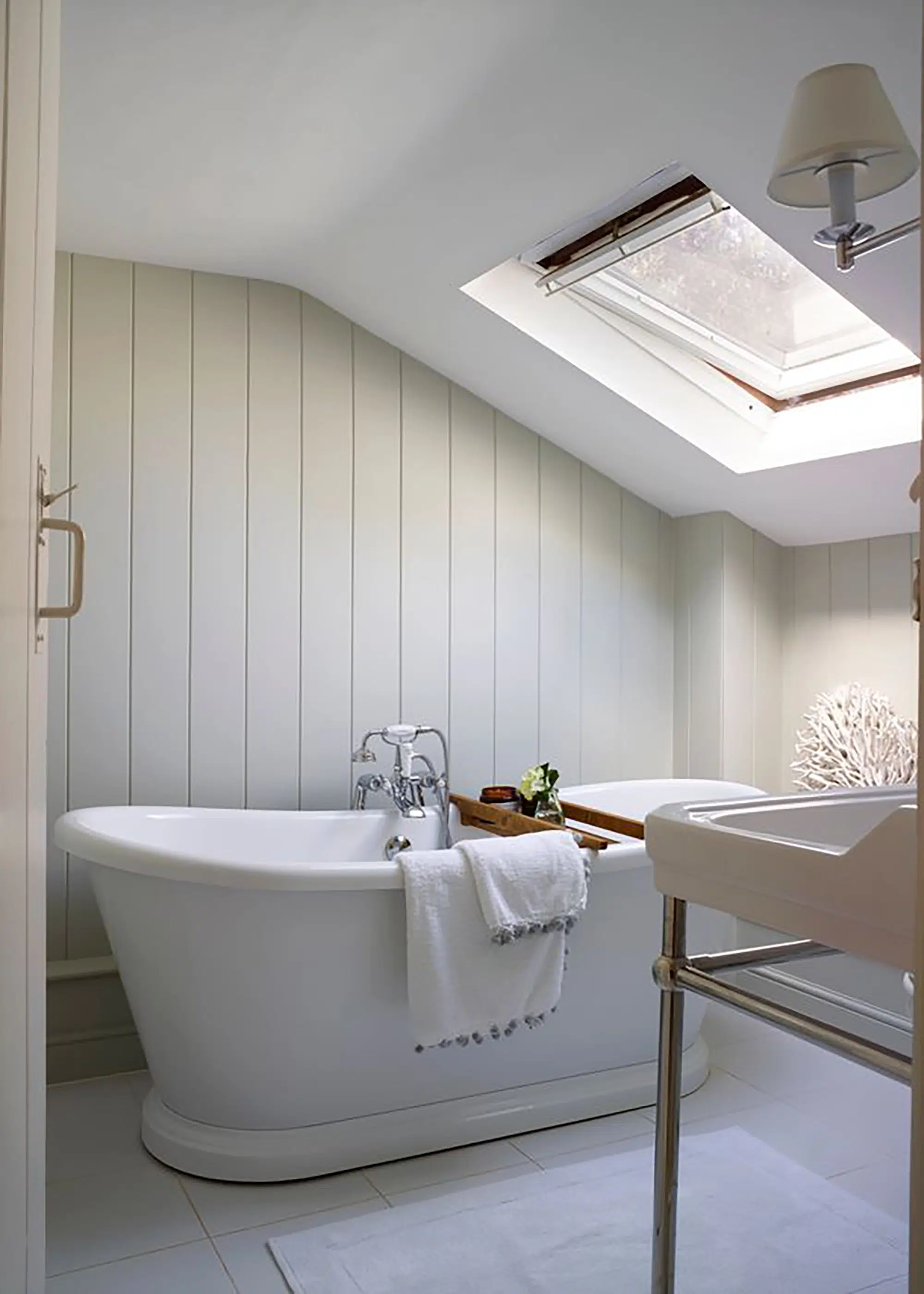
BC Designs selected a calming and neutral colour palette for this Nofolk home, creating a sanctuary-like bathroom with a freestanding bathtub positioned as the room’s focal point
With limited headroom also comes restricted natural light, which means the arrangement of specific bathroom features, such as showers, will either encourage the flow of light through the room or block it entirely. By avoiding tall pieces in these areas, the space can benefit fully from the strong pockets of daylight entering through overhead glazing, preventing dark shadows and creating a brighter, more balanced interior.
Layout decisions should be also guided by how water, waste and air will move through the space, rather than solely by where fittings appear to fit. “Showers in particular need to be located where ceiling height supports comfortable use, but also where water pressure and drainage can be delivered reliably without excessive adaptation,” says Richard Eaton, design manager at Tissino.
Managing ventilation & moisture in an attic bathroom
Moisture control and airflow play a crucial role in the overall comfort and longevity of a loft bathroom and should be considered as integral to the overall design. As warm air naturally rises to the highest point of the home, attic bathrooms rely on efficient, discreet mechanical ventilation to manage humidity effectively ‒ protecting finishes and preventing damp whilst operating quietly in the background.
A continuous mechanical extract ventilation system is ideal for this, offering a controlled and balanced airflow. This could be a standalone, manual extractor fan or operate as part of a wider background mechanical ventilation with heat recovery (MVHR) system, which you may be considering if you’re undertaking a whole-house, deep energy retrofit.
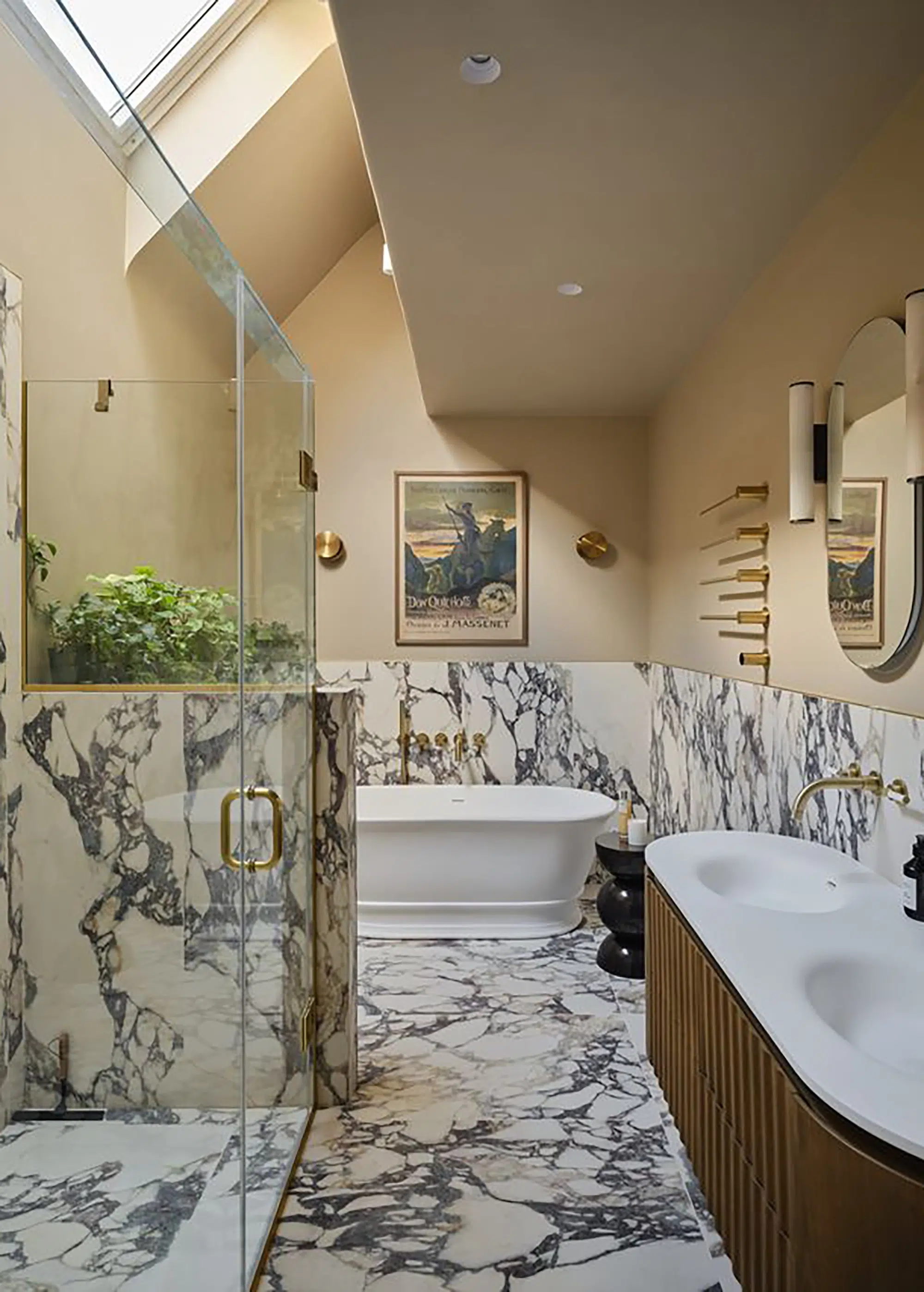
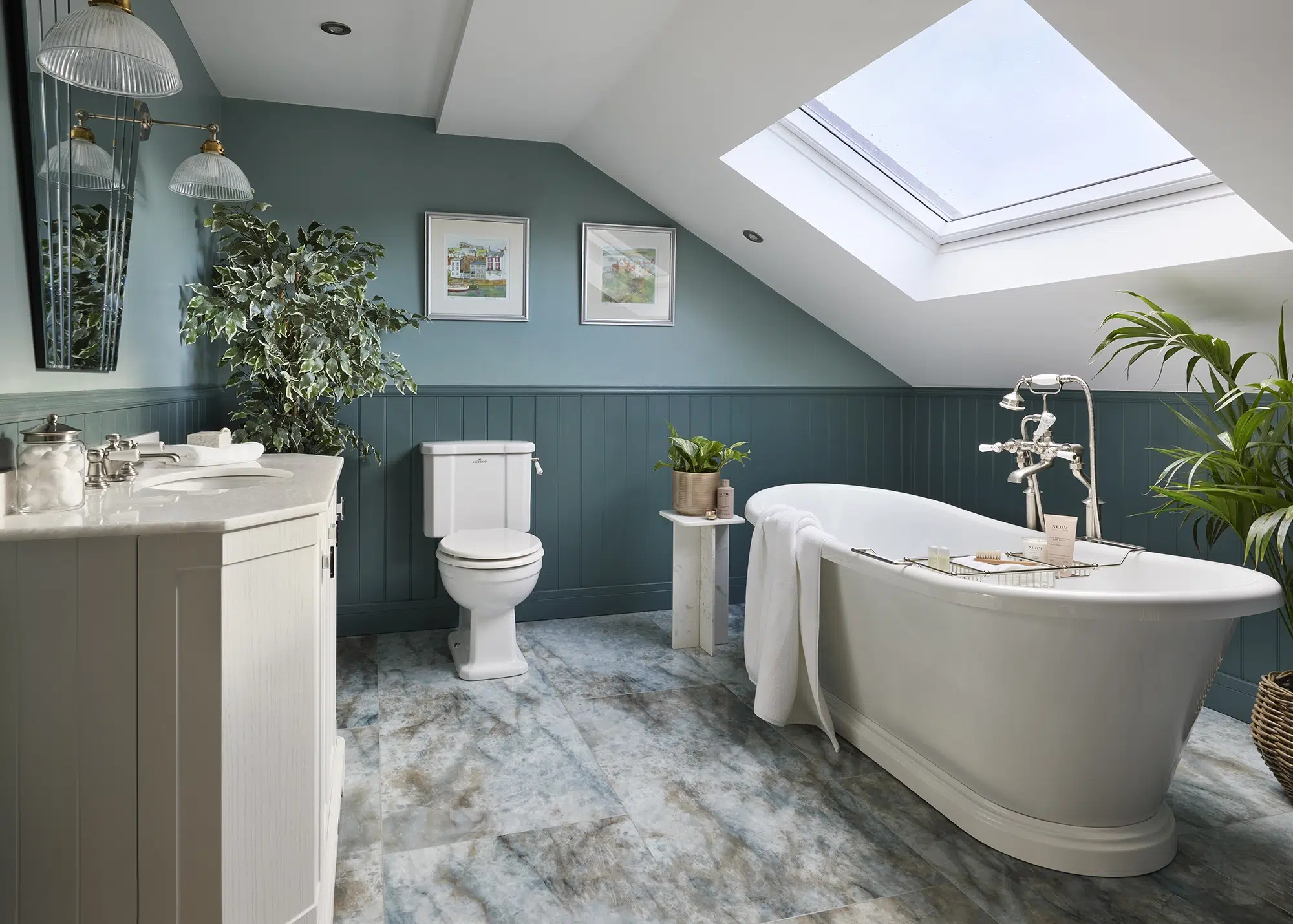
Designed by Loud Architects, this scheme combines luxurious materials with thoughtful planning, showcasing rich marble tiles as the bathroom’s standout design feature
You can also specify smart ventilation systems, such as a humidistat, which detects moisture and kicks in automatically. “In roof-level bathrooms, moisture has nowhere higher to escape,” says Richard. “So, this is not an area where specification should be downgraded as poor airflow can compromise both performance and durability over time.” If your bathroom has an opening window, you can also use purge ventilation. It is important to note that Building Regulations require an extraction rate of 15 litres per second for intermittent models; or 8l/s for continuous extract fans.
Premium Content
Downloadable E-Guide
Build It's loft conversion downloadable e-guide takes you through the essential considerations, from costs to an estimated project timeline. Click below to find out more.
find out more
CASE STUDY Bungalow loft conversion with a stylish bathroom suite
Pam Robinson’s dormer bungalow once had a loft so small it was practically unusable, with ceilings too low to stand upright. As part of a full renovation, the roof was removed, lifted and redesigned to create a master suite with an ensuite bathroom, an additional double bedroom and a smaller room currently used as a dressing area.
Working with the sloping ceilings was a one of the project’s main challenges. In this bathroom, the layout cleverly situates the bath under the lower roofline, while the vanity area occupies full head height to maximise comfort and available space. Alignment with the home’s existing plumbing routes and careful positioning of fittings ensures a functional and efficient space.

Every material and fixture was chosen to enhance light and space. A boat bath and Old London timeless vanity with marble top from BC Designs paired with Ca’ Pietra Minerale tiles in Lake Garda create a calm, cohesive scheme throughout the space.
| Type of project | Dormer loft conversion |
| Project took | Eight months |
| Total loft conversion cost | £200,000 |
| Loft bathroom cost | £100,000 |
| Property end value | £550,000 (previously £198,000) |
Plumbing & structural considerations for attic conversions
From a planning perspective, structural checks are essential before you make any design decisions. Loft floors are rarely designed to support the loads associated with a modern bathroom ‒ particularly where deeper baths or ultra-modern furniture-led layouts are involved ‒ meaning joist reinforcement is often a necessary part of the process rather than something to be avoided.
Addressing these structural considerations early opens up far more freedom in both layout and material selection. “A successful loft bathroom should feel intentional and comfortable, shaped by the architecture but not limited by it,” says Keeley.
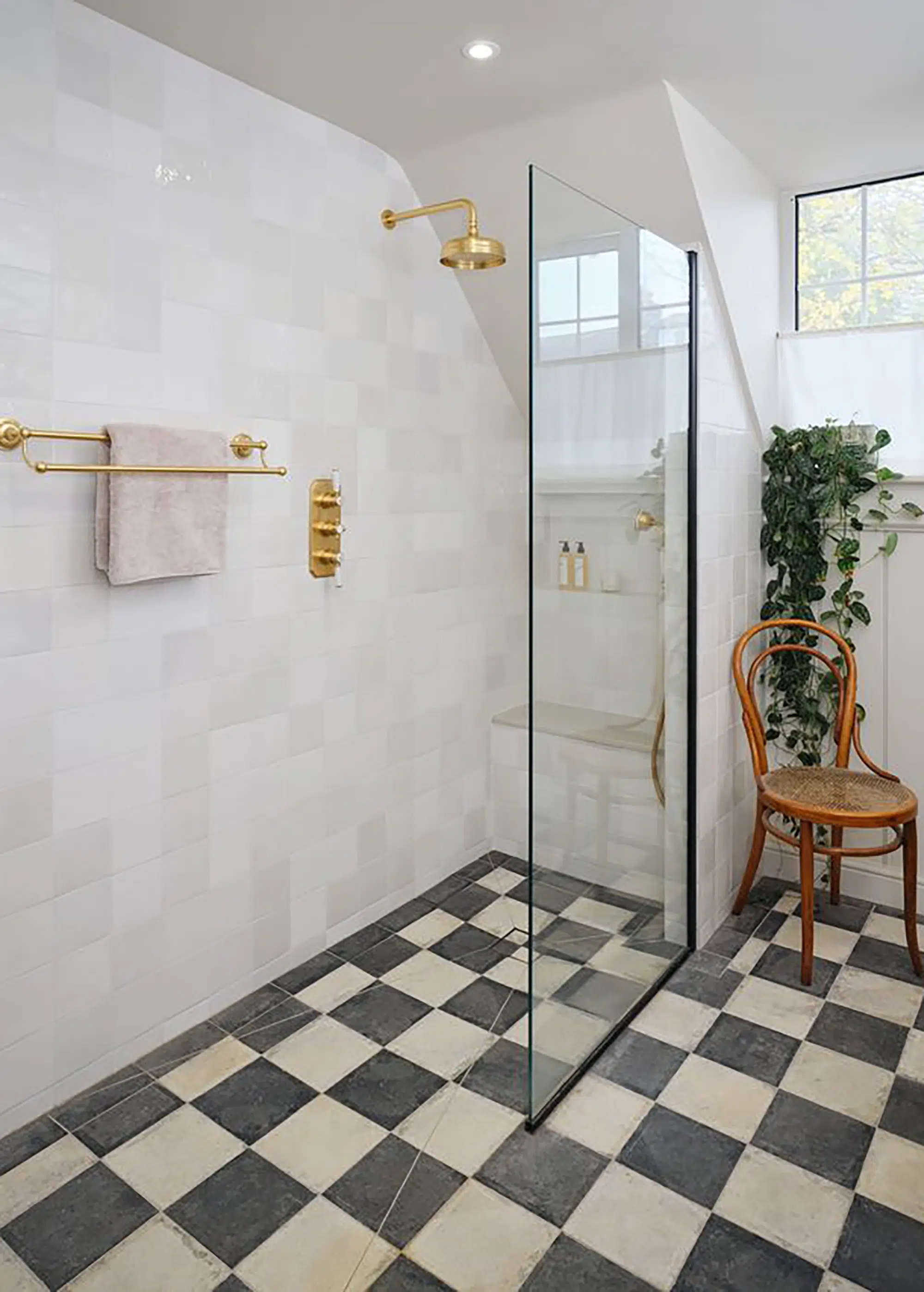
Ripples Bathrooms designed a wet room in a loft converted bathroom, creating a striking open-plan layout to optimise the available space
Weight management plays a key role in the structural planning of your bathroom. If you’re opting for heavier fixtures, such as a bathtub, incorporating wall-hung fittings could be an ideal solution to help to reduce structural load while simplifying installation. When these technical elements are resolved properly, the finished bathroom functions efficiently, without drawing attention to the infrastructure that supports it.
Drainage demands equally careful consideration. “Achieving sufficient fall for waste pipes is often more complex in loft conversions, especially where the bathroom is located far from the main soil stack,” says Richard. Early coordination allows for alternative solutions, such as rerouted pipework or pumped drainage systems, to be integrated where necessary, without forcing compromises later in the process. Aligning the attic bathroom with existing plumbing routes on lower floors, like other bathrooms or the kitchen, can also simplify pipework and reduce the need for complex, costly adaptations.
How to use surface materials effectively
In areas with restricted space and natural light, thoughtful design choices are the best way make the room feel larger, brighter and more comfortable to use. A good place to start with this is to look at the choice of materials, notably walls and floors, along with carefully considered colour palettes that help create the atmosphere you want.
Tiles can have a direct impact on how the space is experienced, particularly where ceiling height is limited and daylight enters from above rather than through full-length windows. “Lighter-toned tiles with a soft, matt surface help reflect daylight without creating glare, which is important in roof spaces where light can feel harsh at certain times of day,” says Grazzie Wilson, head of creative at Ca’Pietra.
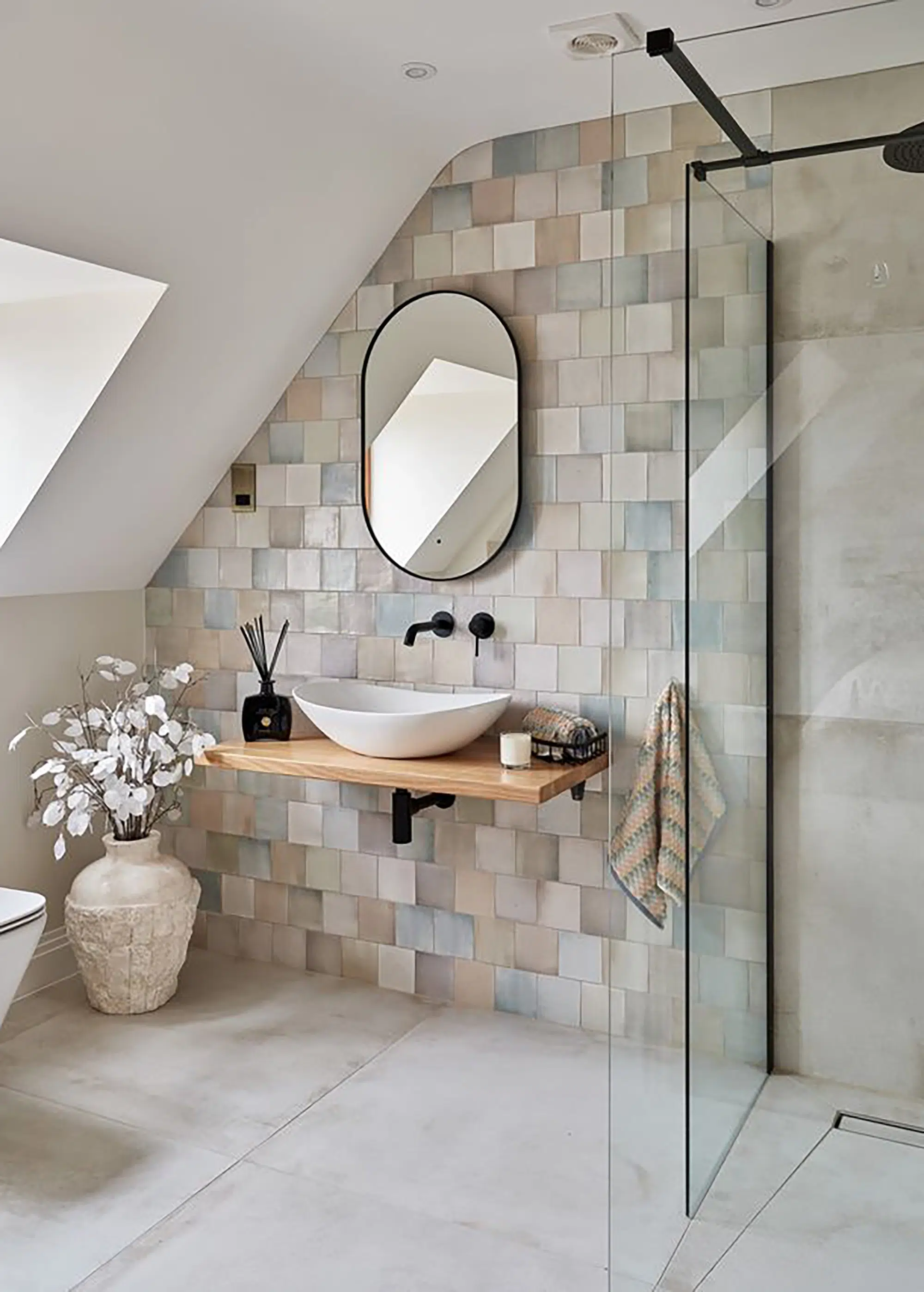
By embracing the sloped roof, this bathroom showcases a feature wall of pastel-coloured tiles by Ca’Pietra to create texture and harmony, reinforcing the ceiling as a unique architectural detail. Photo: Adam Carter
Using larger-format tiles can make a noticeable difference, as fewer grout lines allow the eye to move more freely across surfaces, reducing visual interruptions and helping the room feel more spacious. “Running wall tiles vertically can draw attention away from sloping ceilings and emphasise height, while continuing the same tile from floor to wall creates a sense of continuity that suits compact attic bathrooms particularly well,” says Grazzie. Texture can be added through the surface of the tiles rather than through contrasting colours or patterns, maintaining a calm, cohesive scheme while still introducing visual depth.
Specifying the best bathroom fixtures
When it comes to bathroom fixtures, clear signs of quality to look out for are robust materials, such as robust brassware and vitreous China basins, which will provide durability over time. High-quality engineering reveals itself in the smaller details, for instance the smooth action of a mixer tap, the stability of a glass panel or the precision of a hinge. Elements with mechanical components that need to perform reliably on a day-to-day basis, such as taps or integrated cisterns, are particularly worth the investment in the long run.
Loft bathroom FAQs

How difficult will it be to install a bathtub in an attic bathroom?
Installing a bath in an attic bathroom is often achievable, but it requires early structural assessment. Floor joists may need reinforcing to support the combined weight of the bath, water and user, particularly with deeper or heavier bath styles. Access is also a factor, as baths must be able to be manoeuvred into the space before finishes are completed.
Can I fit a shower underneath a sloped ceiling?
A shower can work under a sloped ceiling provided there is adequate standing height where the shower head is positioned. Generally, you should aim for the tallest user to be able to stand comfortably beneath the highest point of the ceiling, with the slope falling away behind them. Low-profile trays or wet room-style floors can help maximise usable height.
What’s the best way to prevent condensation & damp?
Effective mechanical ventilation is essential, as warm, moisture-laden air naturally rises to roof level. High-performance extractor fans, ideally with humidity sensors, should be ducted directly outside rather than into roof voids. Good insulation and vapour control layers also play a key role in preventing condensation build-up.
Can a loft bathroom boost my home's value?
A well-designed loft bathroom can add value, particularly when it forms part of a new bedroom suite or makes better use of previously unused space. The key is ensuring the space feels properly integrated, with good headroom, light and ventilation, rather than appearing as an afterthought.
What are the common mistakes to avoid when designing an attic bathroom?
Common issues include underestimating the importance of ventilation, failing to check structural capacity early and forcing a standard bathroom layout into an unsuitable space. Poor planning around headroom, drainage routes and access for installation can also lead to costly compromises later in the build.
Amandine Lefevre
You may be interested in
Our sponsors