
- Plan ItBack
- Design ItBack
- Build ItBack
- Homes
- ProductsBack
- CostsBack
- Self Build Cost Calculator
Estimate your project costs instantly with Build It's interactive self-build cost calculator
Calculate Now - Costs & Finance
- Contracts & Warranties
- Build It Estimating Service
Get an accurate, detailed cost breakdown of your project
Submit plans
- EventsBack








 Login/register to save Article for later
How to Choose the Right Type of Steel Roofing or Cladding for Your Project

Steel roofing and cladding systems are no longer confined to barns and industrial-style buildings. Today, architects, self builders and renovators increasingly specify these versatile materials to create striking facades and crisp rooflines on high-quality contemporary homes and extensions. Get the design and installation right, and this material can deliver a distinctive, long-lasting exterior that performs reliably for decades.
So, how can you choose the right type of steel cladding or roofing for your project? This guide looks at the key considerations, costs and more, to help you make the right choice.
What are the benefits of steel cladding and roofing?
Steel systems consist of thin sheets of metal that are profiled, folded or formed to create protective external surfaces for roofs and walls. It’s typically galvanised or coated to protect against corrosion and weathering.
Self builders and renovators tend to specify pre-finished products, meaning the colour and protective coatings are applied during manufacture rather than on site. The result is a lightweight, strong and low-maintenance external finish capable of withstanding harsh weather while retaining its original appearance.
Where do steel finishes work best?
For self builders aiming to create minimalist facades and sharply defined roofs, steel is a strong choice. Standing seam roofs and creative cladding panels, for instance, deliver geometric effects and a contemporary aesthetic that sets the tone for the rest of the architecture.
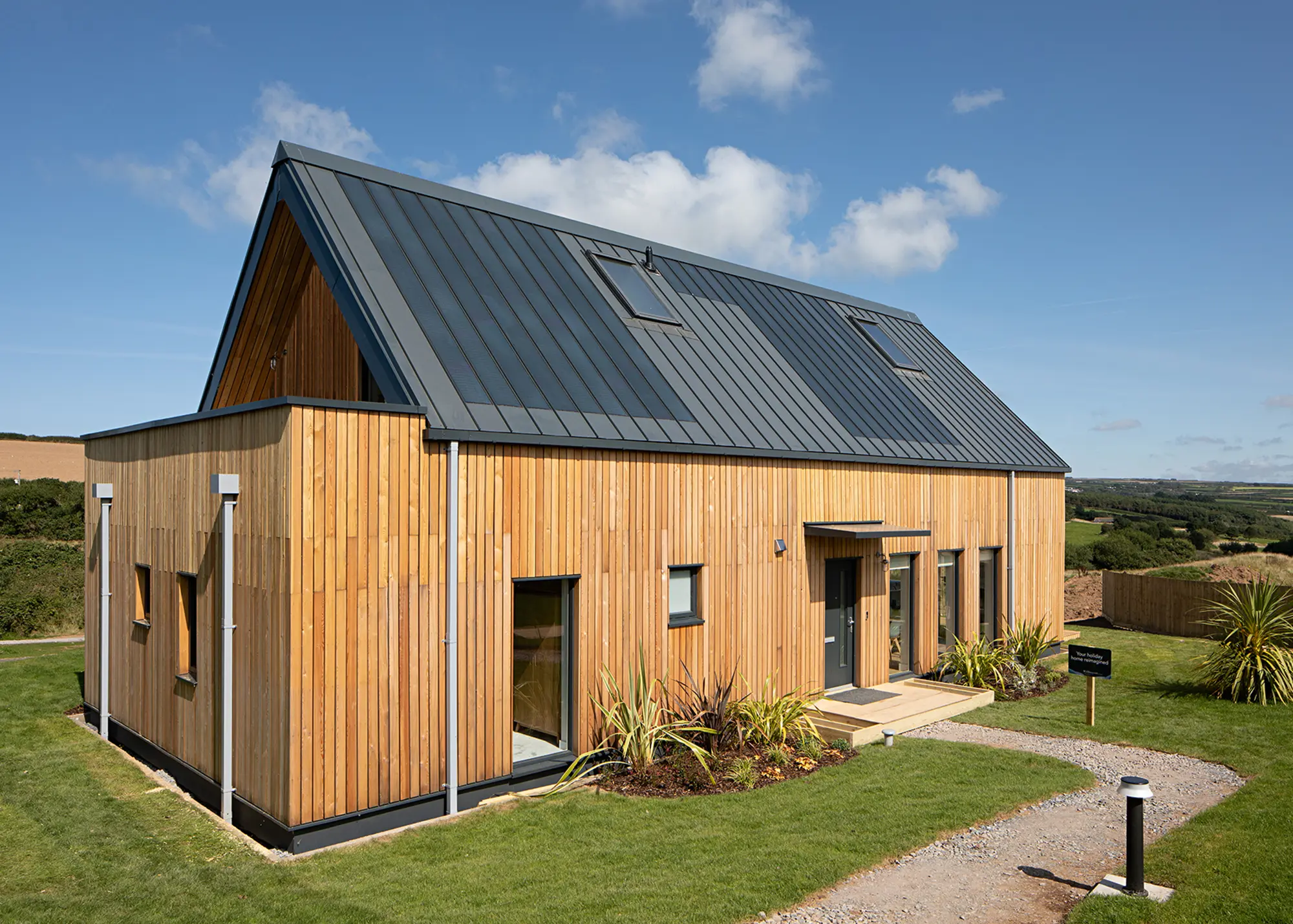
Catnic’s MCS-certified SolarSeam provides a discreet PV solution that avoids the issue of complex mounting systems detracting from the sleek look of its Urban standing seam steel roofing. A 3.68kW system would require just over 31m2 of roof space. SolarSeam was awarded Best Sustainable Technology at the 2024 Build It Awards
Extensions are another common application. A metal-clad addition can contrast effectively with existing brick or stonework, expressing the new intervention while keeping the materials palette simple. Steel finishes are also widely used in barn-style homes and rural projects, where corrugated or profiled sheets echo agricultural buildings while delivering modern performance.
There are generally few issues from a planning perspective, although muted colours or limited use as an accent material may sometimes be required in heritage settings. Discussing materials with the planners early in the design process can help avoid delays later.
complete cladding materials guide
How can this material be used in a project?
Steel finishes can be used across walling and roofing; even wrapping around an entire building. Many architects, however, prefer to soften the effect by pairing it with other materials – such as timber, brick or render. For example, a steel-clad upper floor could sit comfortably above a masonry ground level.
Case study Sympathetic timber frame self build with a Corten steel roof
Set in rural Aberdeenshire, Jim and Barbara Hewson’s self build journey began as a leap of faith, and ended up as a labour of love. As a result, the couple say they now have “a site sympathetic home rather than a house.” It not only meets their requirements in terms of space, but the couple – who downsized – have also dramatically cut down on their energy usage. Prior to the project, the couple had spent 35 years living in a granite farm steading, which Jim and a team had renovated all that time ago. The couple had a strong attachment to the area after living there and knew that they wanted to stay local whilst building somewhere that would facilitate their retirement.
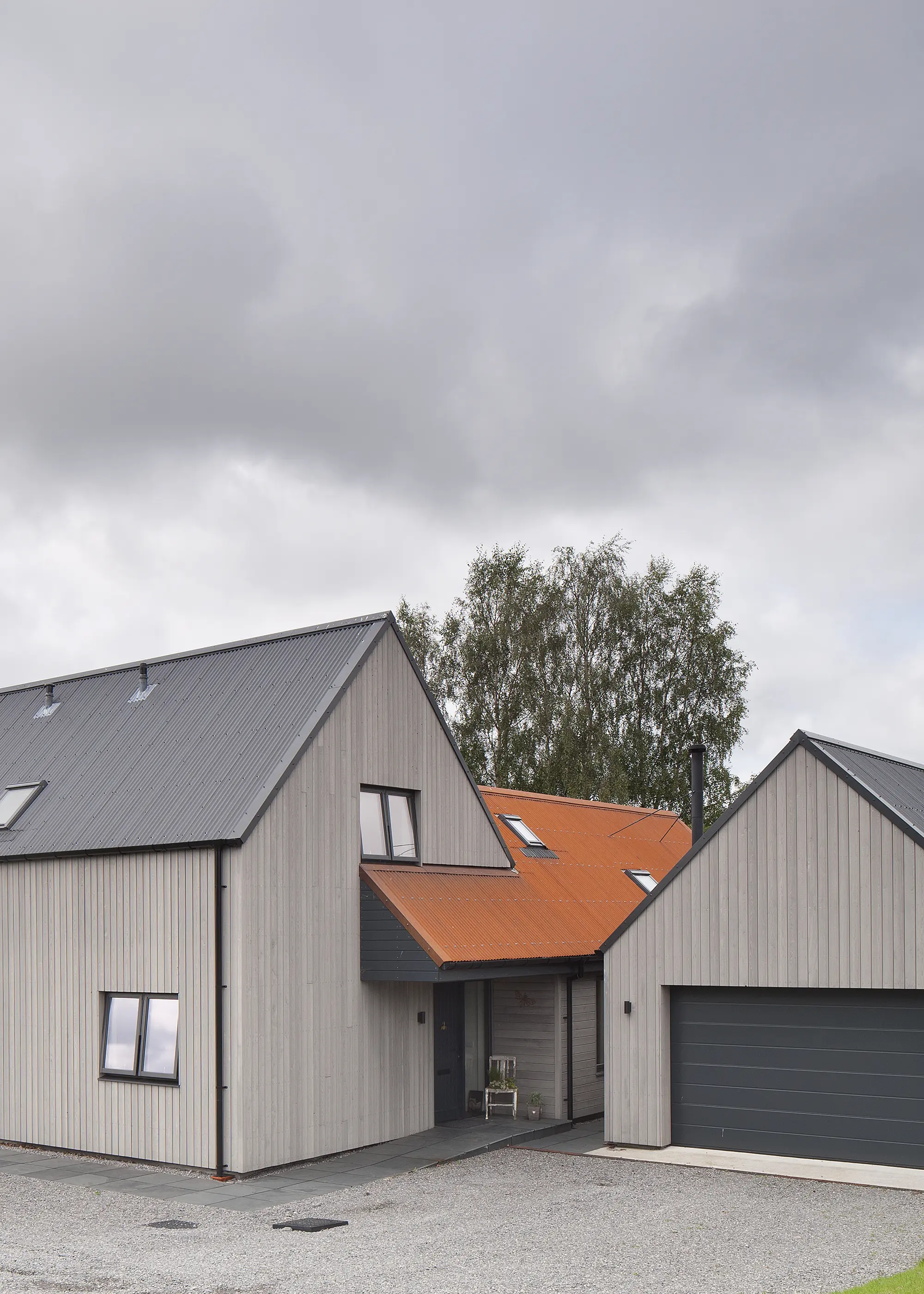
Photo: David Barbour
Their back garden plot presented an amazing opportunity, so the couple researched the ins and outs and set foot on their building journey. The couple had clear intentions for their project; “We wanted a house with a smaller footprint and reduced garden area, but we were keen to stay local – and in this hamlet in particular. The couple had enough land, but it took a year just to get outline planning permission, after an appeal.
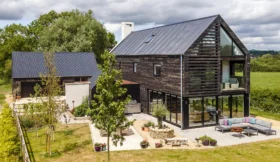
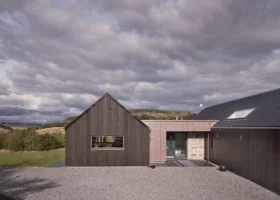
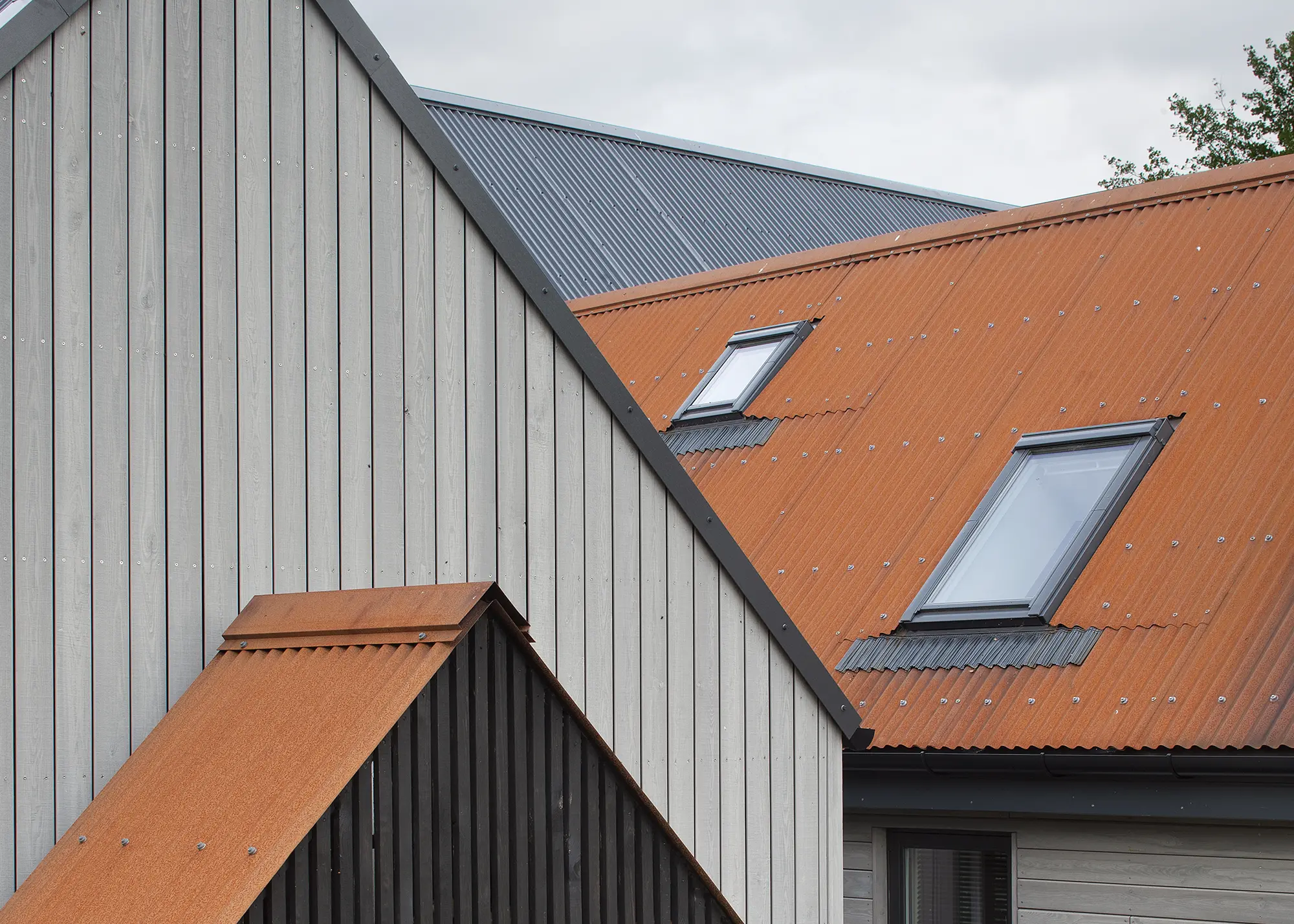
The couple enlisted Eoghain Fiddes of Fiddes Architects to draw up the self build’s design. He proposed a timber frame structure, clad in Siberian larch, with a corrugated roof made from Corten steel. Installed by JGB Steelcraft, the roof is coated black on the two-storey volume, with a weathered version on the single-storey wing for architectural contrast.
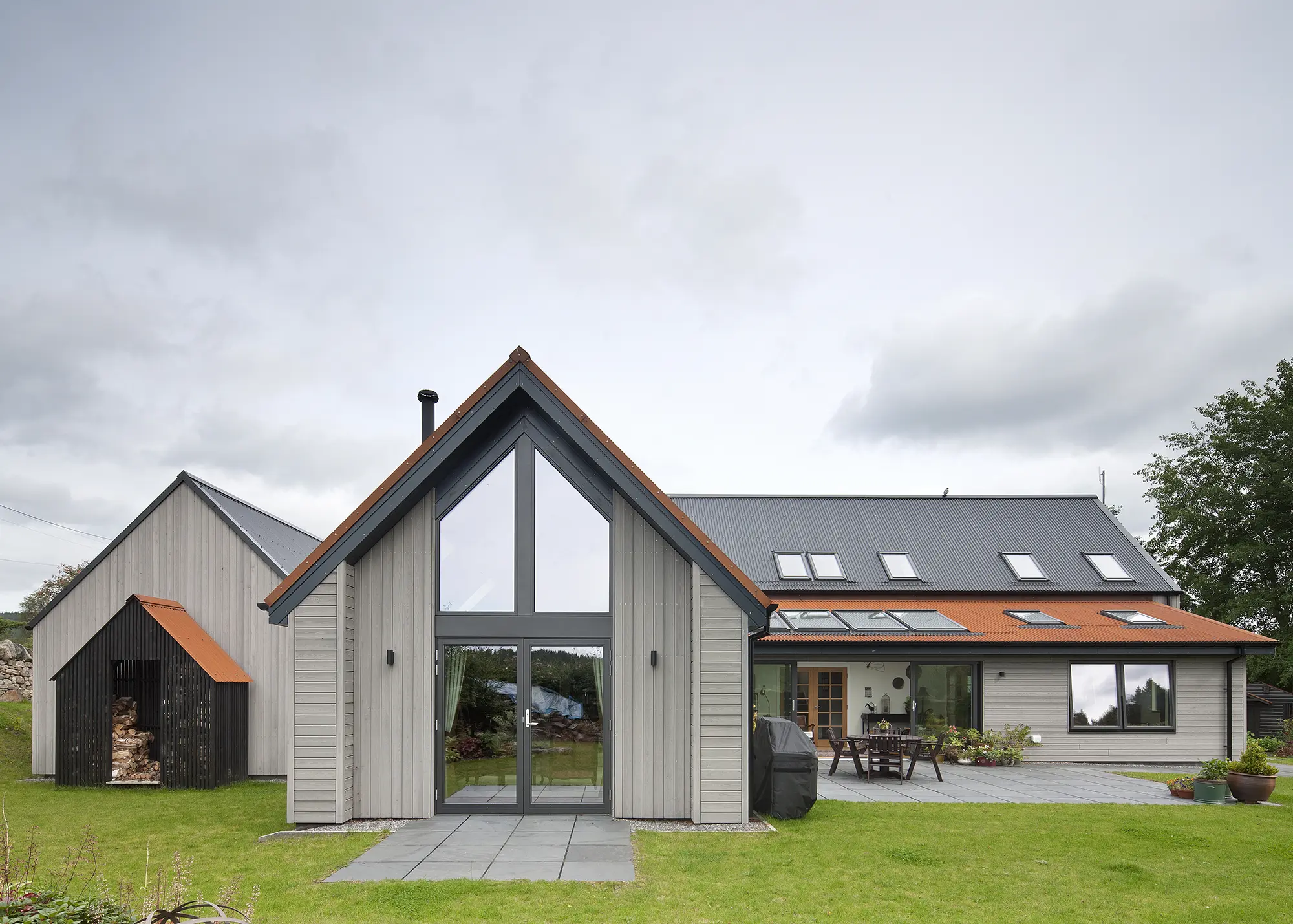
Photo: David Barbour
An L-shaped plan provides generous accommodation and living zones, whilst keeping the building’s footprint to a minimum, and allowing for a secluded area to be formed in the garden. The living spaces are in the main body of the house, which runs from north to south with a 45o roof pitch and roof windows.
In addition to the aesthetics of the steel roof, this and the other external materials were chosen for their low maintenance qualities. “The corrugated Corten roofing is an exciting product that we thought would look fantastic. The Hewsons loved it even though it was a more expensive item,” explains architect Eoghain. “Barbara is from New Zealand, where there are a lot of buildings featuring corrugated metal. The Corten will outlast a standard steel roof, as it won’t corrode. You should get 100 years out of it, without maintenance.”
| Location | Aberdeenshire |
| Plot size | 1,703m² |
| Project cost | £630,000 |
| House size | 291m² |
| Project cost per m² | £2,165 |
| Roof structure & covering cost | £87,500 (£301 per m²) |
What are the different steel cladding and roofing options?
Here are some of the most popular steel systems and ballpark installed costs:
Standing seam
Standing seam systems are the premier choice, delivering superb aesthetics and long-term performance across roofs (including low pitches) and walls. Long sheets of metal are formed with raised seams that interlock along their edges, typically by crimping together on site, which conceals the fixings within characteristic vertical ribs. When used vertically as cladding, it produces shadow lines that accentuate the building’s height and add a textural quality.
Standing seam typical installed costs: £120-£200 per m²
Corrugated steel
Corrugated steel with its familiar wavy profile, has a long history of delivering a practical, utilitarian finish for barns and similar projects. It can be installed on roofs or walls, and is typically fixed with exposed fasteners through the crest of the wave. Today’s products are available with factory-applied coatings in a wide range of colours and finishes – so they’re very different from older galvanised sheets. Yet they remain one of the most cost-effective metal external finishes.
Corrugated steel typical installed costs: £60-£100 per m²
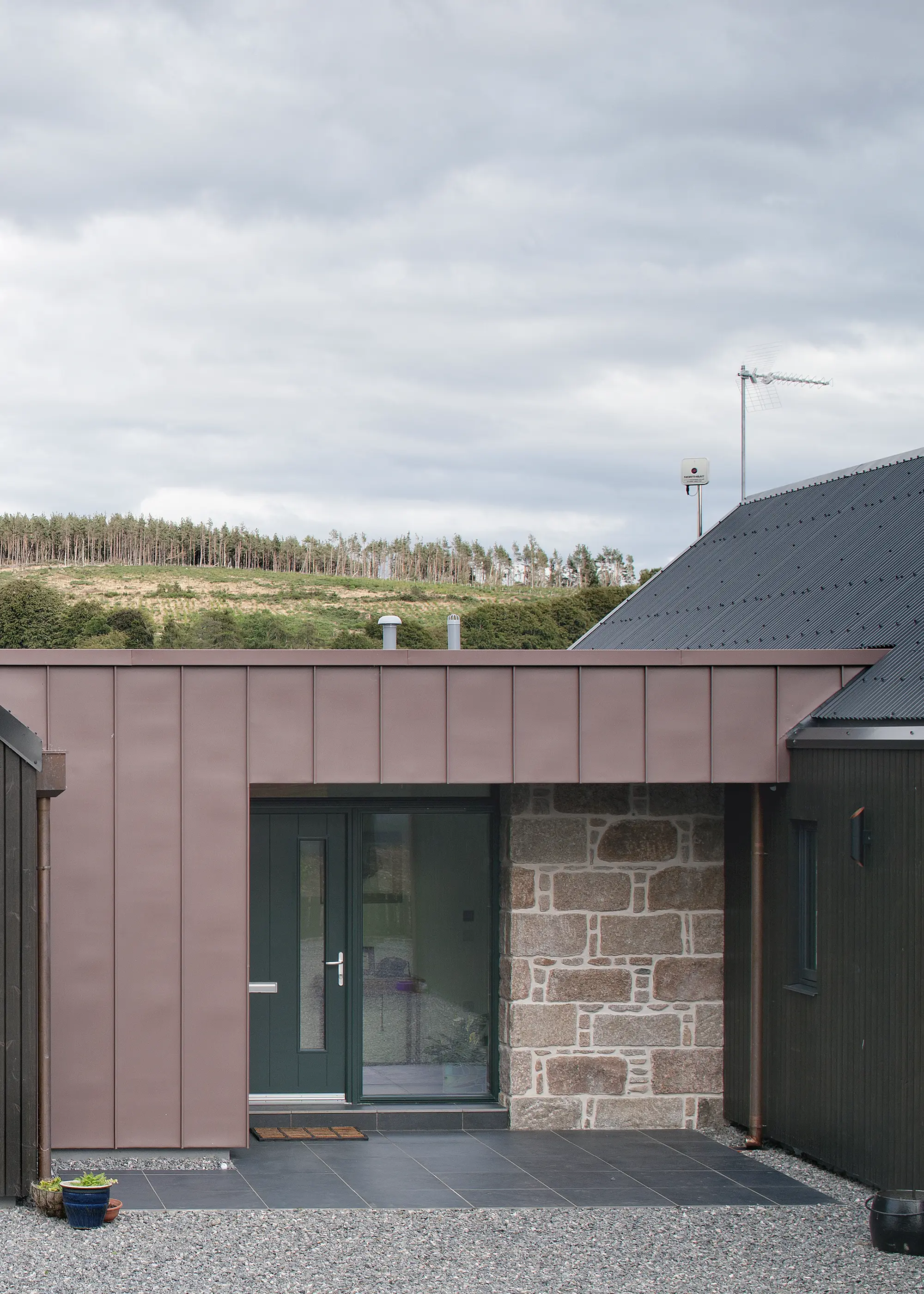
In search of a warmer, more manageable house to enjoy her retirement, Fiona Henderson built a contemporary timber frame home in Aberdeenshire on her own land. The black corrugated steel roofing references local agricultural buildings and, combined with the bespoke-designed hidden gutter system, is a nod to the traditional Scottish detail of clipped eaves. Photo: David Barbour
Cladding sheets
Cladding sheets in flat or light profiles are also popular for facades, installed vertically, horizontally or even as metal shingles (in square or diamond patterns, for instance). Vertical arrangements tend to work well on tall buildings and gable walls, emphasising height. Horizontal panels, by contrast, can visually stretch a building and reinforce long rooflines.
Cladding sheets typical installed costs: £120-£180 per m²
What finishes & coatings can be specified?
Most products are sold pre-coated, with a protective layer applied in the factory. The default is galvanised zinc, combined with high-performance polymer paint finishes to achieve the look you want while resisting UV degradation, corrosion and scratching.
Aluminium-zinc coated steel (often referred to as galvalume) provides even greater durability and is often selected for harsh coastal environments. You can also specify textured or matte finishes for a soft yet still contemporary feel. Pre-coated products typically include warranties of around 25-40 years on both the colour and corrosion performance.
For a very low-maintenance install, consider weathering steel (often referred to by the Corten brand name), which is designed to quickly develop a dense patina of rust that acts as its own barrier against further corrosion.
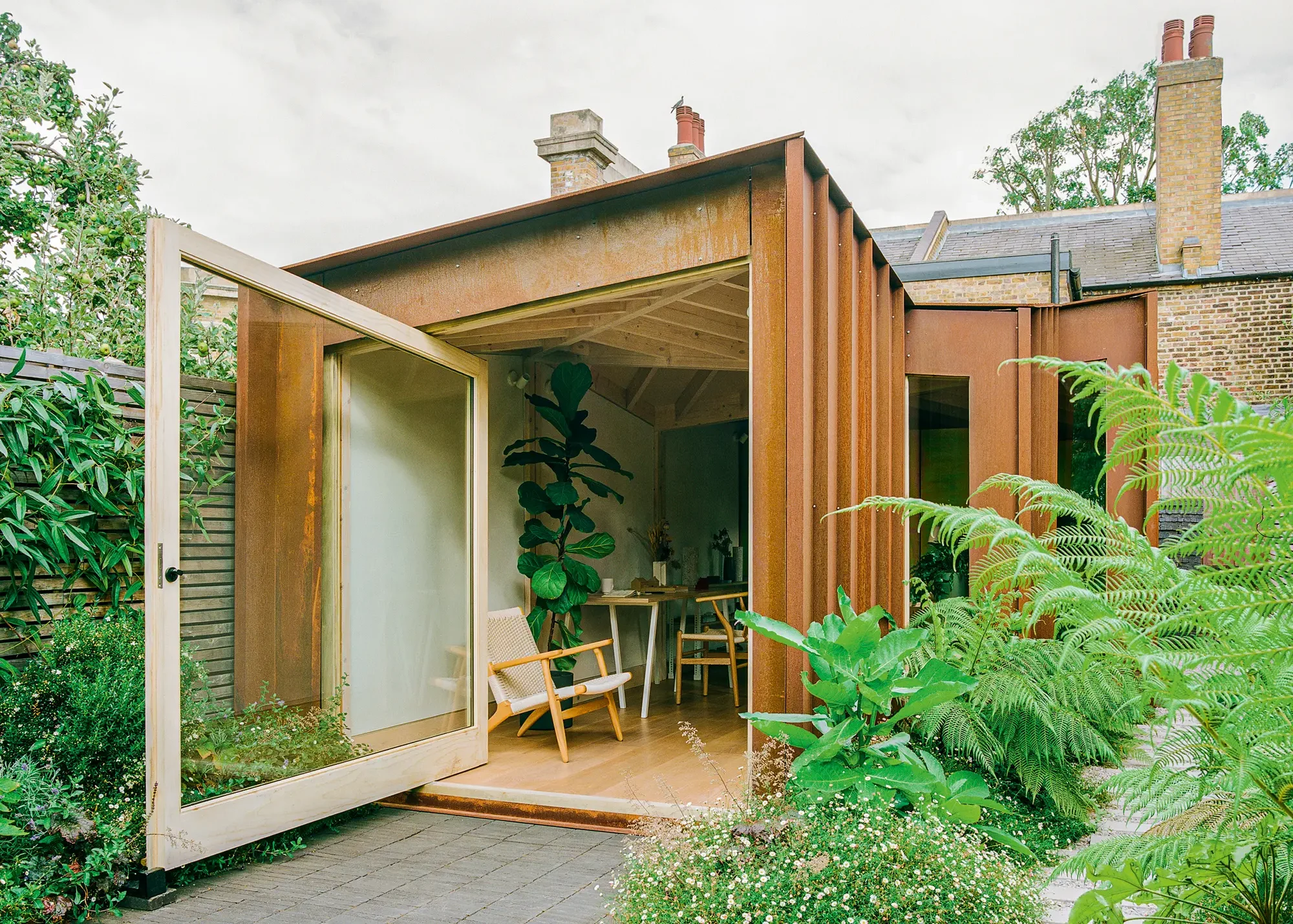
ByOthers Studio designed this striking 30m² garden office, featuring a vast glass pivot door and weathered steel cladding with finned detailing. Photo: Lorenzo Zandri
How is this cladding system installed?
Steel cladding is usually installed as part of a ventilated rainscreen system. The metal panels act as the outer weathering layer, fixed to battens or rails that create a ventilated cavity. Behind this sits a breathable membrane and the insulated wall structure. Roof build-ups typically include a structural deck, vapour control layer, insulation and ventilation layer beneath the metal sheets.
Standing seam systems are slightly different, as they include continuous support decks/backing boards (eg 15mm-18mm moisture-resistant OSB) to ensure proper fixing and control thermal movement, with the vapour control membrane between the metal and deck.
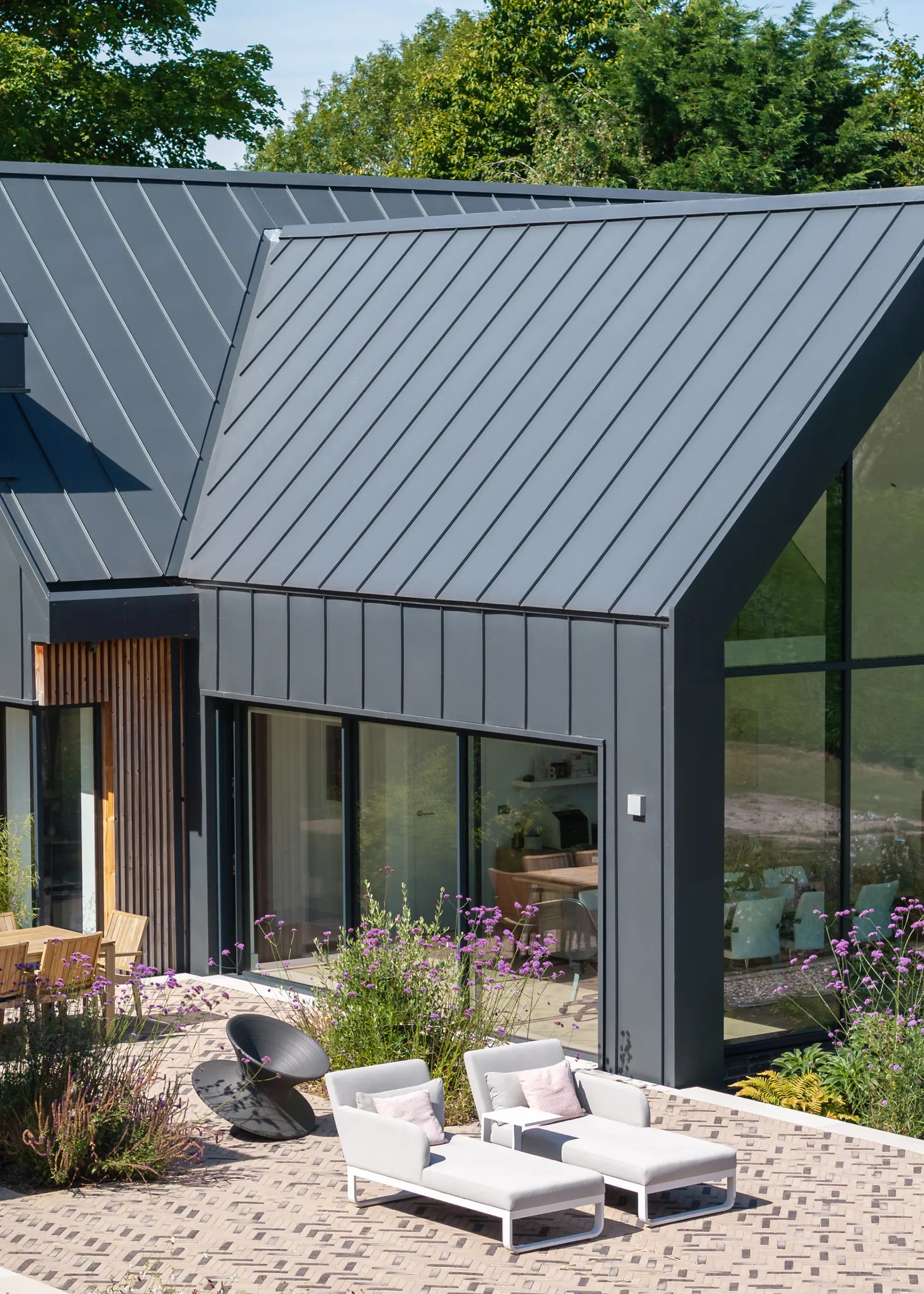
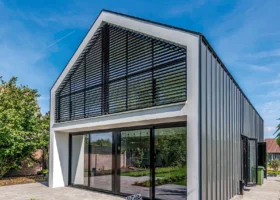
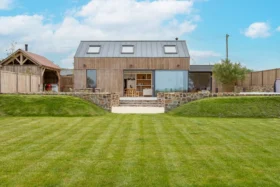
Jonathan Boyne and Karen Anders’ contemporary take on a barn was an absolute dream to build, thanks to a top team and plenty of planning. Steel cladding and roofing from Catnic defines the architecture at the back of the house, completely wrapping the striking glazed gables. Photo: Mike Couch & Paul Craig
As with any external material, successful steel cladding and roofing projects rely on good design and installation. Correct detailing around any edges, junctions and penetrations is essential to ensure weatherproofing and durability – and the right coatings must be selected, particularly in coastal or similarly harsh environments.
Installation is best carried out by contractors who are experienced with metal roofing systems, and ideally the product at hand, with attention paid to accommodating thermal movement. Precision is essential to achieve the crisp appearance that makes steel so attractive. Using screw guns with depth-sensitive noses is vital to avoid overtightening, which is a prime cause of the oil canning (visible rippling) that blights poor installations.
What are the key performance benefits of steel cladding?
Correctly specified as part of a wall and roof build-up, steel can perform well across several key areas:
- Durability & weather resistance: Protective coatings help prevent corrosion (or encourage it, in the case of Corten), while modern systems accommodate thermal expansion and contraction.
- Fire performance: Steel is non-combustible and can typically achieve Euroclass A1 or A2 fire ratings, depending on the complete wall/roofing system design and backing materials used.
- Thermal performance: Steel finishes are typically installed as part of a cladding or roofing system, incorporating insulation behind the sheets.
- Acoustics: Rainfall noise is sometimes cited as a concern with metal roofs, but insulated roof build-ups significantly reduce sound transmission.
- Maintenance: Steel roofs and facades require minimal upkeep beyond occasional routine cleaning and periodic inspection of seals, flashings etc.
Emily Batesmith

You may be interested in