


























































 Login/register to save Article for later
Mark Stevenson has worked as a construction professional for over 35 years and is a serial self builder. He runs project management consultancy Elsworth Projects and, as chair of NaCSBA, advocates for the interests of self builders and contributes to the success of the emerging custom build industry.
- Plan ItBack
- Design ItBack
- Build ItBack
- Homes
- ProductsBack
- CostsBack
- Self Build Cost Calculator
Estimate your project costs instantly with Build It's interactive self-build cost calculator
Calculate Now - Costs & Finance
- Contracts & Warranties
- Build It Estimating Service
Get an accurate, detailed cost breakdown of your project
Submit plans
- EventsBack
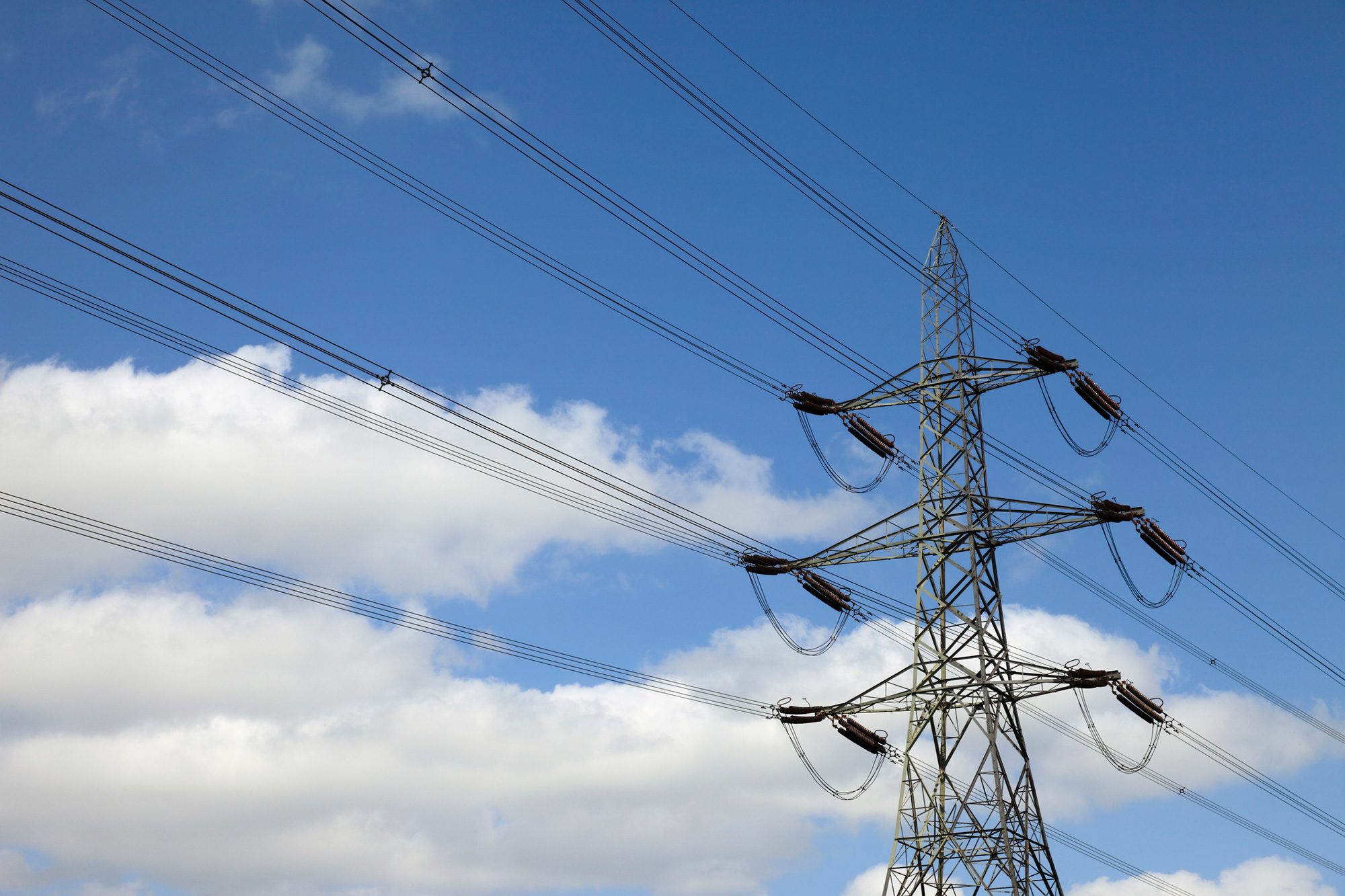
Connecting to Services – An Expert Explains how to Secure Utilities Connections for a New House
Self build expert Mike Hardwick looks at how to get your self build plot and new house connected to services and utilities, including electricity, gas and water

Whatever style of home you are building, from a fully-fledged eco house to a straightforward knock down and rebuild dwelling, you are going to need to arrange connections to the necessary services. This includes your supplies of electricity, water and telephone/broadband – as well as mains sewerage and gas, if they are available.
In this article, I’m going to look at how to get your self build home connected to services and utilities, and the key considerations to note for a successful connection.
In this connecting to services guide we will cover:
- When to organise services
- Are services already on site?
- Connecting to water & sewerage
- Connecting to electricity
- Connecting to gas
- Connecting to broadband
- Your FAQs answered
When should I organise services?
You can’t really organise service connections too early. Once you own the plot of land and planning permission is looking likely, you should get the ball rolling straight away. Here’s why:
- Having water and electricity on site is a real boon during the build and it is fairly straightforward to set up a temporary supply of both using local trades.
- A simple stand pipe for water and a weatherproof box with a small consumer unit and a couple of 13 amp sockets (which can be fitted into a garage later) will be useful on site for everything from boiling a kettle to powering lighting rigs and power tools.
- Ideally, power tools should run off a step-down transformer at 110v, but if you have to use mains voltage, a residual current detector is essential.
Is my site already connected to utilities?
Replacement dwellings (knock down and rebuild houses)
For self builders working on a replacement dwelling, connection should be relatively easy. The chances are that the site’s existing property will already be linked up to the essential facilities. Here it should be a simple case of isolating these as part of the demolition procedure, and arranging reconnection to the new dwelling. A quick call or note to the current service provider is all that is needed and in many cases, things like existing telephone numbers can be retained.
Empty or remote building plots of land
It is a different matter for self build plots where there’s no existing supply. The question of where these services will come from – and how much they’ll cost – should always be a well-researched part of your plot evaluation.
Land that has been sub-divided from an existing property, such as garden developments, should not present too many problems – connection should ideally form part of the terms of sale agreement. It would be in the vendor’s best interest to arrange for services to make the plot more attractive and command a higher premium.
Virgin plots and remotely located conversion opportunities can be an entirely different prospect so some serious consideration, and not inconsiderable cost, may be required. A common pitfall is to assume that because there are electricity supply poles in the vicinity, it will be possible to tap into that source. Remember that if you have to cross someone else’s land to do this, there may well be an additional cost involved.
Premium Content
Downloadable E-Guide
Not sure where to start with your plot search? Kick-start the journey with Build It’s complete downloadable e-guide to finding the perfect self build site. Click below to find out more.
find out more
Connecting to water and sewerage facilities
Most properties will require a mains water supply and a drainage connection, too, if you’re within a sensible distance of a sewer. Here’s how to connect your home to mains water and sewerage facilities.
Connecting your new house to water mains
Most self build plots and properties are within a reasonable distance of a mains water supply. If you are not sure whether or not your plot has existing connections to water supplies, you can arrange a CON29DW drainage and water enquiry report (this can cost between £50-£70 depending on location). This report will identify the location of the nearest water mains and sewer, and will highlight any risks such as low water pressure.
Those that aren’t connected to a mains supply are usually serviced by a private borehole. These are expensive to drill, but once approved by the Drinking Water Inspectorate, will provide you with your own mineral water supply.
To find out your options, contact your local water company who can arrange for a new supply and will quote for all the work required to bring connections to your site. You will need to fill in an application form and provide a 1:500 site plan showing the plot boundary and entry points – they’ll then work out a scheme and a price for you based on that.
Your ground worker would then be responsible for connecting this supply to the house. Any trenches dug will need to be inspected by the specified water company (who will want 21 days’ notice) before they are back filled. Water pipes are usually 25mm or 32mm polypropylene lengths, which are laid at a depth of at least 750mm and no more than 1,350mm, bedded on pea gravel to prevent damage.
For ease of identification, water supply pipes and associated conduits are always coloured light blue.
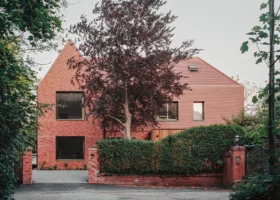
CASE STUDY Oak frame cottage in Essex
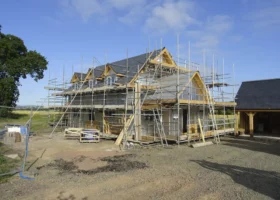
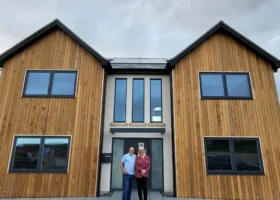
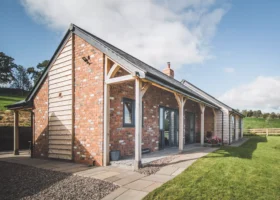
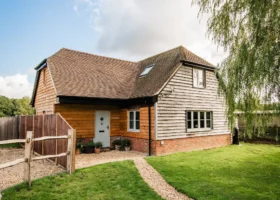
Looking to self build, Katy and Alan Pateman found a site which had previously been an allotment next to the village hall. It had lapsed outline planning for a two-bedroom, Essex-style cottage and had been on the market for three years. The couple engaged Welsh Oak Frame to help bring their design to life, with builder friend Greg Marston from Marston Contracts taking on the project with enthusiasm, despite having not built a complete house before.
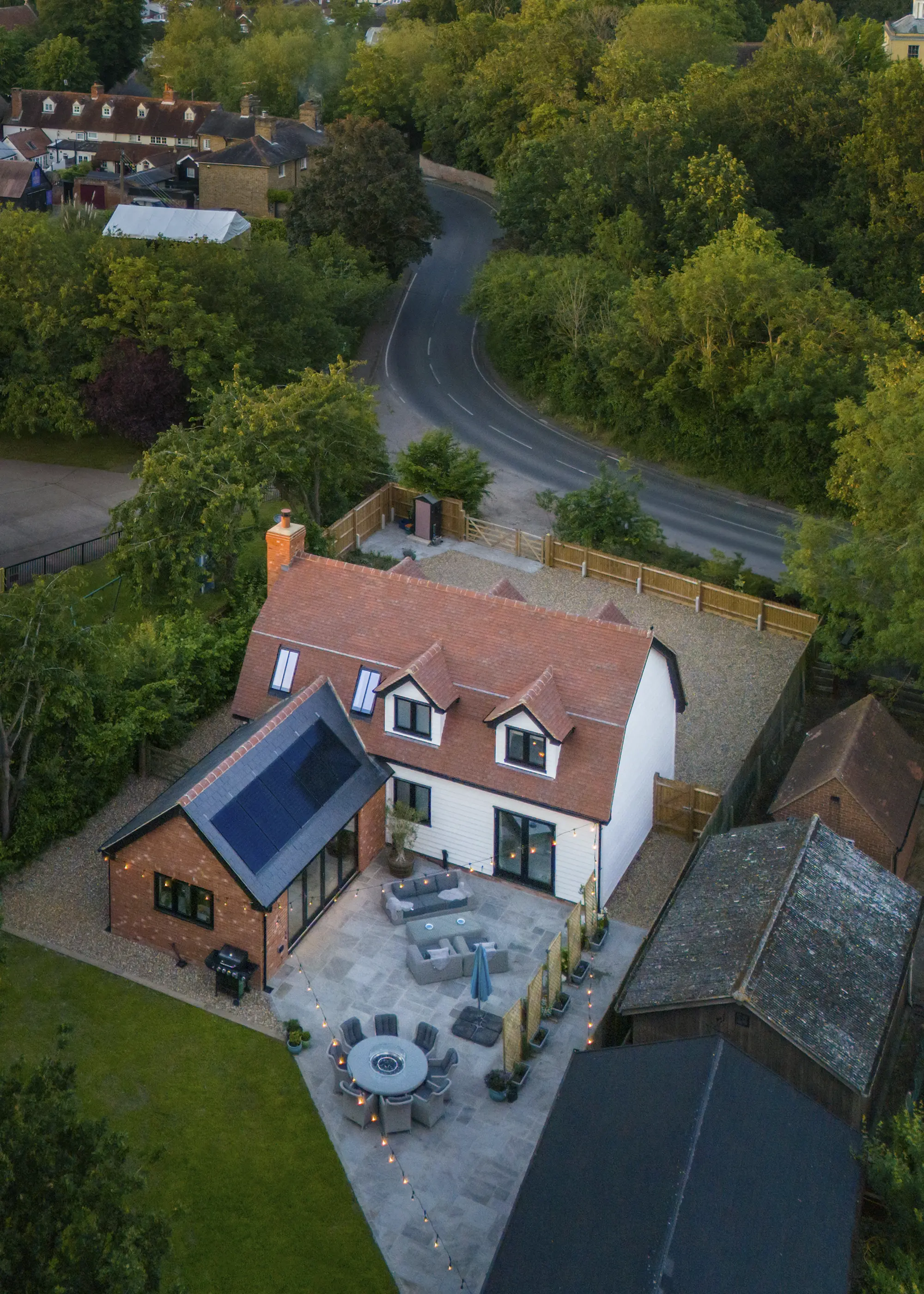
Photo: Nikhilesh Haval
Construction work began on site in November 2022, and the build team used a generator until services were finally connected. The water company shut off traffic to lay its pipework, while the distribution network operator ran the electric supply on the same day – both up to the property’s border. Greg’s experienced team then picked up the feed, taking it to the site of the cottage, where they were already working on the foundations, right alongside the cabin Katy and Alan would live in during the rest of the works.

Photo: Nikhilesh Haval
The couple moved into the cabin in March. Not long afterwards, the oak frame arrived to the site be erected by a team from Wales, organised by Welsh Oak Frame. “The team told me it would take three weeks to erect the frame, but they got everything finished in just two – they were really amazing,” says Katy.
Connecting a self build project to sewers
Local authorities will usually insist that a mains connection be used if at all possible, but they will be pragmatic about the practicalities. Connection from the boundary to the main sewer will have to be undertaken by an approved contractor from a list provided by your local authority. This will ensure that any work to highways and pavements will be made to the appropriate standards.
As a rough guide, if you are within 200m of a main sewer, it will be cost-effective to connect to it. Any more than that and you may need to consider an alternative, such as a septic tank or treatment plant.
Foul drainage and surface water drainage are almost always considered separately – the latter would not be allowed into the foul system. A popular option to tackle surface water is to install a rainwater harvesting system. These are highly sustainable and will reduce the sewerage element of your water bill considerably.
Connecting your new home to electricity
Pretty much every home will require mains electricity, even if it is fully loaded with all of the latest renewable generation technologies. Site-generated renewable electricity is hard to store at times when the sun isn’t shining or the wind isn’t blowing. If you have a hydro-electric system that generates enough power 24 hours a day, you are very lucky indeed, but for most of us a mains supply is the only option.
What does the process involve?
As with water, it is a case of contacting the lead provider and asking for a new connection scheme to the boundary of your new property. Your electrician will then connect up the meter. From there, it will be fed into the house via your consumer unit. Your building control officer should be able to help if you don’t know which electricity company is the lead distributor for your area.
This distributor will be responsible for providing a new meter for the property together with its own unique number, and will supply you with electricity initially. You don’t have a choice of supplier at this stage, but once the meter is in and you have the unique number allocated, you will be free to switch companies as you wish.
For identification purposes, electrical cables and conduits are always coloured black.
Gas connections for a new house
Connection to mains gas is dependent on the availability of supply in your area – which is always on tap in urban zones. If you are out in the sticks, then alternatives such as oil, LPG and electrically powered heat pumps will be the norm. It’s important to note that gas boilers are being phased out after 2025, so you’ll need to look at alternative heating systems, such as a heat pump.
What does this involve?
To get connected, you will need to contact your regional gas transporter, such as the national grid, to establish a new supply. As part of their standard service (the norm for new domestic connections) they will dig trenches up to 2m from the house, supply and fit a suitable meter box and then make good by filling the trenches.
You would then speak to a gas supplier who will install the meter and connect to the supply. Alternatively, you could ask your gas company to arrange for the whole thing – they will charge you for the connection, all pipework, their own fee plus a meter installation charge.
The cost to connect to the national grid can vary from a around £200 to over £4,000. With that in mind, it will be a judgement call as to whether mains gas is practical and affordable for your project.
Gas pipes and conduits are always coloured yellow to distinguish them from other services.
Connecting your house to broadband
Broadband connectivity should be considered alongside other utility connections at the earliest stages of your self build. In most areas, new homes can connect to the Openreach full-fibre network, but some alternative networks and cable service providers may also be available.
Traditional telephone lines are rapidly being replaced by digital voice services that operate over a broadband connection. So for most of you building a house now, the priority is generally securing a reliable fibre broadband service, rather than a separate phone line. Installation costs vary depending on the network available, the distance to existing infrastructure and any site-specific works needed. Things get more expensive if you’re self building in the countryside, and may well involve a survey to determine the cost of connection.
If you’re building in a remote part of the country, it’s important to investigate broadband options early in the process. Full-fibre, fixed wireless and mobile broadband solutions may be viable alternatives where a standard network connection is costly or impractical.
FAQs

What are the most common causes of delays in getting a permanent electricity supply connected, and how can self builders avoid them?
When it comes to connecting a new build to electricity, delays usually come down to planning or coordination issues. The most common culprits are:
- Missing paperwork.
- Late applications.
- Design changes after the initial quote, as network operators need detailed site plans and load requirements before they can approve and schedule work.
- Trenches or ducts aren’t properly constructed, not deep enough or not ready when engineers arrive.
The best way to avoid all this is to apply early (ideally several months before you need power), avoiding changing your designs, and stick to the process the service provider wants you to follow.
What is an MPAN (Meter Point Administration Number), and at what stage does a self builder receive one?
An MPAN, or Meter Point Administration Number, is the unique identifier for your electricity supply point. It’s essentially the address of the connection within the national grid system. You won’t get an MPAN until your Distribution Network Operator (DNO) has processed your new connection request and issued the official connection offer. Once you accept that offer and pay the fees, the MPAN is generated. It’s then used by your energy supplier to set up your electricity account and arrange meter installation. For self builders, this usually happens once the permanent supply has been confirmed but before the meter is fitted.
Can a temporary water supply be arranged during the building process, and how does that differ from a permanent connection?
Yes, a temporary water supply can be arranged during construction and enables the build to have running water for construction and welfare requirements without waiting for the full, permanent connection. A temporary supply is usually connected via a standpipe or a feed from the mains, and is metered. Once the house is ready for occupation, the connection is converted or replaced with a permanent one that meets standard domestic requirements.
What are the most common causes of delays in getting a permanent electricity supply connected, and how can self builders avoid them?
Delays when connecting to the water mains tend to mirror the delays associated with electricity connections – paperwork issues, revisions to designs, or poor trench preparation such as inadequate depth are all common. Sometimes, the local water authority also has to plan off-site works such as road crossings which can slow things down if road closures are required.
To avoid holdups, apply well in advance, ensuring the site layout matches the application, and follow the process meticulously. Keep in contact with the water company to confirm all inspections and complete groundworks on time.
Mike Hardwick
You may be interested in




Our sponsors