Can Bricks Really Be Eco-Friendly? The Pros & Cons of Low-Carbon Masonry Alternatives
Could low-carbon bricks and blocks be contenders for your sustainable self build project? Eco expert Nigel Griffiths investigates the innovative brick alternatives entering the market and how they’re manufactured
Nigel Griffiths
With every update to Building Regulations, newly constructed homes become ever more efficient in use. We eco builders are therefore now more focused on the energy required to build new houses – in other words, the embodied carbon emissions arising from the manufacture and installation of materials. This affects many of the big-ticket items we install in our homes, such as insulation, windows, roof coverings and floor constructions. But there’s one set of products that stands out as having a particularly high environmental impact: bricks and blocks. So, what are the options to reduce embodied energy when building a brick house?
What makes bricks high carbon?
Cavity wall construction has three main components: an outer skin to keep the weather out; insulation; and an inner load-bearing skin (supporting the upper floors and roof). Depending on their specification, bricks or blocks can be used in either of these skins.
Conventional bricks are made from clay and fired at high temperatures to make them hard and weatherproof (although the material can also be used unfired). Clay is plentiful and extracting it does little damage to the environment. But it takes a large amount of energy to get a kiln to over 1,000°C, and it’s this process that gives brick such a high embodied energy/carbon. It also takes energy to extract and process the raw material (the clay). Composite bricks are also traditionally high in embodied energy. A key factor is that most of them use cement as a binder to hold the aggregates (sand, crushed stone, concrete etc) together.
The are several approaches that can reduce the embodied energy present in bricks and blocks:
Clay bricks
Reduce the temperature at which clay blocks need to be fired by adding other materials to the mix.
Composite bricks
Cut down the carbon intensity of the binder used to glue the aggregates together (usually, but not always, cement).
Minimise the embodied energy of the aggregates by using waste products (such as crushed, recycled masonry).
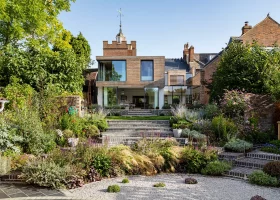
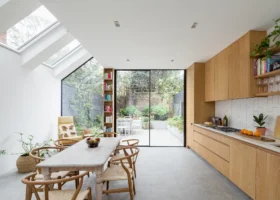
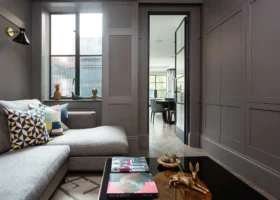
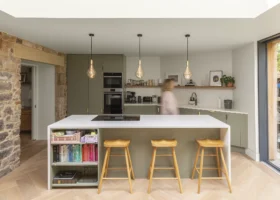
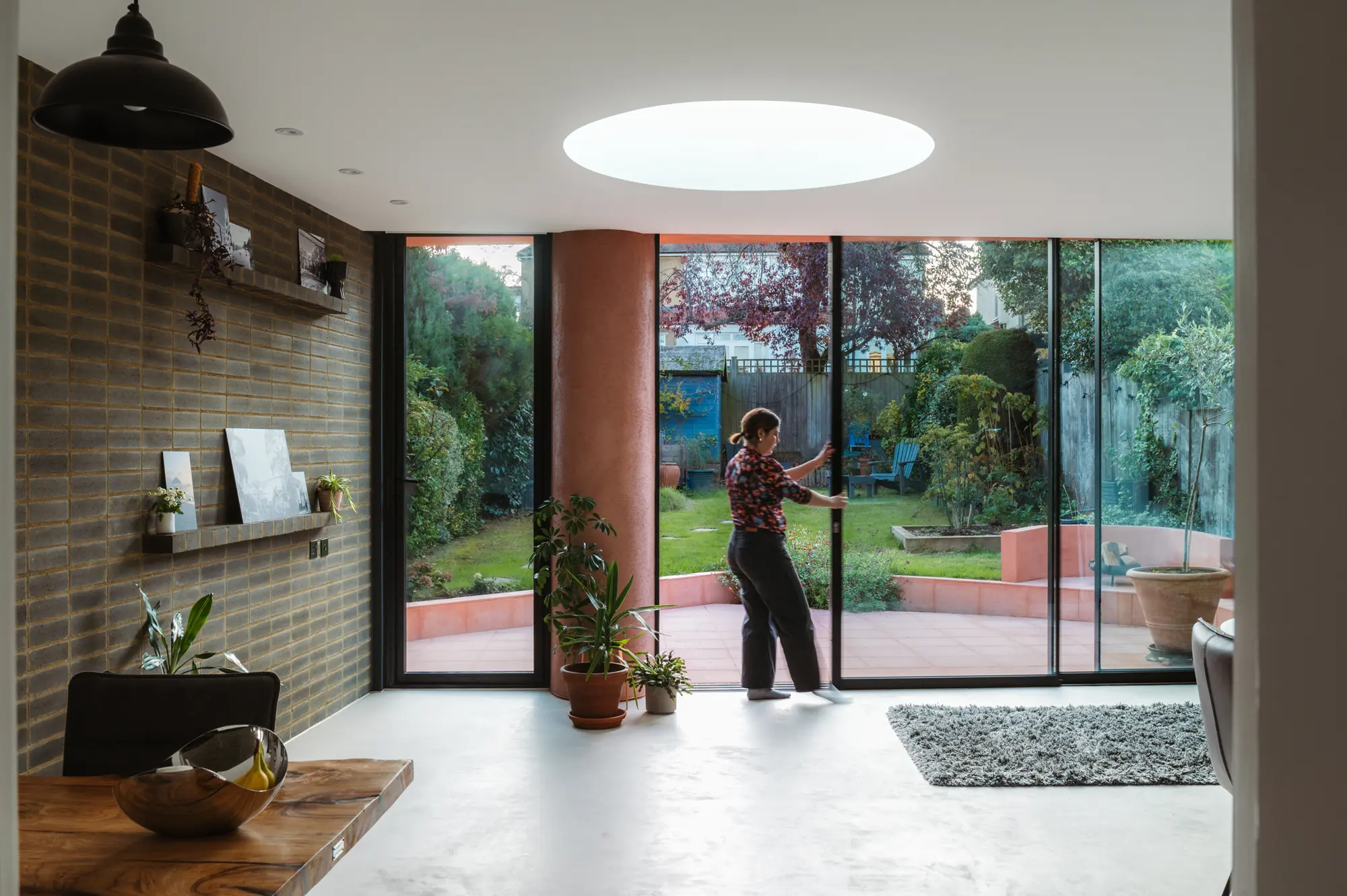
Scottish innovation K-Briq (in Medero Dark Grey) was used to create an interior feature wall in this stylish rear extension project designed by Whittaker Parsons – saving 300kg of embodied CO2 versus using conventional bricks. K-Briq can also be used as an external facing brick. Photo: Christina Hancock
Before we dig deeper, it’s worth mentioning that embodied energy is a large part of the sustainability story – but not the whole story. Some natural materials also have the capacity to absorb pollutants, for example, delivering a healthier living environment – whereas less eco-friendly materials actually contribute to indoor air pollution. If your project needs to meet Building Regulations and you’re looking to use innovative products, always be sure they hold the right certifications (keep reading for more on this).
Here are the pros and cons of the most popular low-carbon brick alternatives on the market:
Fired clay bricks
Since cavity wall construction was introduced in the early 20th century, clay bricks have been the first choice for the outer skin (facing bricks). The load-bearing inner skin is normally constructed from composite or insulated blocks. Most of the UK’s housing stock is built this way.
For its Eco-Brick, Wienerberger has taken the simple approach of making fired clay facing bricks in a slimmer profile – thus reducing embodied carbon by 30%, requiring less mortar to lay, and allowing for more insulation within the same overall wall thickness
Some brickmakers have worked to improve the firing process, reducing the energy required and emissions generated. One way to achieve this is to reduce the amount of clay that’s to be fired, such as by adding aggregates and other materials to the mix. Cleaner fuels, such as hydrogen or biomethane, can also be used in the firing process. Kiln heat recovery and use of recycled water can help to bring down the embodied energy of fired clay bricks, too.
Unfired clay bricks
We’ve been using clay since humankind first built mud huts – and similar unfired bricks and blocks are still in use today in many parts of the world. Closer to home, cob blocks are often specified to repair old buildings, especially in Devon, where cob construction was common up until the 18th century. Cob is made from raw clay (often containing other minerals) with straw added to the mix for tensile strength. The exact mix varies according to where you are and what kind of clay is available.
Unfired clay products do, of course, require protection from the elements. They are not suitable as an external skin on their own. Most cob buildings, for instance, were coated with lime-based render. Properly-maintained, this most eco-friendly of materials can last indefinitely – but it’s important to note that without good upkeep, unfired clay walls will decay much more quickly than fired brick.
Most commercially-available unfired clay blocks are used for non-load bearing purposes only – although there are some products marketed for structural use, including the likes of H G Matthews’ Strocks (a compressed brick of clay-rich earth and chopped straw).
One enterprising brickmaker – Belgian firm Lowie – has developed a new type of brick that sets hard without any firing. This is made from fine sands, held together with a binder created using byproducts of the steel industry – a great use of waste material. Its strength is achieved through an innovative production method, compressing and vibrating the material before natural carbonation then completes the hardening process.
Lowie’s range of facing bricks is available in a range of white and grey hues, offering the look and warmth of clay while slashing embodied energy
The company claims a 76% reduction in carbon emissions in comparison to conventional fired clay bricks. While it’s currently made in Belgium, it is certified for use in the UK for both internal load-bearing skins and externally as a facing brick.
FAQ
Is stone an eco-friendly building material?
You might not be expecting to hear this, but stone is potentially the most eco-friendly of all wall building materials. It requires no firing, as all the work to make the material hardy was done thousands of years ago by processes lost in the mists of time. It’s also highly durable: stone generally lasts longer than fired clay bricks and, importantly, can be (and often has been) reused many times. Unfortunately, stone is simply not available in many places, so we’ve had to rely on other materials for construction.
Monolithic brick
There’s another approach to wall construction we should bear in mind, as it reduces embodied energy through a different methodology. Monolithic fired clay blocks – such as Porotherm and Juwo Evolved SmartWall – deliver a watertight, load-bearing and (often) pre-insulated wall construction with just one component.
Juwo Evolved SmartWall is a fired clay block system that can deliver excellent thermal and acoustic insulation in a single-skin, monolithic system – enabling a swift route to create a low-energy building envelope
They are normally finished externally with render or brick slips, and internally with a smooth board – ideally using vapour permeable materials to maximise thermal buffering within the walls. This preserves a more even internal climate, with fewer peaks and troughs of temperature. Compared to conventional cavity wall construction, the combination of aerated clay blocks and thin-joint adhesive (rather than cement mortar) offers advantages in terms of speed and simplicity, all of which reduces environmental impact.
Composite bricks & blocks
This type of masonry is made from aggregates, which are bound together and shaped in a mould. The most common binder is cement, resulting in the concrete building blocks with which most builders are familiar.
The cement industry has been taking steps in recent years to cut the carbon intensity of cement, mainly through the use of cleaner energy to manufacture the cement. Some composite brick and block makers have also found ways to reduce the cement content of their products, thus reducing the overall embodied energy.
Even greater reductions can be achieved through the use of lime as a binder. While it does require energy to produce, lime absorbs CO2 as it cures, so blocks made this way have a far lower embodied carbon. Lime is commonly used as a binder in other sustainable building products such as hempcrete and woodcrete blocks. These products use renewable, lightweight aggregates that also lock in (sequester) CO2 for the lifetime of the building.
Excitingly, a recent market entrant – Kenoteq – has found a way to produce low-carbon composite facing bricks. This is a great challenge, as facing bricks need to be weatherproof. The company’s K-Briq product is BBA certified – so will be acceptable to building control – and is designed to deliver 90% carbon savings against conventional facing bricks by using recycled aggregates and no cement or lime. Instead, it features a secretive proprietary binder which the company says is non-toxic, and uses a compression technique to form the bricks.
K-Briq is produced using nearly 100% recycled construction and demolition waste, and is hydraulically compressed rather than kiln-fired. It’s available through builders’ merchants and is now also stocked by B&Q
In effect, this is the holy grail of brick production: providing a market for demolition waste; no firing; and super low-energy binders. K-Briq is also recyclable at end of use, so we can assume the toxicity of the binder is indeed low – the Environmental Product Declaration (EPD), due in early 2026, will confirm this.
Recycled plastic bricks
From time-to-time, I am alerted to the fact that a wonderful new product has become available, made from some sort of recycled plastic – anything from jewellery to art to bricks. However, it’s by no means clear to me that this is good for the environment; in fact, it requires careful consideration.
When it comes to building materials, recycled plastic is sometimes used as an aggregate to replace stone or other fillers. This requires the use of some sort of binder to form the bricks or blocks. Mixing such different materials together and binding them makes it very hard to then recycle them at the end of their life. In my book, it’s therefore very likely that these products will end up in landfill, or worse, escape into the wider environment.
Plastic is a very persistent pollutant. Many single-use items can last 500 years, if they ever break down at all, and future archaeologists may well refer to the present as the late plastic age. I believe what we really need to do is to stop producing non-biodegradable plastic, period. Then we need to focus on the clean-up, which means destroying this material by controlled incineration to prevent it from ever again entering our environment. Recycling essentially pushes the plastic problem further down the road, leaving it for future generations to clean up.
I hear the sharp intake of breath when I say that I don’t believe recycled plastic is always a good idea. But think about it. Perhaps there is a reason why the plastics industry pays lip service to recycling with marketing messages such as “30% of this material comes from recycled plastic.” Ultimately, this allows them to go on cheaply producing the other 70%, much of which will end up as pollution.
If you’re tackling a self build, extension or major renovation, your project will almost certainly need Building Regulations approval. It’s also a good idea to obtain a guarantee on your newly built or altered home, via a warranty from the likes of LABC, Self-Build Zone or Protek. This means you’ll need to ensure all materials used in your building are acceptable to building control and the warranty provider.
Certification is the most secure route to achieving this. But it can be something of a minefield, especially if products are manufactured abroad and approved under European or other international certification systems. What’s more, we’re at a stage of innovation in the industry. So, you’ll find that while some products are already fully certified, others – including some mentioned in this article – are still in the development phase.
Cob block has a centuries-long history in UK construction, but it must be used alongside the right (breathable) materials – at this property in Sidmouth, Devon, an original wall is uncovered beneath an inappropriate cement render. Photo: Jane Metcalf
The best way to keep your building inspector happy is to use products that hold BBA (British Board of Agrement) certification. Its logo should appear on the documentation for the materials you plan to use. The corresponding certificate should also relate to how you’re using the product in your project.
CE marking also applies to building products. This label confirms that the relevant manufacturer complies with the conditions set out within the EU Construction Products Regulation 2013. Post-Brexit, this has become the UKCA mark on our shores, although CE is still acceptable in some circumstances. It sets the minimum legal requirements for a product to be marketed.
The original CE mark set out several categories of environmental performance, including Basic Requirements for Construction Works (BRCW) No. 7: Sustainable use of natural resources. However, this element has not yet been fully operationalised in most product standards. So, if you want to put more scrutiny on the sustainable use of natural resources in your project, be sure to investigate the underlying Environmental Product Declarations (EPDs) or refer to the BBA Environmental Assessments, which are sometimes issued alongside the main BBA Certificate.
Nigel Griffiths
Nigel Griffiths is Build It's eco expert, specialising in sustainable construction and retrofits. He is the author of the Haynes Eco House Manual and advises public bodies and individual developers on their building projects. You can meet Nigel at Build It Live and speak to him about your own eco project.










 Login/register to save Article for later