
- Plan ItBack
- Design ItBack
- Build ItBack
- Homes
- ProductsBack
- CostsBack
- Self Build Cost Calculator
Estimate your project costs instantly with Build It's interactive self-build cost calculator
Calculate Now - Costs & Finance
- Contracts & Warranties
- Build It Estimating Service
Get an accurate, detailed cost breakdown of your project
Submit plans
- EventsBack























 Login/register to save Article for later
10 Top Tips for Building a Garage – Your Guide to Costs, Planning & Design

Most people still think of the garage as a standalone zone with the chief purpose of housing the car. However, a growing number of homeowners – and self builders in particular – are rethinking this strategy, and choosing to create multi-functional spaces that form an extension to the main living area.
Regardless of what they are used for, garages add an extra dimension to a home. Tim Cima, sales manager for Foxtons in Woking, says the average three bedroom house in the area – typically worth around £500,000 – can vary in value up to £20,000 depending on whether or not it has suitable garaging. “Houses around the £600,000 mark just won’t sell at all without adequate sheltered parking,” says Tim
A well-designed structure can also infuse your property with extra kerb appeal. So if your current property doesn’t have sufficient garaging, or you’re a self builder creating a home from scratch, where do you start?
Jump to building a garage FAQs answered
1. How can I use a garage?
Don’t be afraid to think outside the box. Yes, you’ll want parking space – but this zone could also offer anything from simple storage to a home office or gym. In fact, a study from the RAC Foundation found that roughly 60% of garage owners do not use their garages to house their cars, instead allocating them for extra storage space and/or as a shed.
Therefore, it’s important to carefully consider what role the space needs to perform at the early design phase of your project. “This will inform future decisions, including the size and shape of the structure,” says Zoe Dolan from Scotts of Thrapston.
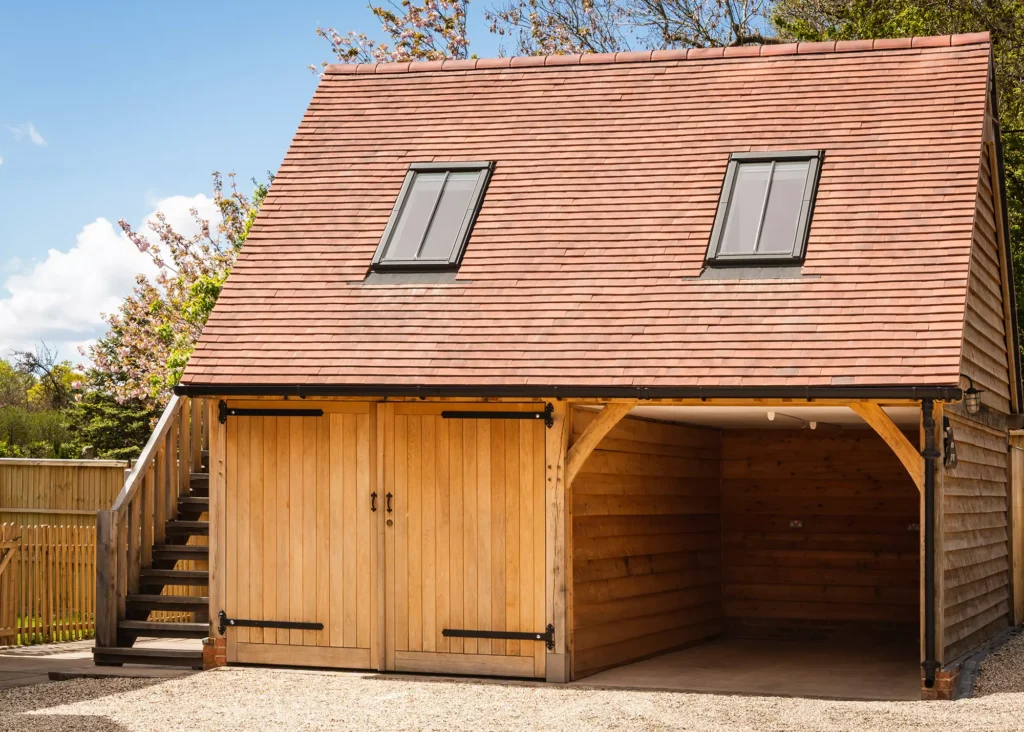
The charming Little Gloucester garage from Oakwrights features oak double ledged and braced garage doors with black metal detailing and handles. The double-height garage is part of Oakwrights’ Room above Garage range; a customisable green oak frame design with the option to include dormer windows, rooflights and your choice of roof covering for additional character
It’s also worth bearing in mind that incorporating a multi-purpose zone could provide an extra selling point if you plan to move house in the future. “We’re seeing a trend towards tailoring the garage to fit with people’s lifestyle needs, such as a zone to exercise,” says Dominic Wishlade from Dura Garages. “It’s ideal, because you’re working with a well-ventilated space and there’s plenty of room. Plus, as it’s on the ground floor, it’s also easier to install heavy gym equipment.”
2. Will an integrated garage design suit my house?
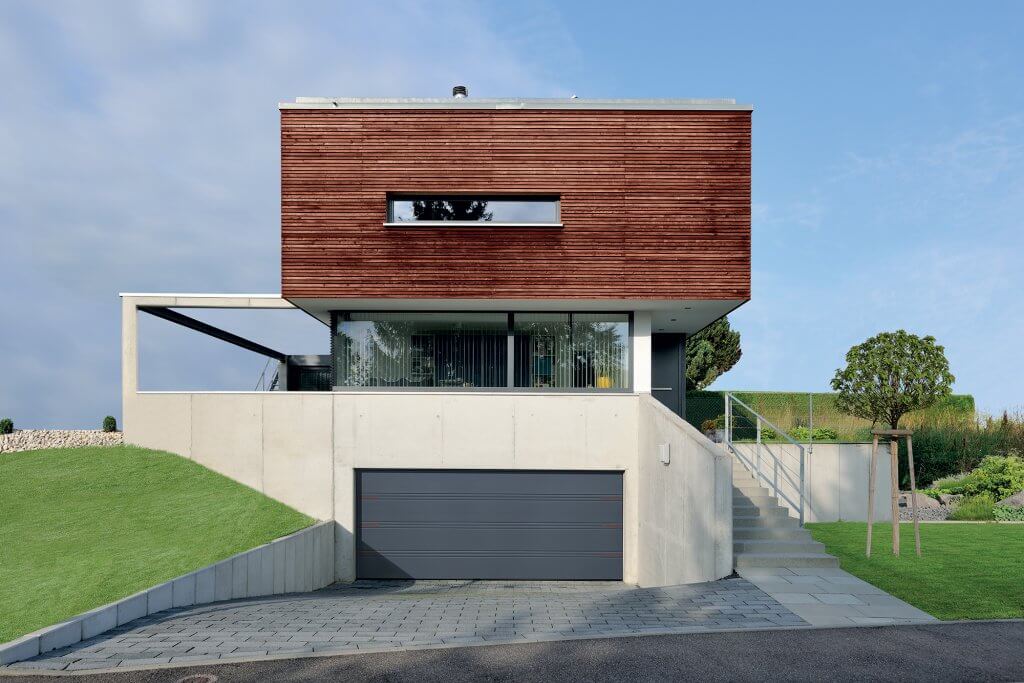
Whether you build an attached or detached garage will depend largely on your plot of land, budget and the amount of available space. There are a number of advantages to creating a zone that’s directly linked to the main property.
For example, if your garage is going to double up as a utility area that houses the washing machine and tumble dryer, access will be a lot more straightforward. Plus, if you need to add more living space at a later date, you have a ready-to-convert structure that’s already connected to the main residential dwelling.
3. What are the advantages of a detached garage?
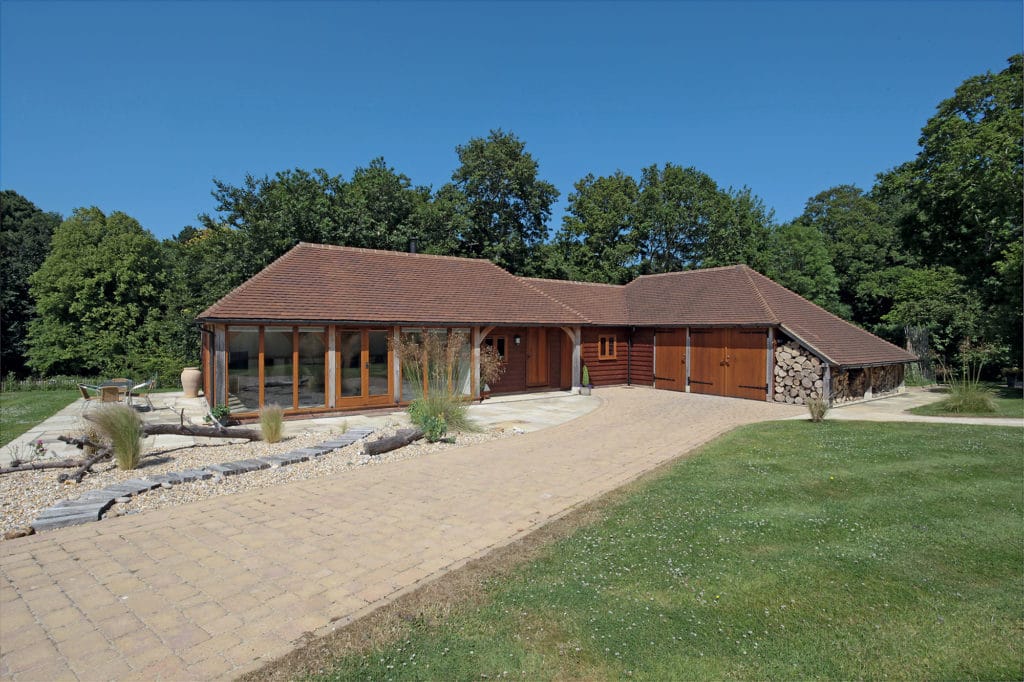
If you have the space to build one, a standalone, detached garage can make a striking visual statement that complements the main dwelling. “If you’re creating a new structure on the grounds of an existing property, you’ve got more freedom to develop what you want without having to fit it around the design of the main building,” says Charlie Mills from Oakwrights. “Key considerations will be how to position the building for good access, as well as drainage, power and water supplies – depending on how you intend to use the space.”
You should also think carefully about the proportions of the structure and how it’ll relate to the residential part of the property – you don’t want it to overwhelm the main house.
Many timber and oak frame providers specialise in the development of standalone buildings like this, and can offer design advice based on your unique requirements.
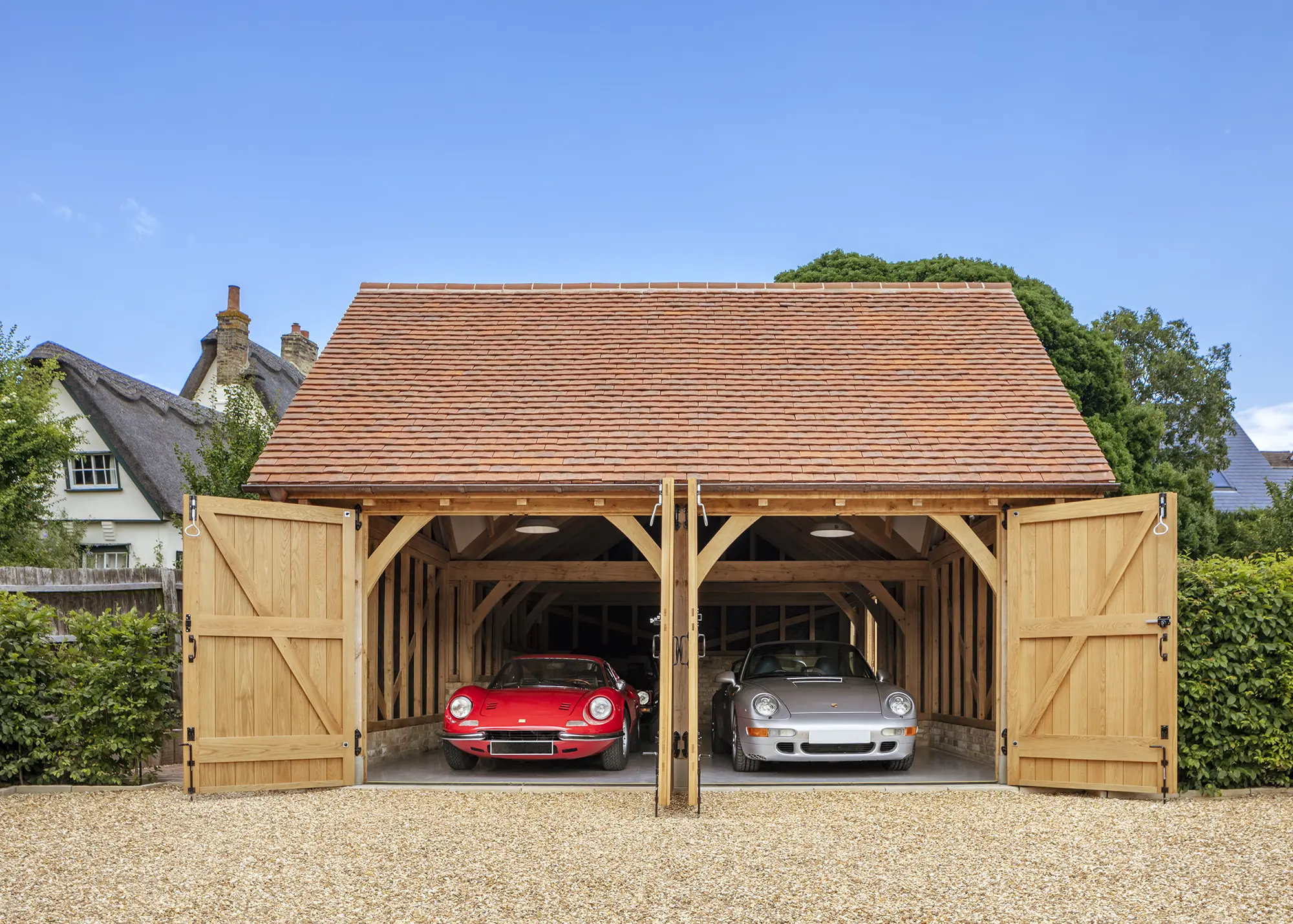
CASE STUDY Detached oak self build garagePhilip and Clara worked with oak frame supplier, Oakwrights, to design and build their dream, detached single-storey oak framed garage. Situated in a charming Cambridgeshire village, the couple own a selection of beloved classic cars and wanted a timeless garage space to house the collection. “Our classic cars are our pride and joy,” says Philip. Fuelled by an eye for detail and an appreciation of timeless design, “we opted for everything to be made from oak internally. We love how the oak joints are shaped and crafted. The curved braces and struts flow brilliantly with the roof design,” he says.
The couple’s home in a conservation area is made from naturally light-coloured reclaimed Cambridgeshire bricks. Having discussed plans with their neighbours, Philip and Clara felt their garage should adopt a harmonious design that would complement the existing house and its rural surroundings. “It was important that the design of our garage was sympathetic to its location,” says Philip.
The couple worked with Oakwrights’ outbuildings & extensions specialist, Zoe Grey, to develop a design for the four-bay timber garage, which is shaped like a square with two bays in front and two behind. “Philip wanted the oak to complement the cars, so we included oak trusses, rafters and oak studwork,” explains Zoe. Philip’s choice of a shimmering light-grey resin floor complements the garage’s internal oak features beautifully. When pulling into the driveway, the oak building creates a spectacular first impression, with two large oak garage doors revealing four bays and their remarkable classic cars. |

4. How big should my self build garage be?
In the UK, the recommended size of a standard parking bay is 2.4m x 4.8m. “A typical two-bay garage would be about 5.65m wide and 5.3m deep,” says Matt Lyward from The Oak Design Company.
However, if you are the owner of a modern 4×4 vehicle or a large family car, this might end up feeling a little cramped. And if you’re keen to establish a multi-purpose space, either for storage or other uses, you may prefer to create a more commodious zone – as far as the dimensions of your plot allow.
5. What are the design options for a self build garage?
The garage typically forms a large part of the facade and can have a big impact on first impressions. Therefore, it’s important to plan this element early on to ensure it delivers maximum kerb appeal.
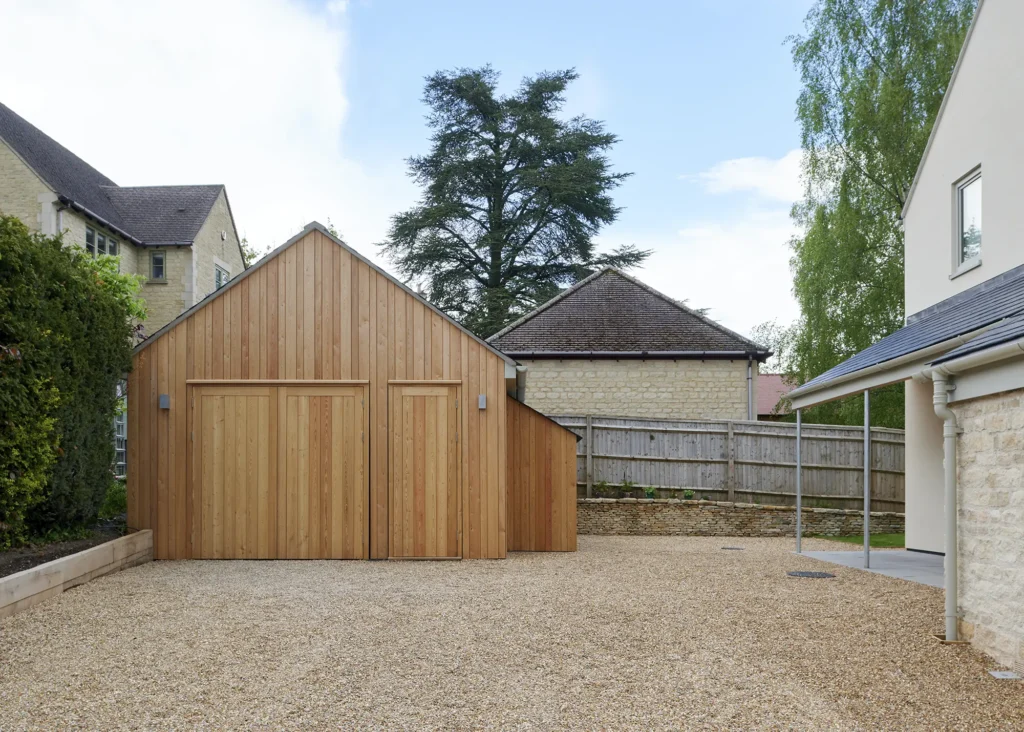
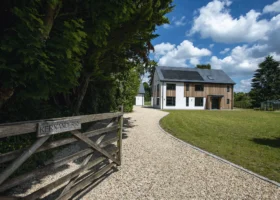
Designed by Rixon Architects, Sam and Suzie Andrews took a fabric-first approach to creating their new, contemporary and energy efficient home. A detached garage sits at the rear of the property’s driveway – tucked away from the roadside. It’s been clad in timber to complement details found on the home’s picture window and veranda, which feature Siberian larch from Vastern Timber. Photo: Adam Carter
There’s an array of options when it comes to creating a standalone structure, from traditional brick and block solutions to characterful oak frame. “A lot depends on the surroundings, as you may want a building that stays true to the feel of nearby dwellings,” says Zoe Dolan.
“Many of our clients prefer designs that fit in seamlessly with the look and style of the main house. The benefit of this is that your garage will complement the existing architecture
rather than appearing disjointed.” This can often be achieved by specifying roof tiles, bricks and cladding that coordinate with the residential building.
Is a timber frame garage right for you?If you are hoping to factor in a garage at a later date, don’t despair. Many companies such as English Heritage Buildings (EHB) specialise in high-end timber-frame garages and outbuildings, having the advantage of being easy to assemble and quick to build. Versatility and functionality are key, and attractive catslide roofs and exposed beams make these buildings the natural progression to multi-functional hybrid garages. Once commissioned and fabricated, the frame arrives and is put together quickly as a dry build, assuring a more controlled quality than building from a plan. You can simply purchase an oak frame from EHB and self build (or use your own contractors) using the technical drawings and assembly instructions supplied, or have them create something bespoke for your plot that they will assemble for you. The dry frame goes up in three days and EHB provide technical support and back up. “The timber frame dry builds give great design flexibility,” says Darren Hook, managing director of EHB, “and they’re great to look at. These days, people can spend as much on their outbuildings as they do on their kitchens, so it’s important to get it right and make sure that the property price will reflect this investment.” |
6. Will I need planning permission for my garage?
If you’re creating a garage as part of your self build, the proposed design should be included within the planning application for the main house. If you’re building it as an addition to an existing home, you may be able to complete it under permitted development (PD) rights. The full criteria for PD are on the Planning Portal website, but fundamentally to be eligible, a new garage must not be positioned further forward than the principal elevation.
It must also be single-storey, with a maximum eaves height of 2.5m and a ridge height of no greater than 4m for dual-pitched roofs (or 3m for other types of roof). If it’s to be within 2m of a boundary, then it can’t be taller than 2.5m.
If your home is listed or within a designated zone, such as an area of outstanding natural beauty or a conservation area, PD entitlements may not apply, so double check with the council. “In terms of design, many planners will be pleased to see a proposal that mimics the main house – though some will encourage a contrast in styles, too,” says Matt.
Where should you position your garage?Design the garage in tandem with the new driveway, which will be determined by access from the main road. Planners will decide how much parking is required based on the size of your house and expect provision for a safe, turning space. They may have a say in whether you can/can’t have an integral/detached garage or state the garage has to be positioned within a certain distance from your home. Practically, the garage needs to be close enough to the house to be convenient but not located in a way that compromises or undermines its appearance or views. |
7. Can I convert my garage into living space?
If you’re considering tackling a garage conversion in the future, it can be helpful to make some provisions when the structure is initially built in order to facilitate any future alterations you might want to implement.
“One of our suggestions would be to not include internal load-bearing walls within an attached garage,” says Zoe from Scotts of Thrapston. “Using non-structural partitions will mean that reconfiguring the space in the future will be easier.”
You should also make provisions for drainage, water and electricity supplies. It’s worth insulating the structure to the same standard as the rest of the house, too, to stop warmth from escaping, in addition to damp proofing the floor. If the work is all internal, it may not require formal planning consent – but it’s worth double-checking with your council. Building Regs will always apply.
8. How do I choose the best garage doors?
Aesthetic appearance is usually the top priority when it comes to specifying your garage doors, followed closely by thermal performance and the level of upkeep required. There is a range of configurations and materials available to suit pretty much any project.
“The four main solutions are roller, side-sectional, sectional and up-and-over,” says Ian Chubb, managing director of Deuren. The latter two versions are operated via a track mechanism that is fixed to the ceiling of the garage. Up-and-over products tend to be the cheapest design, with easy-to-operate retractable versions from B&Q starting from about £400 each.
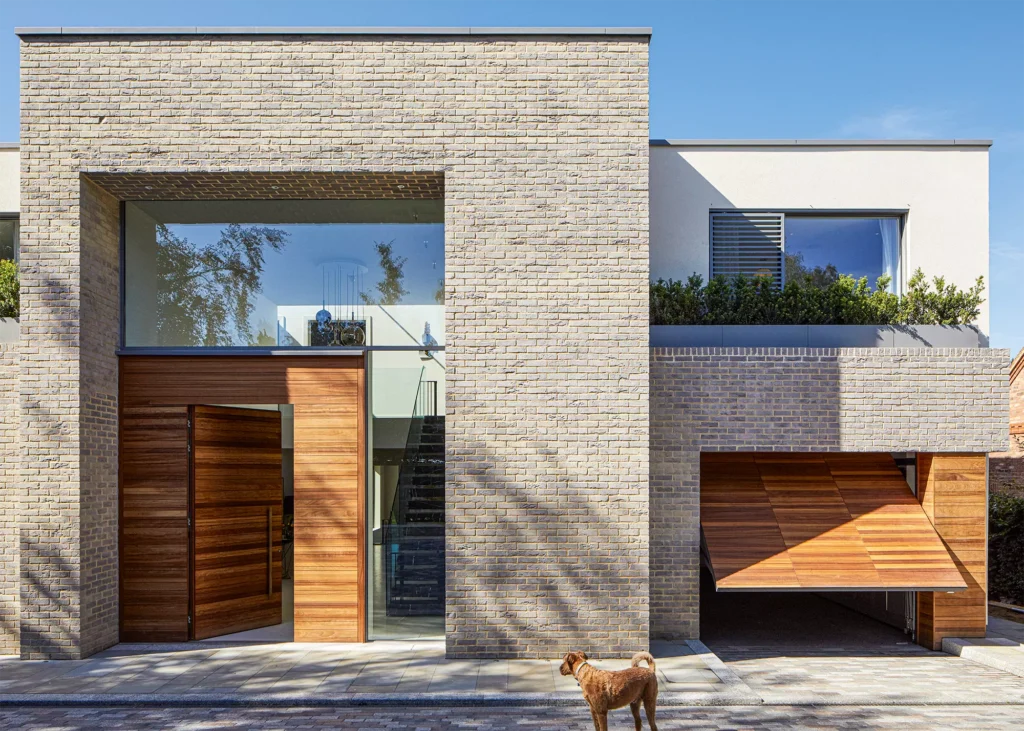
This new build home in Buckinghamshire has been upgraded with a contemporary timber garage door from Urban Front. The model is an up-and-over automated garage door in their Rondo design, made in Iroko wood to match the front entrance. Prices for a similar design start at £20,000 + VAT
“In terms of materials, the cheapest and most popular options are steel and PVCu,” says Ian. “For homeowners who are after a more premium product, timber is a smart solution thanks to its sleek appearance and durability.” Aluminium is also a sought-after choice, and glass-reinforced polyester is popular with people who want to recreate the look of timber without the same level of maintenance.
Here are the pros, cons & costs of the most popular types of garage door
Up-and-over doorsAn up-and-over door is a rigid panel, typically made from timber, steel or glass reinforced plastic (GRP), that swings outwards and tilts back inside the garage. Canopy versions will add provide added shelter, while a retractable style slides back along ceiling tracks. A basic design starts around £300. Pros: Cheapest option. A wide opening. Lots of style choice. An easy-fit solution delivered on a factory-fitted steel frame. Cons: A canopy isn’t suitable for automation. Needs room to swing forwards. Takes up roof space. Roller doorsA roller door is a curtain of steel or aluminium slats that roll smoothly up and around a cylinder or into a box mounted to the wall behind the brickwork. A basic version starts around £400; insulated designs will cost more. Pros: All the garage space can be used. Suitable for curved and arched openings. Possible to park a car in front. Can be automated. Cons: One door style. Looks functional; although wood-effect designs are now available. Avoid entry-level products if security is a key concern.
Section doorsA sectional door comprises a set of large panels. These doors rise up and curve back section-by-section until the door is flat against the garage ceiling. Prices start at £600. Pros: Good for extra-wide garage openings due to strength and stability. Won’t intrude on the driveway. Can be automated. Most designs are insulated. Cons: Takes-up roof or wall space. Not generally available in traditional styles. Side-hinged doorsSide-hinged doors come in a pair, typically with a 50/50 or 70/30 split and will open outwards. Prices start at £300 for most timber models. Pros: Maximises internal garage space. Optional glazing. Partial opening is convenient for accessing a bike or garden equipment. Less to go wrong as no mechanical fixings (though can be automated). Cons: Requires driveway space to fully swing open. Not suitable for drives that slope upwards from the door. |
9. How can I ensure my garage is safe & secure?
There are two main security accreditations to look out for when shopping for garage doors. Look out for ENV 1627 and Secured By Design. Both of these endorsements mean that the product has been thoroughly tested to resist break-ins. “Doors made to this standard have a higher quality locking mechanism, in addition to stronger panels that will help prevent forced access,” says Ian.
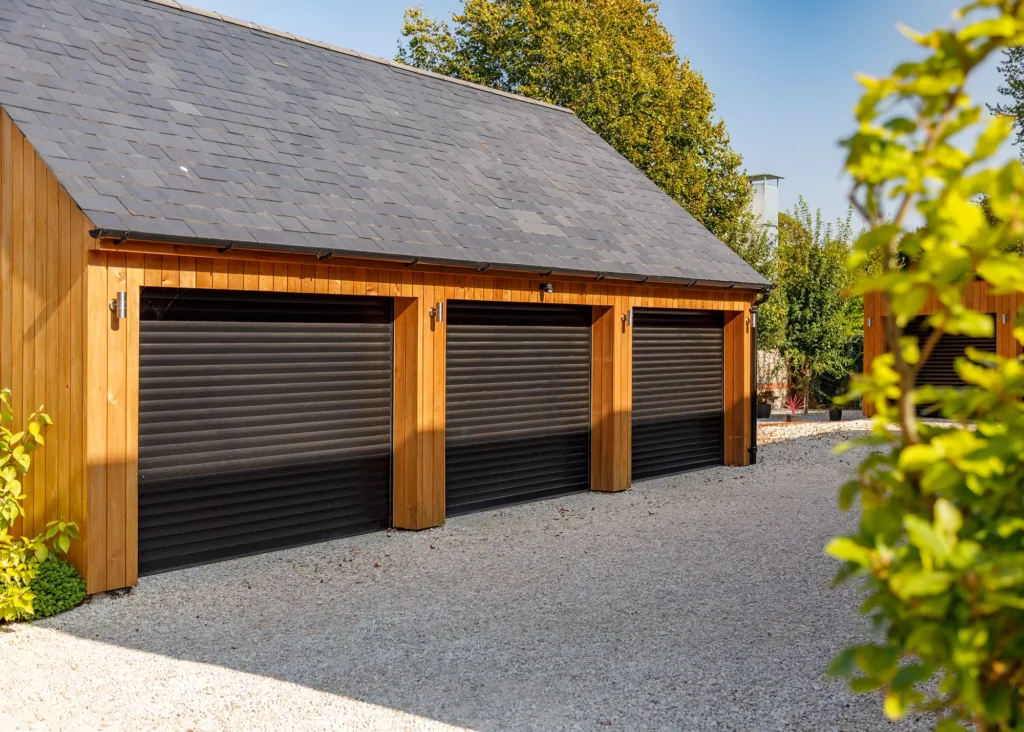
Installed by Freelance Entry Solutions, these insulated aluminium SeceuroGlide roller garage doors in black were specified to match the exterior joinery of this new build home in rural Hampshire. Each door is electrically operated and can be opened or closed via a keyring or through a control panel inside the garage
10. How much does it cost to build a garage?
The biggest factor that will influence how much it costs to build a garage, is the construction method you opt for – whether that’s brick and block, timber frame or oak frame, for example. As with any building project, the bigger the garage, the higher the cost. Larger structures will require more materials and increase your labour fees. For a standard, single-storey 6x6m self build garage, constructed using brick and block, Checkatrade estimates that you should expect to budget within the region of cost between £25,000-£30,000. On the other end of the spectrum, prefabricated garages can offer a great, budget-friendly solution for those after something quick to erect – some priced at under £10,000.
“Our garages start from £3,000 for a single-bay unit, on a supply-only basis. A full turnkey package might be as little as £10,000, depending on the specification. However, we’ve had some high-spec schemes where the overall budget has exceeded £200,000,” says Matt from the Oak Designs Company.
FAQs
How much should I budget for a timber garage, and what is usually included in the price?
The cost to build a garage will vary, depending on the size, construction method, design details and how many stories you’re looking to include. “We provide the garage’s oak frame, and can take on assembly and roofing to dry shell,” says George Allen, regional design consultant at Oakwrights. “The garage’s groundworks, services and any internal fit-out elements are usually left to the client’s designated builder. The structural elements for an Oakwrights garage start at around £850 per m² for a single-storey self build garage, and £700 per m² for a room over garage, both being two-bay car port designs.”
Does my self build garage need a Building Regs approval?
Before setting out on a project and developing your design ideas, it’s important to note the rules surrounding Building Regulations. “If the garage has over 30m² of internal floor area, then yes, it will need Building Regulations approval,” says George. “This is something that we can provide drawings for in-house and can assist with this process. There are a couple of two-bay garage designs that sit under this 30m² dimension, which can be built under a building notice.”
Should my garage match my home’s existing architecture?
Your garage’s design will largely depend on whether or not it is being built in tandem with your new home, or if you’re building the structure separately. If it’s the former, your architect will generally design the garage in sync with the house, to create a cohesive cluster of buildings. However, the decision will be up to you, and you will be able to create a standout garage design to your specifications. “Each home is different. A natural timber exterior can soften the garage’s aesthetic compared to a brick alternative, for example,” says George. “Exterior materials such as tiles and low brick plinth walls can help the garage blend in with the existing property’s character without exactly copying it.”
How long does it take to build a garage?
“This can vary depending on the size, design and complexity of each project. Generally speaking, you should allow around six to eight weeks on site for a standard three-bay single-storey garage,” says George. Zoe Grey, regional design consultant at Oakwrights, adds: “Groundworks usually take about three weeks, and we would require two to three weeks to install the oak frame, the weatherboarded walls and complete the roof. Any internal electrics and finishing touches would take one to two weeks on site. The frame only takes a couple of days to erect, which is one of the major benefits of choosing a timber-based structural system.”
Will a garage boost my home’s value?
Whether you’re self building, renovating or doing a home up to sell on, it’s important to factor in the return on investment when designing a garage. For many, a garage will be a convenient addition, providing useful space for storage, cars, tools and equipment, and for some, extra living space – each of which will be sure to boost value. “Is the garage space adding more storage? Can you consider adding office space or accommodation above to boost your property’s number of bedrooms? All of these options can really enhance your house’s value,” says George.
Build It
You may be interested in