






















 Login/register to save Article for later
Alex Alsop is sales director and founder at Norrsken. Norrsken specialises in triple-glazed timber alu-clad windows and doors for Passive Houses and energy efficient homes.
- Plan ItBack
- Design ItBack
- Build ItBack
- Homes
- ProductsBack
- CostsBack
- Self Build Cost Calculator
Estimate your project costs instantly with Build It's interactive self-build cost calculator
Calculate Now - Costs & Finance
- Contracts & Warranties
- Build It Estimating Service
Get an accurate, detailed cost breakdown of your project
Submit plans
- EventsBack
How Much Do Sliding Patio Doors Cost in 2026? What to Budget for Glazing Types & Installation
How much do sliding patio doors cost in the UK? Find out what makes a good quality sliding door system, and what you should budget to install it in 2026 with our complete guide to materials, glazing specification & more

Type ‘how much do sliding patio doors cost in 2026?’ into any search engine, and you’ll be greeted with all manner of articles purporting to share accurate information on what you’ll pay for sliding doors. Trouble is, most of these rely on readily-available price lists from DIY stores and other entry-level suppliers. Many of these companies sell based exclusively on price, and offer only the most basic of sliding door designs, built with cheaper materials.
If you’re self building, extending or renovating your own home, chances are you’re looking for good quality products that support your ambitions in terms of energy performance, aesthetics, durability, security and more. In other words, the bottom-end products won’t cut it – and price guides based on them won’t help you plan your self build budget effectively.
In this article, we want to help you understand what it will really cost to install a good-quality sliding patio door system – the kind you’ll actually want to live with if you’re doing a project for yourself. Here’s how much sliding patio doors cost in the UK in 2026 – from frame materials to the glazing spec, ironmongery and more.
Jump to
- Frame material
- Door size
- Double v triple glazing
- Glass types
- Solar control glass
- Frame colour options
- Ironmongery & locking systems
- Trickle vents
- Structural reinforcement
- Indicative sliding door costs
- Installation costs
How does frame material impact the cost of sliding patio doors?
Materials matter with sliding patio doors. There’s a good reason most quality products are either aluminium or composite (such as alu-clad timber or PVCu-clad aluminium). These sliding door systems offer superior strength and rigidity, so can cope comfortably with the big spans and panel sizes most people are looking for in sliding patio doors. What’s more, they do so in relatively slim profiles, giving you the best views out.
When it comes to windows, good plastic units offer a cost-effective, low-maintenance choice – especially for replacements – and modern versions can look impressive. But doors are a different kettle of fish. They’re much larger, so it stands to reason they need to be more rigid and robust to ensure good service over their lifetime.
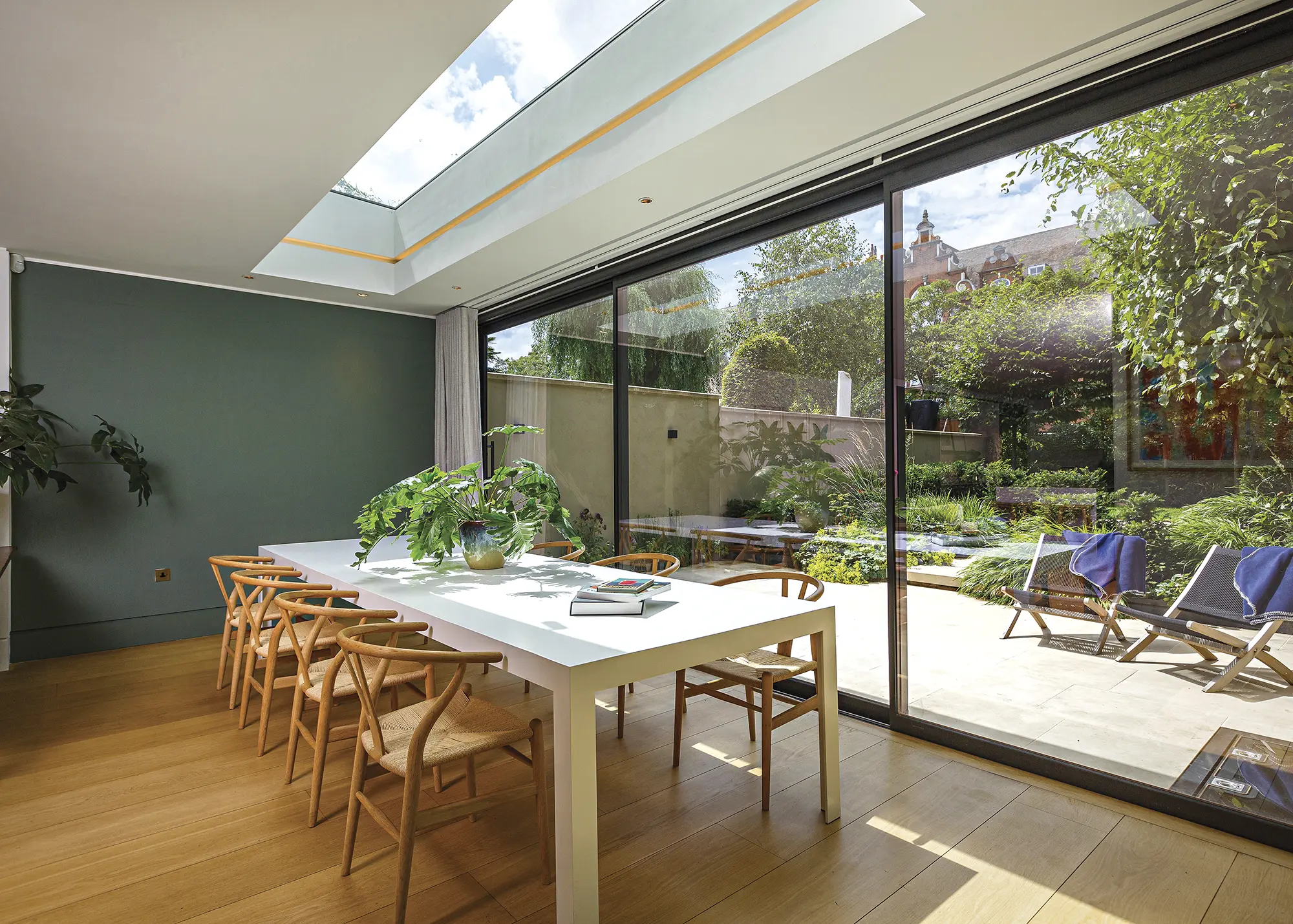
This extension features a large three-panel set of IDSystems‘ theEDGE2.0 sliding doors, which measure a total of 6,618mm (W) x 2,698mm (H) and are finished in RAL 7021 black grey matt, with colour-matched handles. Photo: Chris Taylor Photography
“It’s not just that PVCu isn’t as aesthetically pleasing for doors, with thicker sightlines,” says Dan Todd, Sales Director at Kloeber. “Plastic sliding patio doors are more susceptible to movement and expansion/contraction – they’re not as stable as aluminium or composite designs.” It’s a similar story for timber; even engineered softwood versions can’t match the spanning capabilities, slender sightlines and ultra robustness of aluminium and composite products.
Premium Content
Downloadable E-Guide
Build It’s downloadable e-guide to choosing windows & doors offers ideas and advice on every aspect of planning your home’s glazing and entrances, including expert tips on the key specification decisions you’ll face. Click below to find out more.
find out more
“For most homeowners, the two biggest factors are sightliness and energy performance,” says Craig Luff, managing director at Ecohaus. “The slimmest sliders look fantastic, with profiles of just 20mm-25mm, but they might not suit a really low-energy build.” Ecohaus’ ultra-slim Visiline thermally-broken aluminium sliding patio doors can achieve a U-value of around 1.1-1.2 W/m²K, for example, which will suit many projects. Meanwhile, its composite lift-and-slide Internorm products get down to 0.7 W/m²K (ie Passivhaus levels of efficiency), but with thicker frame profiles.
Visit showrooms or past projects to see and use doors you like in person. Scrutinise the quality of the jointing systems and ask to see certifications to verify, for instance, how airtight and weathertight the sliding doors are. Lift-and-slide doors press down into a gasket when closed, as opposed to sliding into a channel fitted with brush gaskets, which can offer an edge in airtightness. Ask about warranties, too, and what happens if the doors are damaged – how easy would the glass be to replace, for instance?

This project features Internorm’s HS330 triple-glazed lift and slide door system, achieving U-values of just 0.73 W/m²K, as part of a glazed courtyard by ecoHaus Windows & Doors. The striking scheme features 22.5m of continuous bespoke glazing with glass-to-glass corner joints. Photo: Charles Hosea
The quality of the running gear that enables you to slide the door back and forth is another key aspect to interrogate. What are the rolling mechanisms made of, for instance? Steel is generally more hardwearing than nylon, but the latter may be appropriate depending on the size and type of door.
Ultimately, you shouldn’t expect to get a good quality, stylish sliding patio door at a bargain price. If the cost seems low, there’s likely to be a reason for it – and you should be particularly wary when it comes to super-slim doors “When you’re going to really narrow profiles, at the cheaper end of the market you could be risking the quality and rigidity of the door,” says Dan.
How much do different sized sliding patio doors cost?
The biggest factor in the price of a sliding patio door system is size. “We’re currently doing anything from 3m wide up to 15m or more,” says Dan. “But I’d say an average sliding door might be 4m or 5m wide, and 2.1m or 2.2m tall.” This is probably a sweet spot for many extension projects and would most likely lead you towards a two-panel door, which will offer optimum balance between performance and sightlines.
Some homeowners may prefer a three-panel sliding door at this kind of size – perhaps to match the frames up with another architectural feature, or to enable more of the aperture to be opened. A twin-panel sliding door will give you a 50% open aperture, while a three-panel system will achieve 66%. “But if you have too many doors, you may as well switch to a bifold, which can open even wider,” says Dan. And from a cost perspective, bear in mind three doors means more tracks and more mechanism – so it will inevitably be pricier.
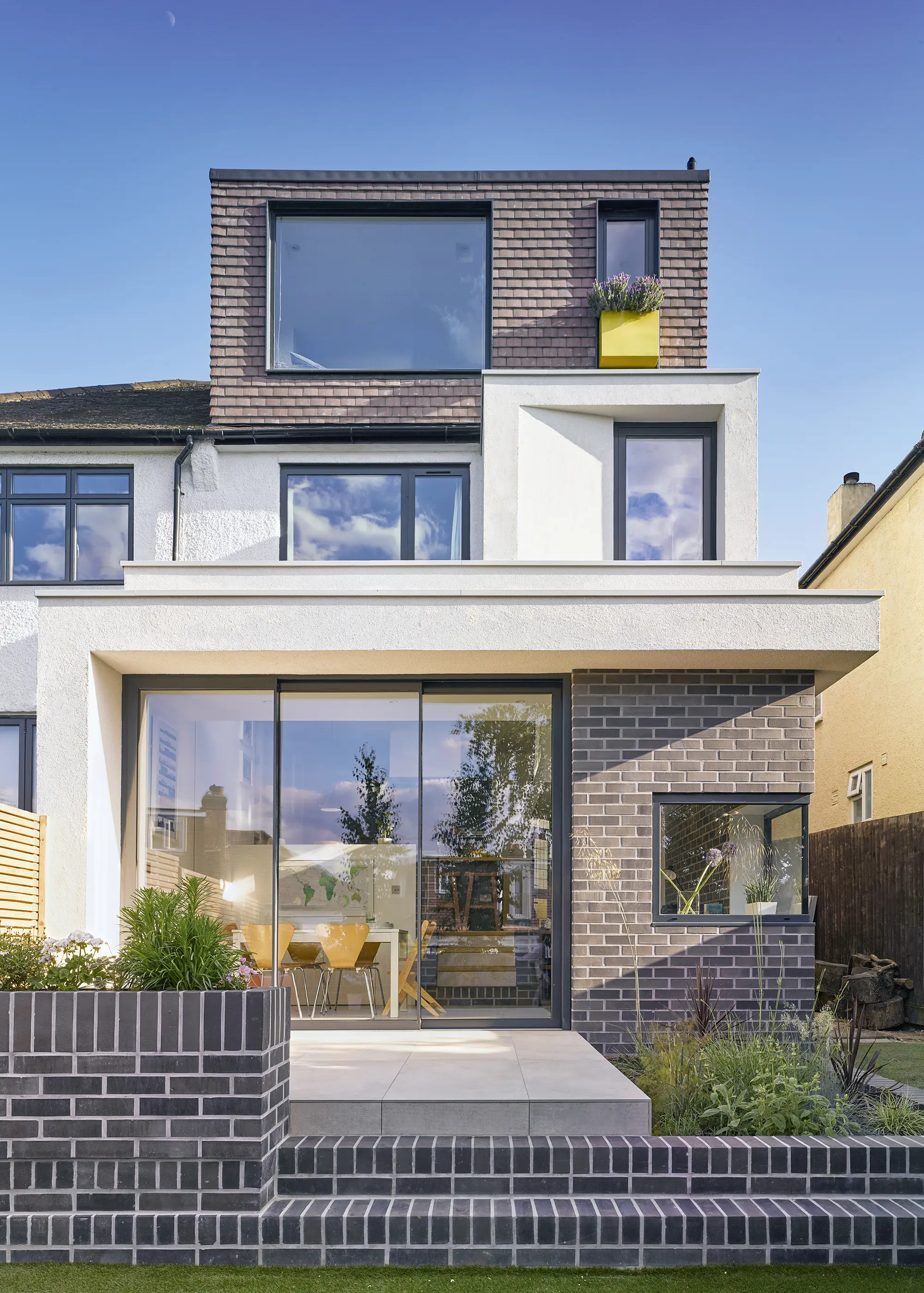
A three-panel set of IDSystems’ theEDGE2.0 ultra-slim sliders in RAL anthracite grey, with laminated glass and PAS 24 locks, installed into an extension and renovation in South London. The system measures 3,223mm (W) x 2,617mm (H), with each panel approximately 1,074mm wide, and all three doors can slide. An equivalent system would start at around £6,650 + VAT (including installation). Photo: Selencky Parsons Architects / Siobhan Doran Photography
Many premium sliding patio doors offer a max individual panel width of around 2.5m to 3m (though some can be bigger). “How wide the system can go is a good indicator of build quality,” says Craig, who recommends checking what the doors look like when closed before selecting the best configuration. “If you’re going with a slimline aluminium product, a triple track might suit you, even on a 4m or 5m door, because there’s still relatively little frame on show.” Three panels means a triple track and extra mechanism, pushing the price up, but if it fits your project goals, then it’ll be worth the money.
Those of you self building a new house might be looking for a mix of sliding patio door sizes. Perhaps a small system for the bedroom, leading out onto a balcony, but a much bigger set across the back of the house to capture views and provide access to the garden. Clearly, one of these will cost considerably more than the other. Purchasing them together (perhaps as a package alongside your windows) may well be the most cost-effective route both for the products and installation.
Perhaps surprisingly, the glass isn’t the most expensive part of good-quality sliding patio doors. “Much of the cost is in the mechanisms and frame,” says Dan. “Generally, if there’s less framework, less rolling mechanism and the door is simpler looking, then it’s likely to be more cost-effective.” So, for an average-sized sliding door, it will usually be cheaper to go for fewer panels. The exception comes when you’re dealing with bigger glass panels, which can be quite pricey and heavy – meaning you need a stronger system to take the weight.
How much do double-glazed sliding doors cost vs triple-glazed?
Quality double glazed sliding patio doors offer very good performance out of the box, so you don’t need triple glazing to meet Building Regs standards. But if you want to go beyond that, what’s the cost uplift between double and triple glazing?
“It’s always project-specific, but with our lift and slide system you’re typically looking at around £100 per m² of glass to upgrade to triple glazing,” says Dan Todd, Sales Director at Kloeber UK Ltd. “It’s simply a case of using a different-sized glass bead.”
“Ultra-slim sliding doors are a little different. Because of their narrow sightlines and bonded glass construction, upgrading the specification has a greater impact on costs,” says Dan. “The engineering is more involved, but that’s what allows us to achieve those beautifully minimal frames in the first place.”
Ecohaus’s slimline doors are also bonded. “A double-glazed pane might be 200kg, but triple glazing 300kg or more,” says Craig. “Our Visiline 2 and Visiline 3 are therefore completely different doors; the wheels we use for a triple-glazed system are completely different, for instance. So, it’s more of an uplift than just paying for an extra pane of glass.”
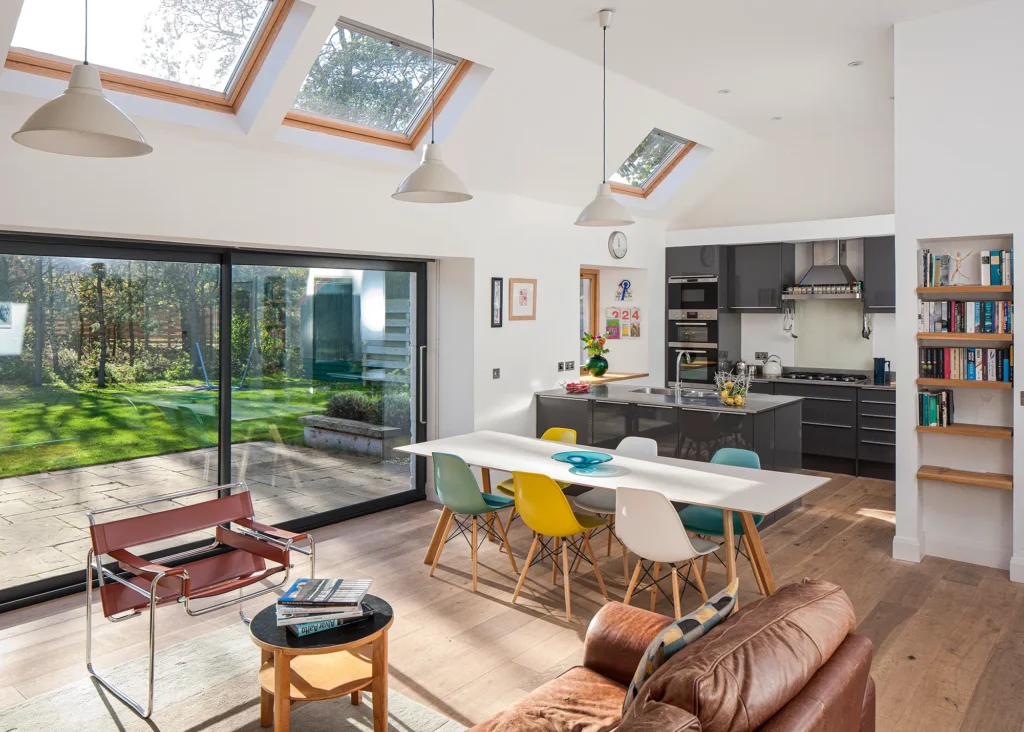
Kevin Adams and Lucy Miller gutted an old stone building on their family’s farmland to transform it into a beautiful new home. The cottage has been transformed into an open-plan kitchen-living-dining space, with rooflights and glazed sliding doors bringing in ample natural light. Photo: David Barbour
“Size is the key factor when pricing up sliding patio doors, but within that are subtle factors like the weight of the glass and any need for lifting equipment to enable installation,” says David Clarke, marketing manager at IDSystems. “This can be a significant hidden cost, particularly with triple glazing.” Bear in mind, too, that if a door needs triple glazing simply to meet the Regs, chances are it’s not as good a product overall as a double-glazed system that already achieves that standard.
Again, quality is crucial in enabling the spec you want; in general, the better engineered sliding patio door systems can achieve much larger sizes when triple-glazed. “If you’re looking at a product that can only go 1.5m-wide, then it’s probably not the most robust option,” says Dan. “But if it can go up to 4m wide in one panel, you can be confident it’s strong and has a high weight-bearing capacity.” Note that some systems are only available triple glazed.
Typical cost to upgrade to triple glazing: £100-£115 per m²
How much should you budget for different patio door glass types?
The spec for your sliding patio doors goes beyond simply double or triple panes. “For security, on new build homes, the Building Regs require laminated glass on at least one pane for any door or window that’s deemed to be accessible,” says Dan. That will mean anything on the ground floor, plus units on the first floor that could be reached via a flat roof or suchlike.
Regulations are generally more flexible for extensions and renovations although toughened glass will still be required as standard. “As a guide, laminated glass is usually around £20 per m² more than toughened across our range,” says Dan. “Given the relatively small difference, many homeowners choose laminated glass for the added reassurance, even when it isn’t mandatory.”
Typical cost to upgrade to laminated glass: £20-£25 per panel
How much does solar control glass cost?
A newer Building Regulation – Part O for overheating – may have a bigger impact on how much your sliding doors cost. It currently only applies to new houses, but the principles are worth considering on renovation and extension projects, too. “If your designer comes up with a big glass box and there’s no overhanging roof or other forms of solar shading, we might need to specify solar control glass to reduce the g-value and avoid overheating,” says Craig. “Solar glass would typically add about 6% to the total door cost.”
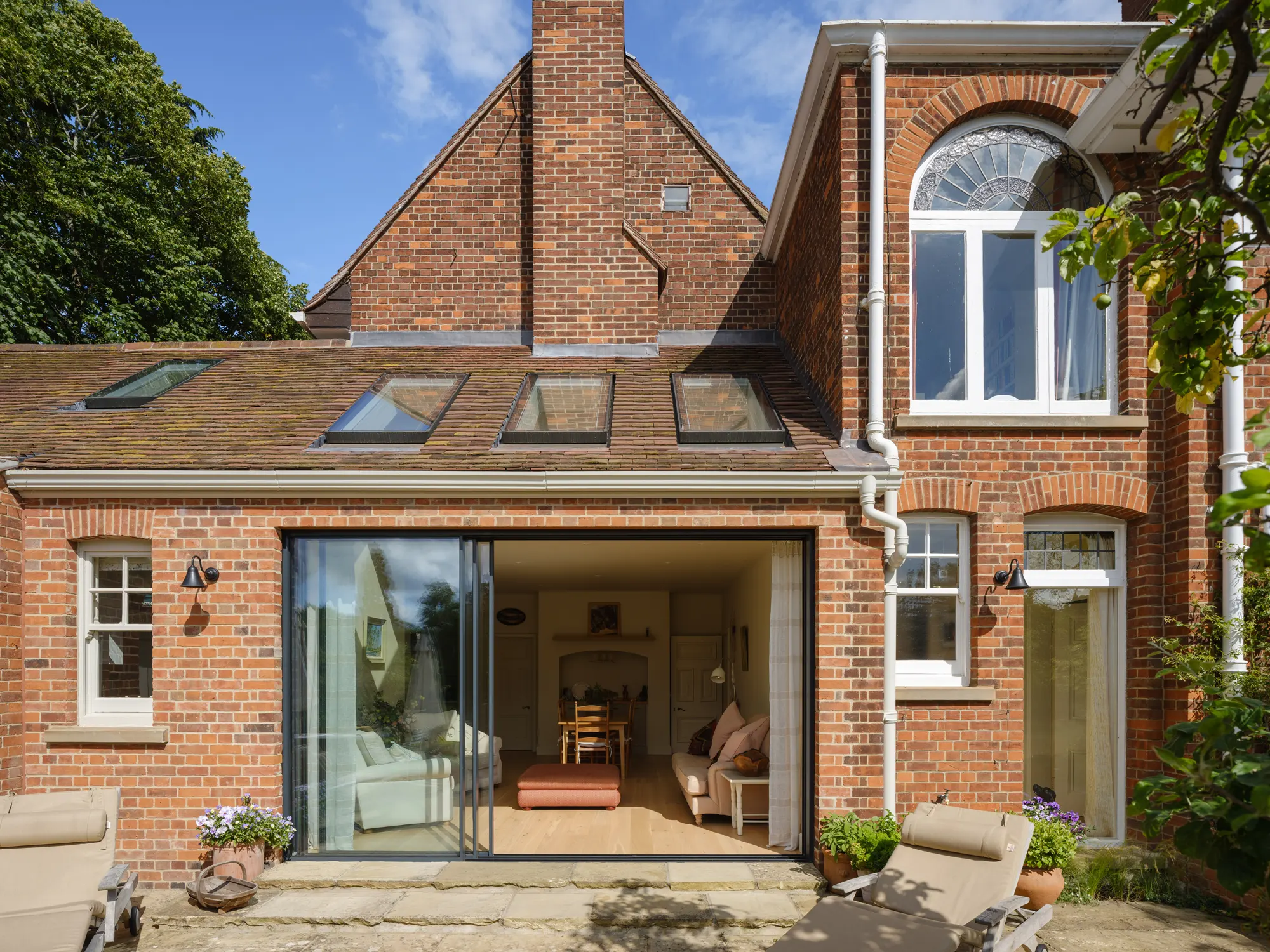
This Arts & Crafts house extension features a set of Kloeber’s aluminium UberSlide sliding doors. The doors allow daylight to flood the interiors, with slim sightlines and a sleek design with no visible handles. At the time of specification, the doors cost a total of £11,000 + VAT. Photo: Matthew Smith Photography
Which colour options are available when specifying sliding patio doors?
These days, most sliding door suppliers offer a wide range of RAL colours as standard. “If you want a different one, it’s not likely to affect the price much,” says Craig. RAL is a colour-matching system that enables quality assurance over the hue of powder coatings and timber finishes for doors, windows and various other products. PVCu products are generally more limited in colour choice.
If you want something more unusual, or to switch to a dual colour system (one hue outside, another inside) this may add some cost – but it depends on the supplier and the product. For instance, with an alu-clad timber sliding door, you’ve already got two construction materials, so you’d need two different finishes anyway.
“On aluminium sliding doors where you need two profiles coated separately, and then rolled together with a thermal break in the middle, there would be an extra cost for going dual-colour,” says Dan. Again, it’s system-specific, but as a ballpark, you might budget around £600 per door panel to have different finishes inside and out on an aluminium slider.
Typical cost to upgrade to solar control glass: Expect an uplift of about 5%-6%
How much should you budegt for ironmongery & locking systems?
With most sliding doors, you can expect a single handle option, albeit with a choice of colours (such as the ability to match the frame). Certain models don’t have any handles at all. “Some of our sliding doors are designed with an even cleaner look in mind. Take Kloeber‘s UberSlide, for example – the locking system is concealed within the frame and electronically controlled, so there’s no need for traditional handles interrupting those uninterrupted glass lines,” says Dan.
With Kloeber’s lift-and-slide doors, you can opt for a simple external cup handle, keeping the lever handle and locking mechanism inside the home for added security. If you’d like the flexibility to unlock and operate the door from the garden, that’s possible too. “It’s all about balancing design, practicality and the way you want your home to function,” says Dan.
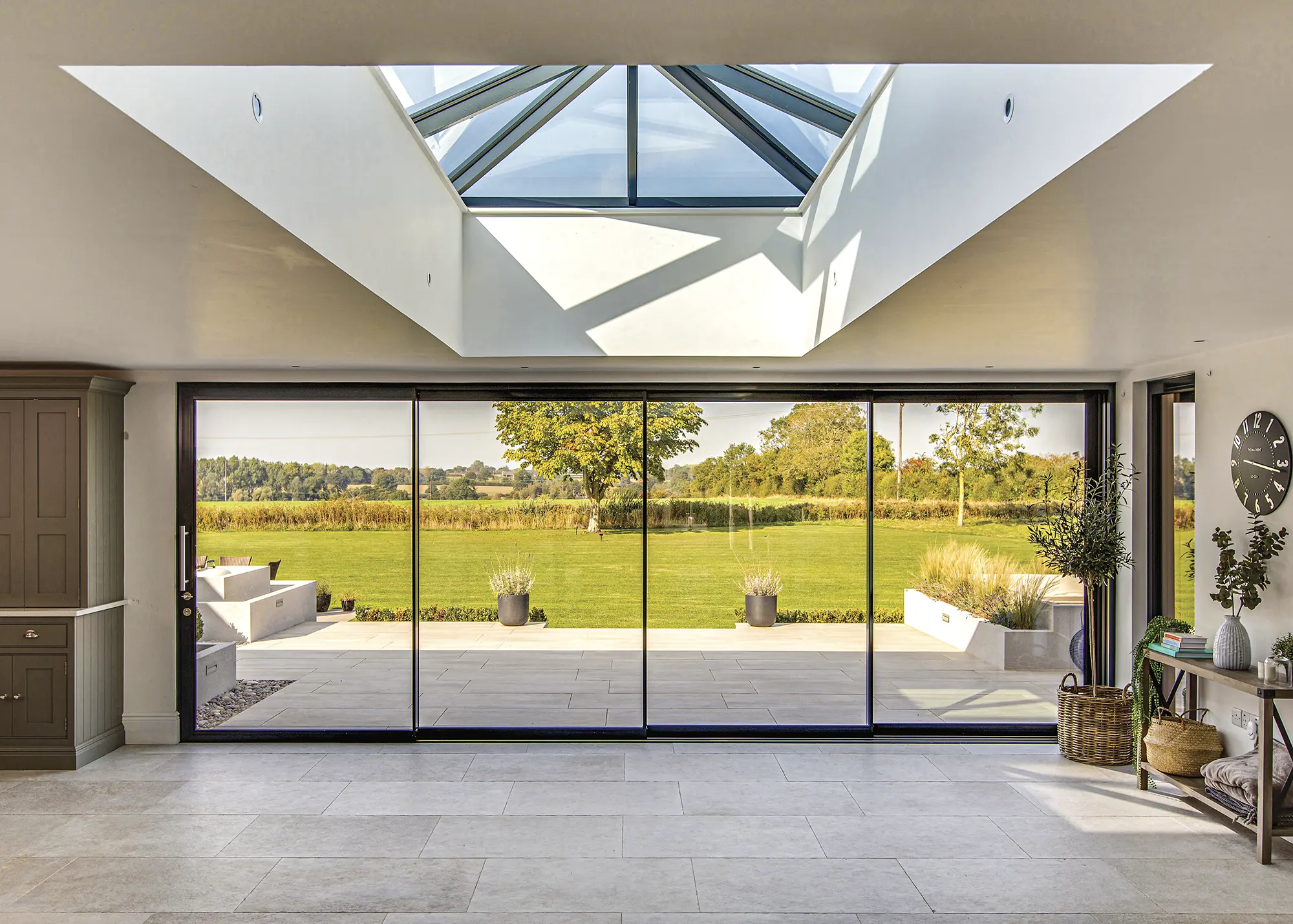
To maximise the opening, this four-panel set of IDSystems‘ theEDGE2.0 doors features three sliding units that glide behind a fixed panel – perfectly framing countryside views from this rural Norfolk home. Measuring a total of 5,985mm (W) x 2,353mm (H) and finished in RAL 7016 anthracite grey matt, with stainless steel handles. Photo: Chris Taylor Photography
Security is an important factor for any door, and shouldn’t be overlooked when specifying sliding patio doors. On new builds, you’ll need a product that’s passed PAS 24 testing and complies with Part Q of the Building Regulations – which generally means a certified multi-point locking system and laminated glass.
While the same standard isn’t mandatory for house extensions or home renovations, it’s a sensible specification. Most sliding doors will have just one locking option, designed to suit that particular slider and make it as secure as possible.
Typical cost for external locking: £110
Do glazed sliding doors always require trickle vents?
Part F of the Building Regulations requires a sufficient rate of background ventilation to be achieved when installing new windows and doors, to preserve good air quality. If you’re building a new bespoke home to good standards of airtightness, then you’ll probably be installing a mechanical ventilation (MV) system to deal with the supply of fresh air. But MV is rare in renovation and extension projects – unless you’re undertaking a major eco home retrofit.
So, in most existing homes, the only way to meet Part F of the Regs is by adding trickle vents to provide that fresh supply of air. Incorporating these vents does cost more – expect to pay anything between £200 and £600 per panel – as the frame will need adjustment. What’s more, not all systems can accommodate them. “We’re hearing of more and more projects that fail building control inspection, because the system that’s been installed isn’t capable of incorporating a trickle vent,” says David.
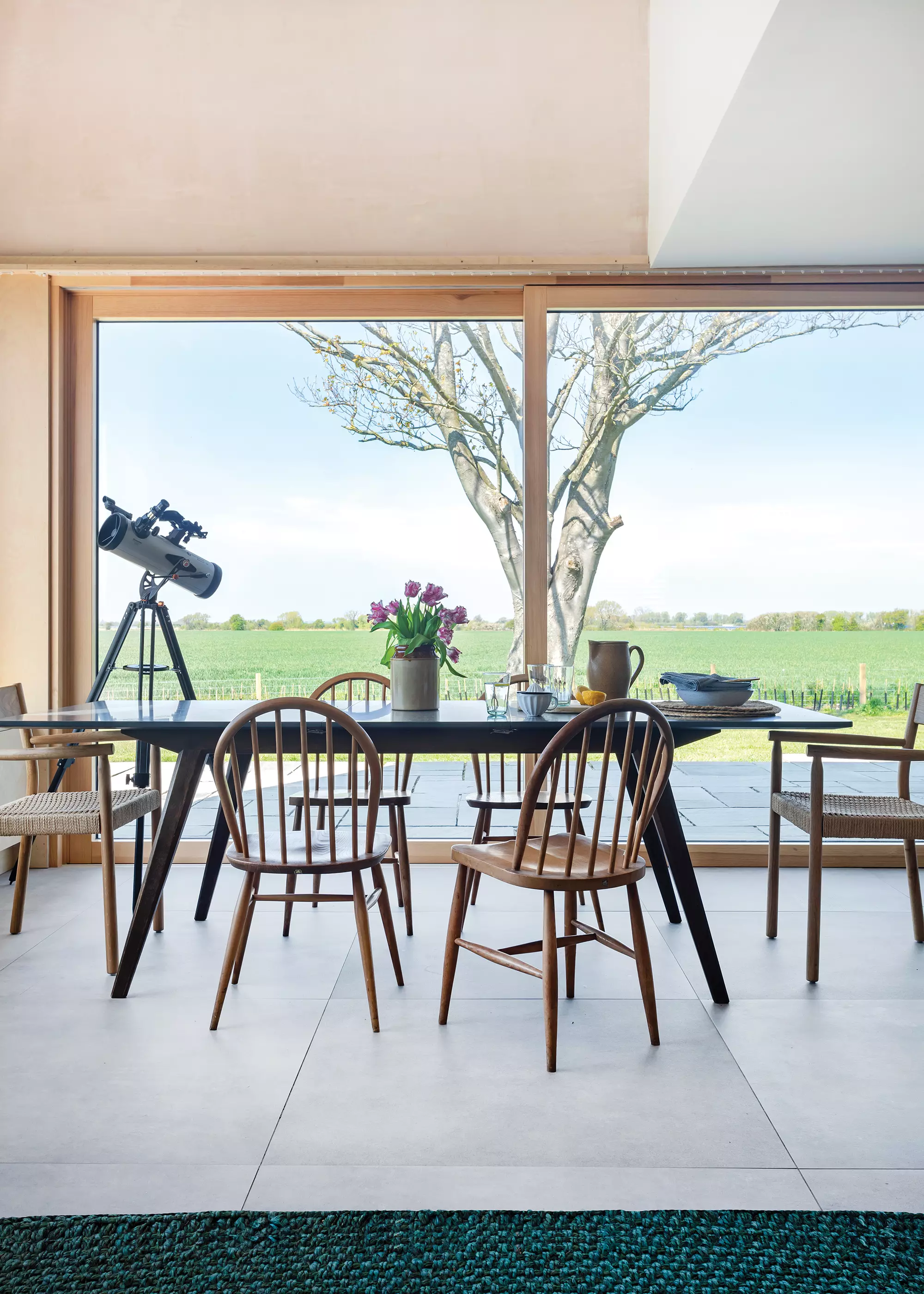
While living in a tiny cabin on the family farm, Freddie and Katie Pack saved up to build a stunning contemporary and efficient house on a farmland plot a few fields away. The home features sliding doors from Norrsken, which provide spectacular countryside views. Photo: Richard Gadsby
Many homeowners are put off by the aesthetics of trickle vents. “They don’t look great, and the last thing you want is to put a hole through a high-performance window,” says Craig. “Controlled mechanical ventilation is the best way of doing it and won’t spoil the look or efficiency of your doors. But if the project needs trickle vents, we’ll do them.”
Typical cost for trickle vents: £200-£600 per door panel, depending on the system
Does this glazing system require structural reinforcements?
Any structural opening that’s holding up weight (walls, roof etc) will need some kind of lintel above to support those loads. That generally means fitting a steel I-beam – also commonly known as an RSJ (rolled steel joist) – across the top of the opening. A sliding patio door system isn’t designed to do this job, though it will be specified to accommodate any anticipated deflection over the steel’s lifetime.
The wider the span of the aperture, the chunkier that beam will be and the more it will cost. If you’re building a new home or extension, this will be part of the structural engineer’s work and priced into the whole project. You’ll need to do the same if you’re fitting new doors into an existing wall – so be sure this is factored into your costs.
This grade II listed cottage in Kent has been transformed with a new kitchen extension, complete with a set of wow-factor sliding patio doors from Minima Sliding, and connected to the main house via a glass link
Open corners, with beautiful glass-to-glass sliding doors, are a popular trend for new homes and extensions. But the structural implications here are even more significant. “The minute you take out that corner section, you need even more structure, such as an upright steel post inside the building or cantilevered steelwork,” says Craig.
Many homeowners aspire to a level threshold between indoors and out. Bear in mind this will have an impact on the price of your system and how it’s installed. “The door itself would be basically the same, but we might need to specify different types of cill, drainage or add-ons to the frame to suit the threshold and paving type,” says Dan. These elements can’t be accurately priced until the design details are finalised.
How much do sliding patio doors cost in 2026?
These are indicative costs for various sizes of sliding door systems. We’ve not attempted to compare the exact specifications of each door in this table, as it would be too much information.
So, be aware that you should always seek project-specific quotes, and prices will depend on factors such as thermal performance, glazing spec, locking mechanisms, threshold type etc. Nevertheless, the information below should give you a good yardstick for planning your budget.
| System | Supplier | Size (w x h) | Configuration | Supply price (double-glazed) | Supply price (triple-glazed) |
|---|---|---|---|---|---|
| Visiline (aluminium bonded) | Ecohaus (2025 cost) | 3,500mm x 2,200mm | 2 panel double track | £3,300 + VAT | £5,800 + VAT |
| Lift and slide (aluminium) | Kloeber | 4,000mm x 2,200mm | 2 panel (1 sliding, 1 fixed) | £5,385 + VAT | £6,315 + VAT |
| theEDGE2.0 (aluminium part-bonded) | IDSystems | 4,000mm x 2,200mm | 3 or 4 panels | £8,350 + VAT * | n/a |
| theEDGE2.0 (aluminium part-bonded) | IDSystems | 4,000mm x 2,200mm | 2 panel | £8,915 + VAT * | n/a |
| SF80 (aluminium – dry glazed) | Sunflex | 4,000mm x 2,200mm | 3 panel | n/a | £13,650 + VAT * |
| SF80 (aluminium – dry glazed) | Sunflex | 4,000mm x 2,200mm | 2 panel | n/a | £14,050 + VAT * |
| Visiline (aluminium bonded) | Ecohaus (2025 cost) | 5,500mm x 2,200mm | 3 panel triple track | £5,900 + VAT | £10,200 + VAT |
| theEDGE2.0 (aluminium part-bonded) | IDSystems | 6,000mm x 2,200mm | 3 or 4 panel | £11,365 + VAT * | n/a |
| theEDGE2.0 (aluminium part-bonded) | IDSystems | 6,000mm x 2,200mm | 2 panel | £12,660 + VAT * | n/a |
| SF80 (aluminium – dry glazed) | Sunflex | 6,000mm x 2,200mm | 3 panel | n/a | £18,250 + VAT * |
| SF80 (aluminium – dry glazed) | Sunflex | 6,000mm x 2,200mm | 2 panel | n/a | £20,445 + VAT * |
| Lift and Slide (aluminium) | Kloeber | 8,000mm x 2,200mm | 4 panel (2 sliding, 2 fixed) | £11,840 + VAT | £13,795 + VAT |
*includes fitting
How much does it cost to install sliding patio doors?
Many sliding patio door specialists operate on a supply-and-install basis, which gives you the added confidence that a single company is responsible for measuring, manufacturing and installing the system. You can, of course, ask your builder to do the job – but just be sure they have the appropriate credentials and that any warranties will still be valid.
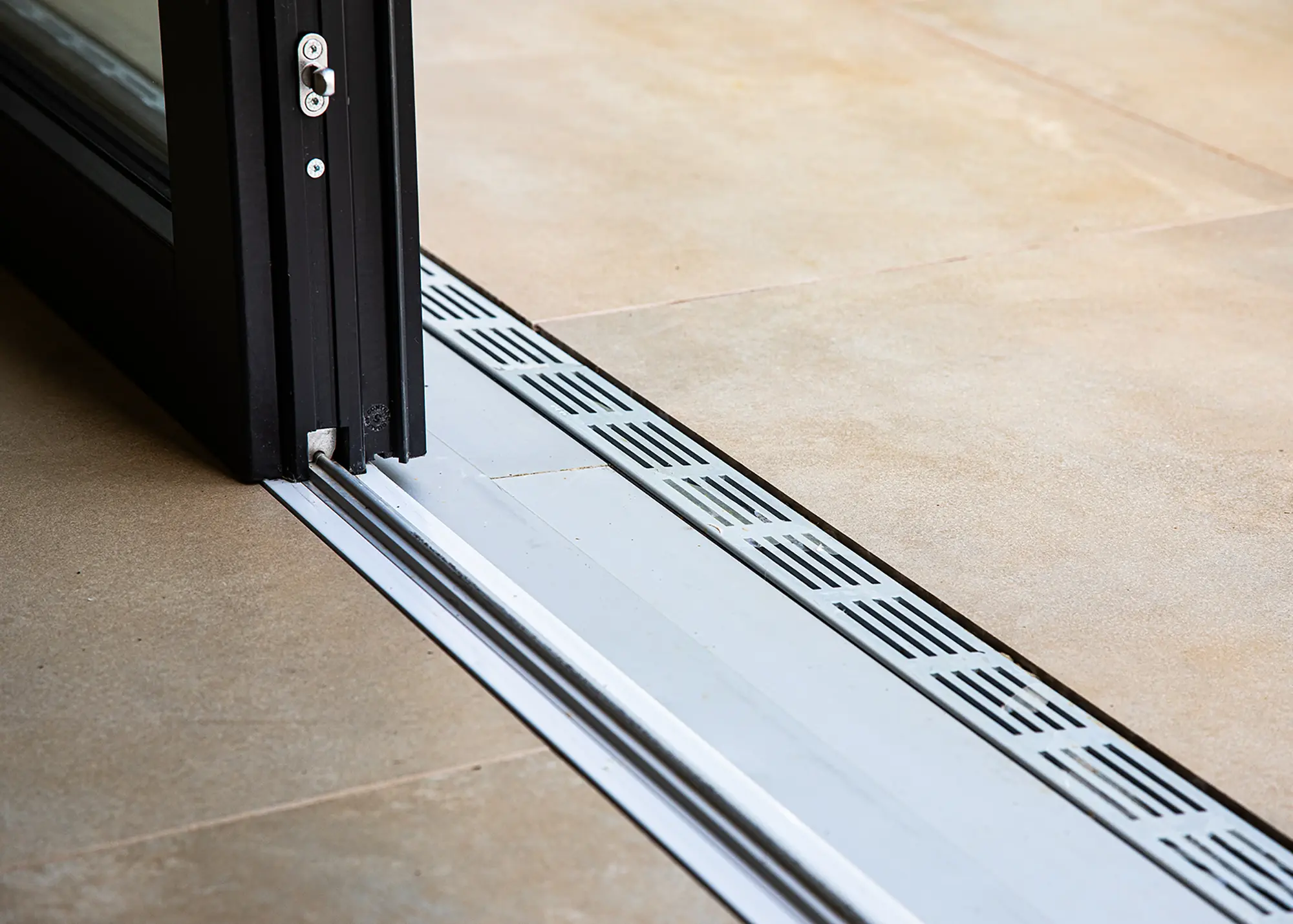
Norrsken’s lift and slide triple glazed alu-clad sliders have been integrated with a level threshold in this home
For a standard two-panel, 4m-wide sliding door system that doesn’t require mechanical lifting equipment, your sliding patio doors should take around a day to install, at a cost of around £800-£1,000 (where you are in the country may affect prices). This is a more detailed job than fitting a straightforward window; with sliders, everything needs to be perfectly level and properly integrated to ensure the panels continue to perform as expected in the long term.
Installation costs will go up if you’re dealing with large or heavy door panels, which may require lifting machinery. In some cases, this can tip the balance away from supersized panels towards fewer, smaller doors. “For large installs, we partner with a specialist company that provides a risk assessment, a lifting plan, and lifts those particular panels for us,” says Dan. “Handling big weights manually is dangerous for the worker and could be expensive if the unit’s dropped. If there’s a cheap installation cost and an extremely heavy door, that’s something I’d be worried about.”
Sliding door FAQs
What’s the whole-door U-value & what does this mean for system performance?
It reflects the performance of the entire system. Some quote centre-pane figures, which measure only the glass. The frame, seals and threshold all affect thermal performance. A door achieving a U-value of 0.75 W/m²K as a complete unit performs very differently from one where only the glazing hits that number.
How will the door be supported at the threshold?
This is a question for your architect or structural engineer. Large sliding doors are heavy – at Norrsken, ours can exceed 500kg. The opening needs adequate structural support beneath, designed to avoid thermal bridging that would compromise performance. This conversation should happen early, not be improvised on site. We see projects where details get made up on the fly, creating delays and additional costs that proper planning would have avoided.
Who takes responsibility for weathering and airtightness when installing the sliding door?
The junction between door frame and building structure is critical. Poor detailing here can cause unwanted draughts, water ingress and long-term problems. Clarify upfront whether your glazing supplier, builder or installer owns this detail, and ensure someone genuinely qualified to do so is specifying it.
Chris Batesmith
You may be interested in
Our sponsors