

- Plan ItBack
- Design ItBack
- Build ItBack
- Homes
- ProductsBack
- CostsBack
- Self Build Cost Calculator
Estimate your project costs instantly with Build It's interactive self-build cost calculator
Calculate Now - Costs & Finance
- Contracts & Warranties
- Build It Estimating Service
Get an accurate, detailed cost breakdown of your project
Submit plans
- EventsBack














































 Login/register to save Article for later
Creating a Sustainable Kitchen – Key Considerations for an Eco-Friendly Cooking Space

Kitchens are probably the most resource-intensive room in the house to kit-out and use. They’re also the spaces we update and change most often, in part due to wear and tear. So, to reduce environmental impact, it’s important to get them right first time and give them as long a life as possible. If you just fancy a new kitchen every five years to keep up with the latest trends, it may be best to stop reading now!
Here, I’m taking a look at the different factors that will contribute to creating a sustainable, eco friendly kitchen – from worktop materials to flooring, water use and more.
Specifying eco materials for a kitchen – how can you make your design more sustainable?
The most significant environmental impact of a kitchen comes as a result of the materials we use to construct and furnish it. Here’s some alternative spec solutions:
Kitchen cabinets
These are conventionally made from melamine-faced chipboard (MFC), which contains formaldehyde and can therefore off-gas VOCs – although low-formaldehyde versions (rated E0 or E1) are avaliable. Chipboard often contains high recycled content, and like most timber boards can be at least partially recycled at end of life. Melamine is more difficult to recycle, but not impossible.
Plywood is another option for kitchen carcassing. Low-formaldehyde versions using FSC-certified wood are available, and it’s more durable and resistant that chipboard or MDF. Marine-grade ply is particularly resistant to water, which could be an advantage close to taps (sadly, leaks do occur in kitchens occasionally).
Some manufacturers have developed solutions that move away from conventional materials – including the Puustelli’s zero-formaldehyde bioframe system.
Eco-friendly worktops
Kitchen countertops are another example of an item where composite materials are commonly used. Instead of laminate, consider natural stone or solid wood for worktops.
Much stone is imported, of course, so this adds to embodied energy. It may, however, still be lower than alternative materials and, importantly, it will last much longer. They will need periodic sealing for protection.
Solid timber will need to be sustainably sourced, but as a worktop it has a warmth and beauty that’s hard to beat. Aim to use coatings that are both durable and eco-friendly.
Made using natural materials, porcelain is a highly durable option offering an excellent service life. The material is fired at high temperatures, so has a fairly high emodied energy, but it doesn’t require chemical sealants.
Sustainable flooring materials
Flooring is a big-ticket item in kitchens. Many self builders and extenders will opt for stone or tiled floors, with underfloor heating and insulation built in from the start. If you’re refurbishing an existing kitchen, you could use other eco materials, such as cork or renewable solid timber, such as bamboo. Laminates based on ply rather than MDF are an option, too.
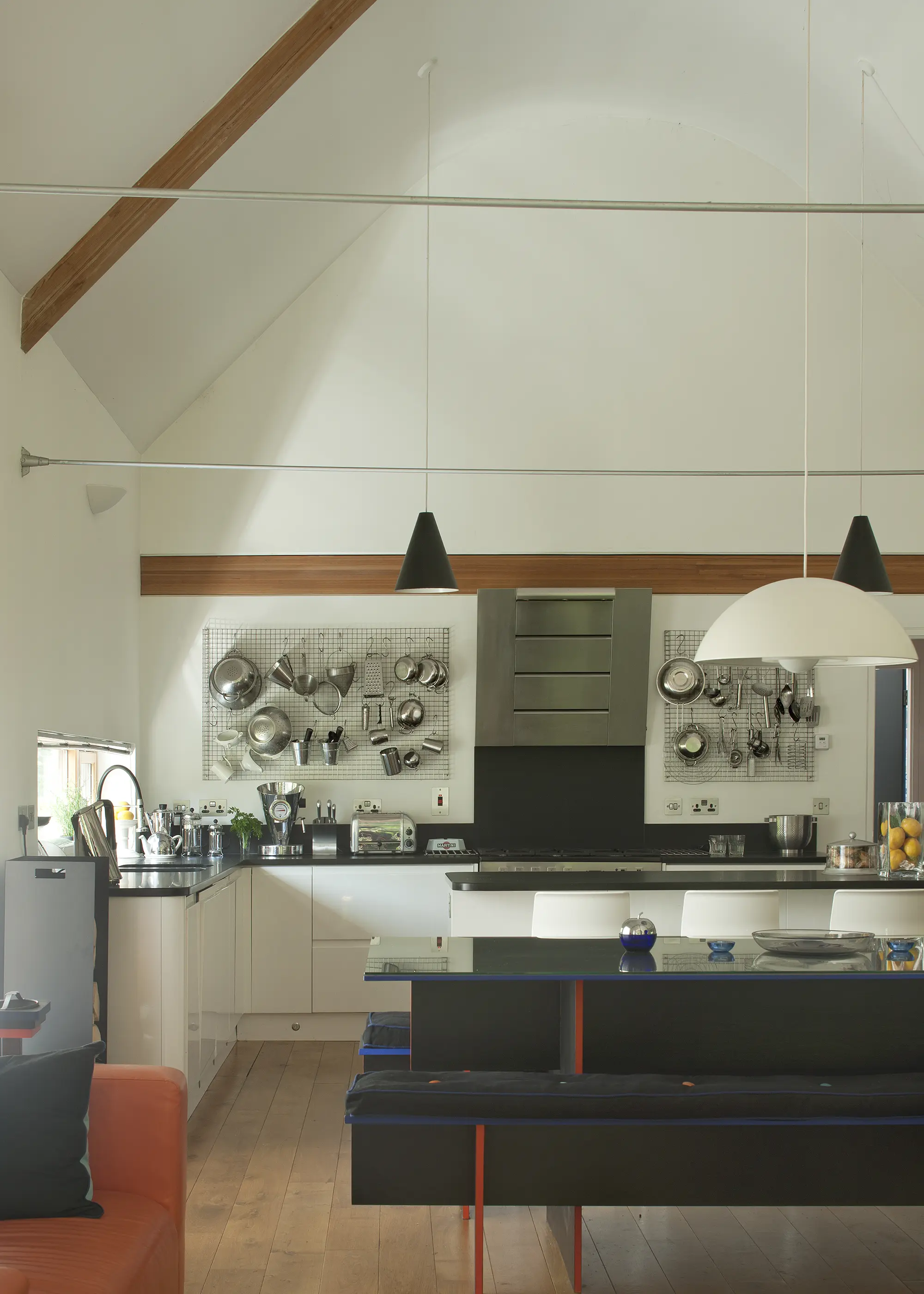
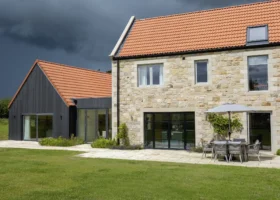
Build It readers Susan and John Shearer knocked down their old holiday cottage and replaced it with an ultra-energy-efficient build packed with architectural wow factor. They laid Russwood’s oak flooring throughout, with an Osmo oil coating for a satin finish. Photo: David Barbour
Don’t overlook natural linoleum – it’s made from linseed oil, unlike most modern versions, which are plastic-based and derived from fossil fuels. If you’re fitting wall or floor tiles, you may prefer to use adhesives that are non-toxic and solvent-free. Do note, however, that some adhesives sold as being eco-friendly are genuinely natural, while others are a blend of polymers and sustainable materials.
Freestanding furniture
This is worth considering. It’s perfectly possible to create a functional and beautiful kitchen using ‘separates’. In other words, forget the conventional built-in kitchen units and invest in individual pieces of furniture – a dresser with drawers for cutlery, wall-hung cabinets for glassware, a larder cupboard, open-fronted storage for pots and pans, topped with solid beech work surfaces, and of course tables and kitchen islands.
The separates approach means a different cleaning regime. However, it gives you much greater freedom to choose and enjoy quality items of furniture (including second-hand items), which mean something individually to you. Kitchens built like this never wear out – individual items get replaced from time-to-time; but all-in-all, it’s a much more sustainable approach.
Go second-hand
Buying a used kitchen (whether pre-installed or ex-display) can be a great way to save money – especially if you can pick up a pre-loved designer range at a bargain price. It also means you’re reusing materials and reducing environmental impact.
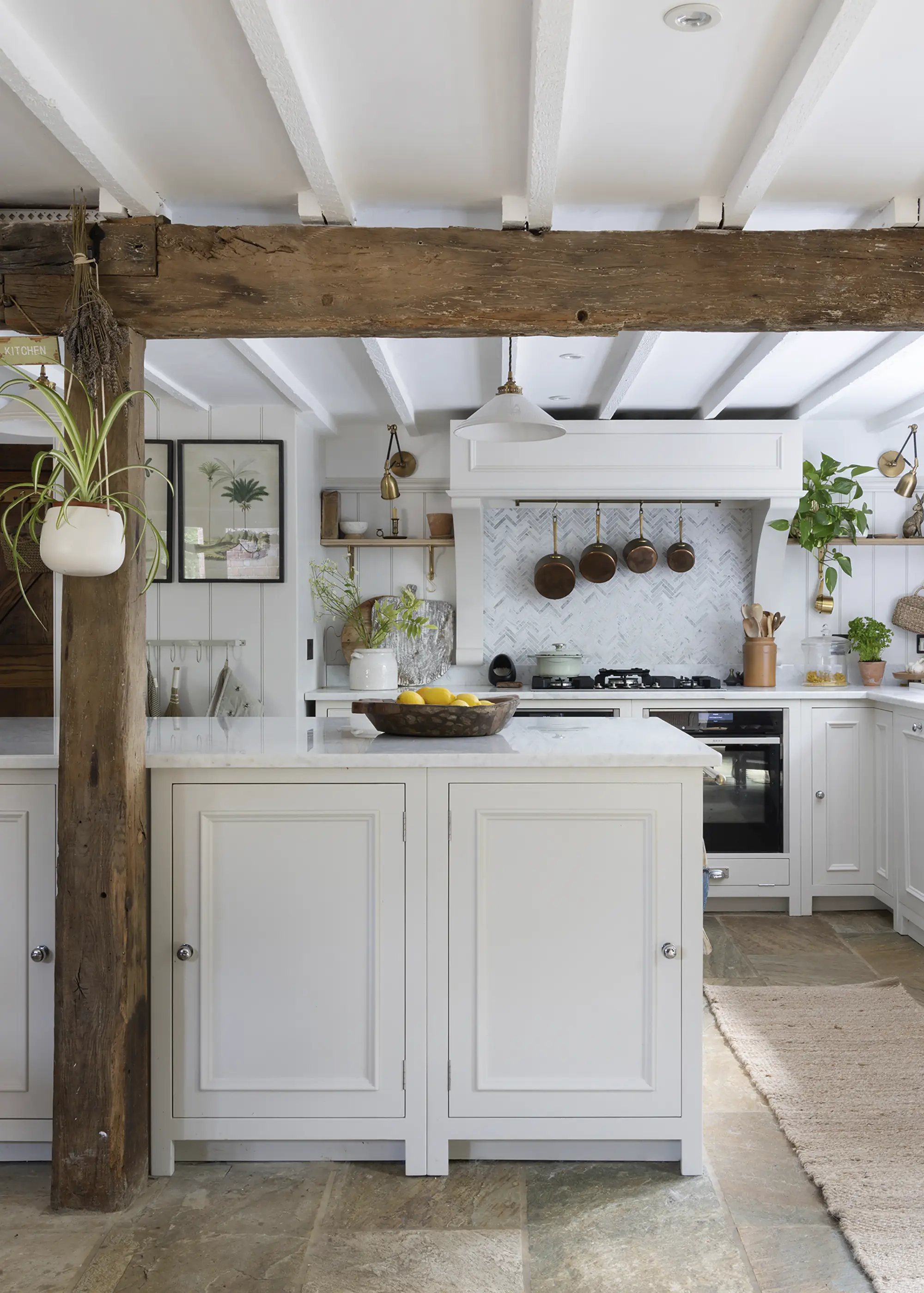
This preloved Neptune kitchen has been reinstalled in its new home and repainted using Neptune Shell paint. All the kitchen cabinetry, appliances, double sink, taps and marble work tops were from Rehome
However, you’ll need to bear in mind you will inevitably need some adjustments and additions made – plus you’ll probably still want to buy new flooring, kitchen appliances etc.
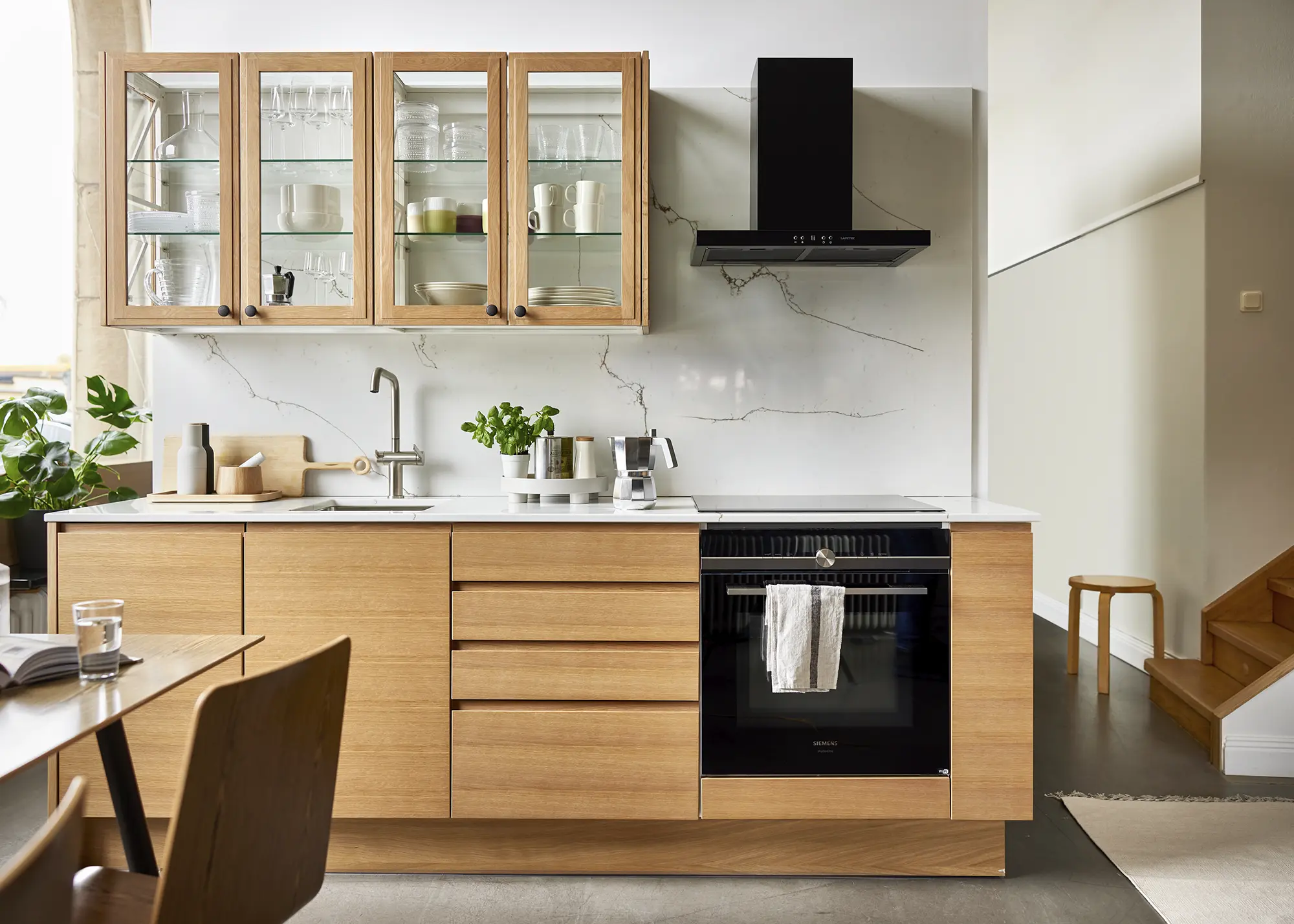
CASE STUDY Sustainable kitchen designSome kitchen suppliers are actively working to make their products more eco-friendly by using low-carbon, non-toxic materials and finishes. A case in point is the Puustelli Miinus range, available from Sustique, which only features products that have minimal environmental impact.
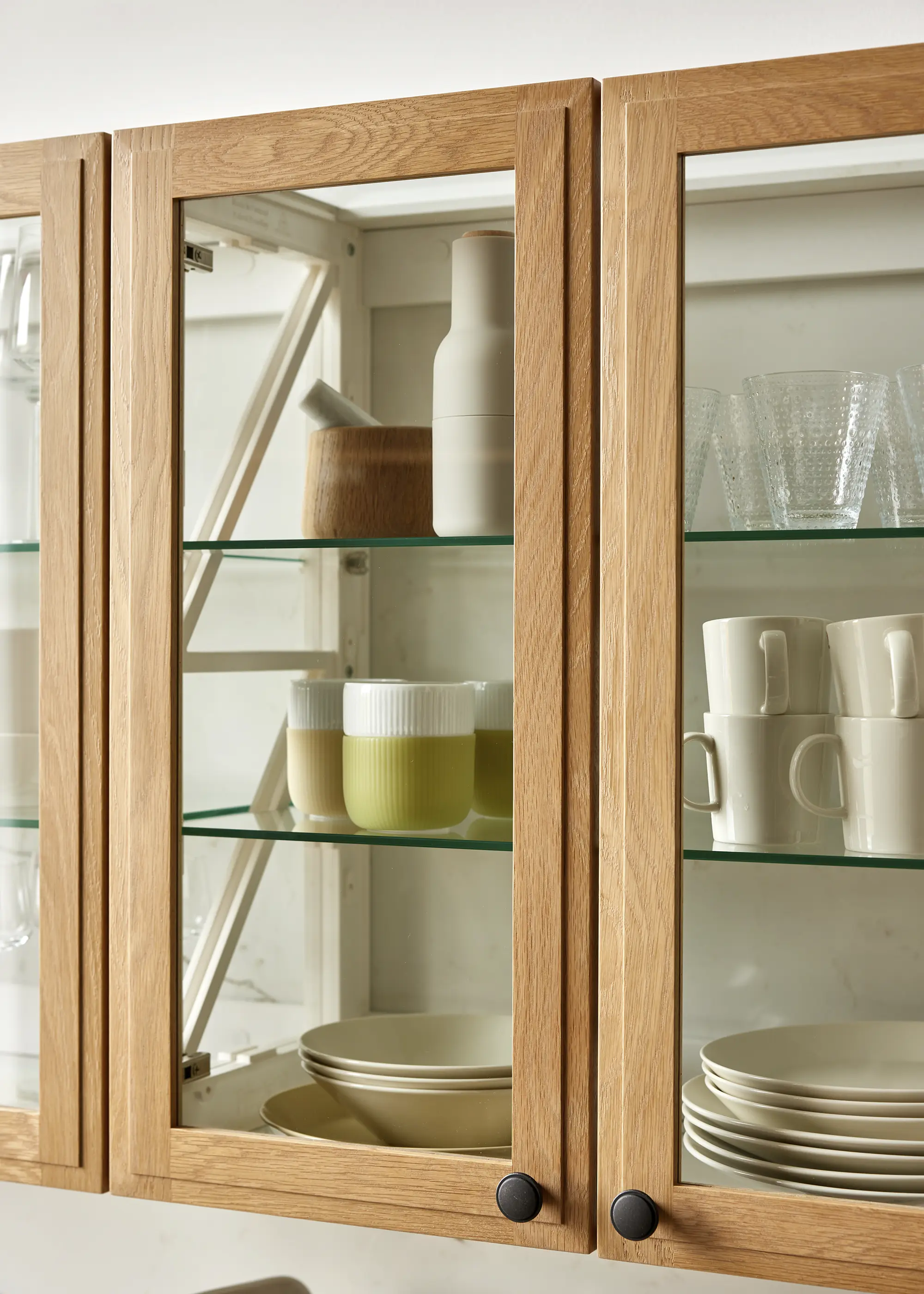
Rather than conventional carcassing, these kitchens are made with biocomposite frames that are waterproof, emit zero VOCs, recyclable and use 50% less material than standard cabinets. What’s more, the frames have a lifespan of over 75 years, so they can be reused many times.
Shown here is the Oak J-Pull kitchen, which features linen biocomposite frames, oak veneer doors, oak-and-glass cabinet doors, porcelain worktop and splashback, and A+ rated appliances. This specific design would cost £11,801 + VAT. |
Making sustainable upgrades to an existing kitchen
If you already have a fitted kitchen, you can sometimes upgrade it cost-effectively and give it a completely new look and feel without spending (or costing) the earth. In many cases, for instance, the carcassing for the wall and floor cabinets can be retained, with new doors and countertops fitted to achieve a fresh finish.
You should always budget to redo the tiles when using this approach – replacing worktops often disturbs them. This also gives you the opportunity to make alterations to power outlets and task lighting (or to add accent lighting), as well as updating a strong visual element of the kitchen.
Why is indoor air quality & ventilation so important in the kitchen?
When it comes to considering sustainability, many people’s first thoughts are about energy use – but I’d suggest that we always ought to begin with human health. Food hygiene is, of course, essential. Yet we also need to consider air pollution in kitchens.
When gas is burned it gives off CO2 and water, both of which adversely impact air quality. Steam leads to condensation, which can result in mould growth, while high CO2 levels can cause various kinds of health problems. Electric hobs don’t cause the same air pollution as gas hobs, plus they’re easier and quicker to clean (though I’ve never mastered them).
The answer to both these issues is ventilation, and plenty of it. Purge ventilation can be achieved simply by opening the windows, but extract ventilation is also required in all wet rooms – ie kitchens and bathrooms. This should be controlled by humidity and CO2 sensors, with a manual override to boost extraction when needed.
How can you can create an energy efficient kitchen zone?
We tend to focus on finding the best-rated low-energy kitchen appliances when thinking about this aspect of kitting out a kitchen. But the way we use our white goods is just as important, and can have a very significant overall impact. Here are just a few ways that our behaviour can affect how much energy we consume in the kitchen:
- Pots boil much more quickly on the hob if they’re wearing lids.
- Fridge doors frequently get left open longer than needed.
- Defrosting items in the fridge (if done well ahead of time) can help it run more efficiently. You can also save energy when defrosting by using the room’s ambient temperature or putting smaller items in a pan of warm water, rather than using the microwave.
- If you’re using the oven, could it cook (or heat) more than one thing?
- Fill the kettle with just a little more than the water you need (and of course above the minimum line), rather than all the way up. After pouring the water out, refill with at least a cupful so that the heat dissipates to the liquid rather than to the room. This means if you boil it again soon, you’ll be starting with warmer water.
Choosing energy-efficient appliances
Energy can of course be saved by careful selection of appliances and choosing energy-efficient options. Induction hobs are more efficient than ceramic versions, for instance, while it stands to reason that a one-cup kettle will use less energy to boil a single mugful of water than a kettle that can cater for seven cups.
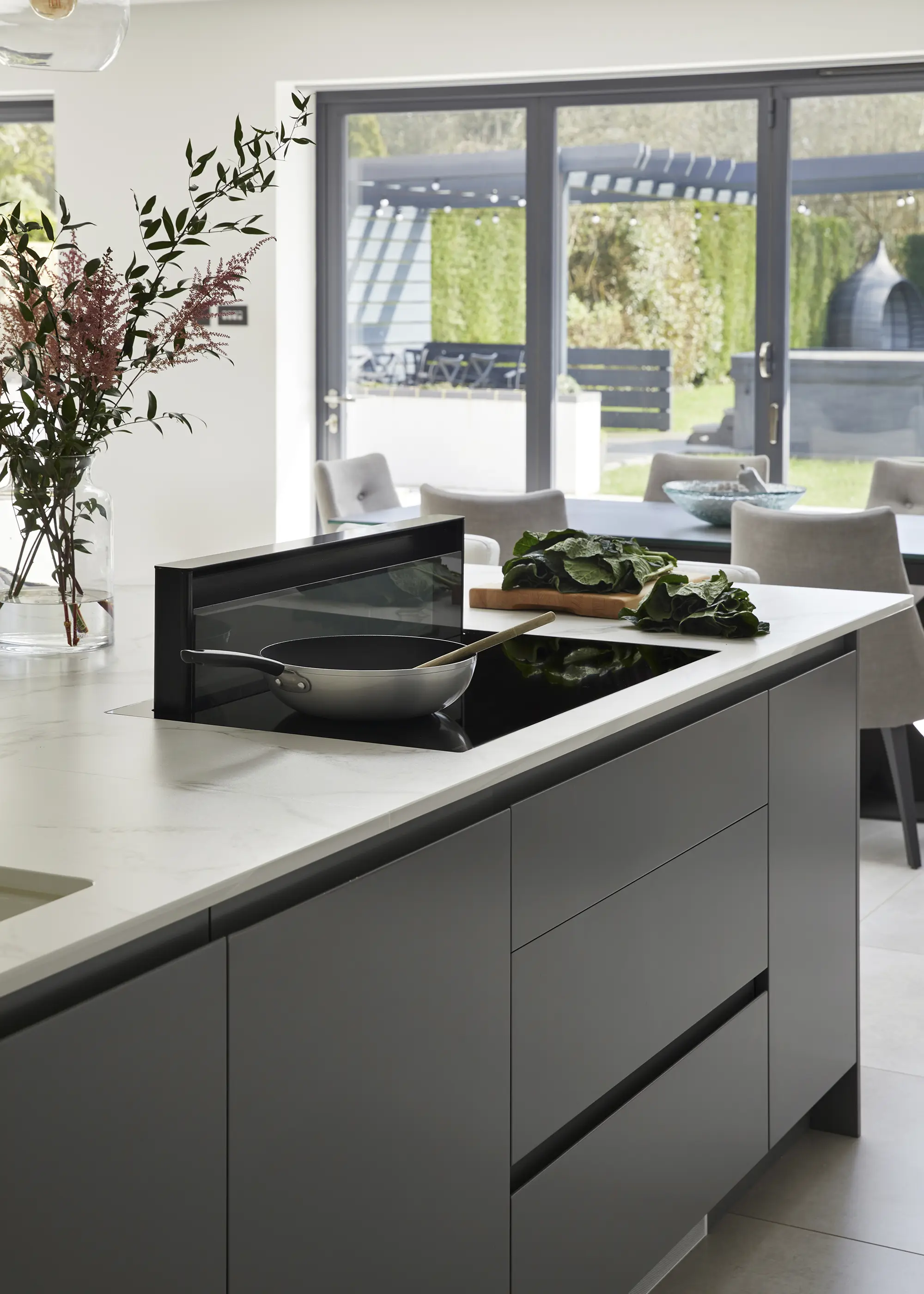
The Panorama Pro 90 by Novy is a powerful four-zone induction hob with integrated down-draft extractor
The latest dishwashers use less energy than older models, and a microwave will cook a baked potato more quickly and efficiently than you can manage in an oven, albeit the skin won’t be as crispy.
Will a boiling water tap help you save energy?
More recently, boiling water taps have been gaining popularity. It is true that these taps use significantly less energy to boil small amounts of water than a kettle. They’re not cheap, however, and it would take a long time for any savings to repay this.
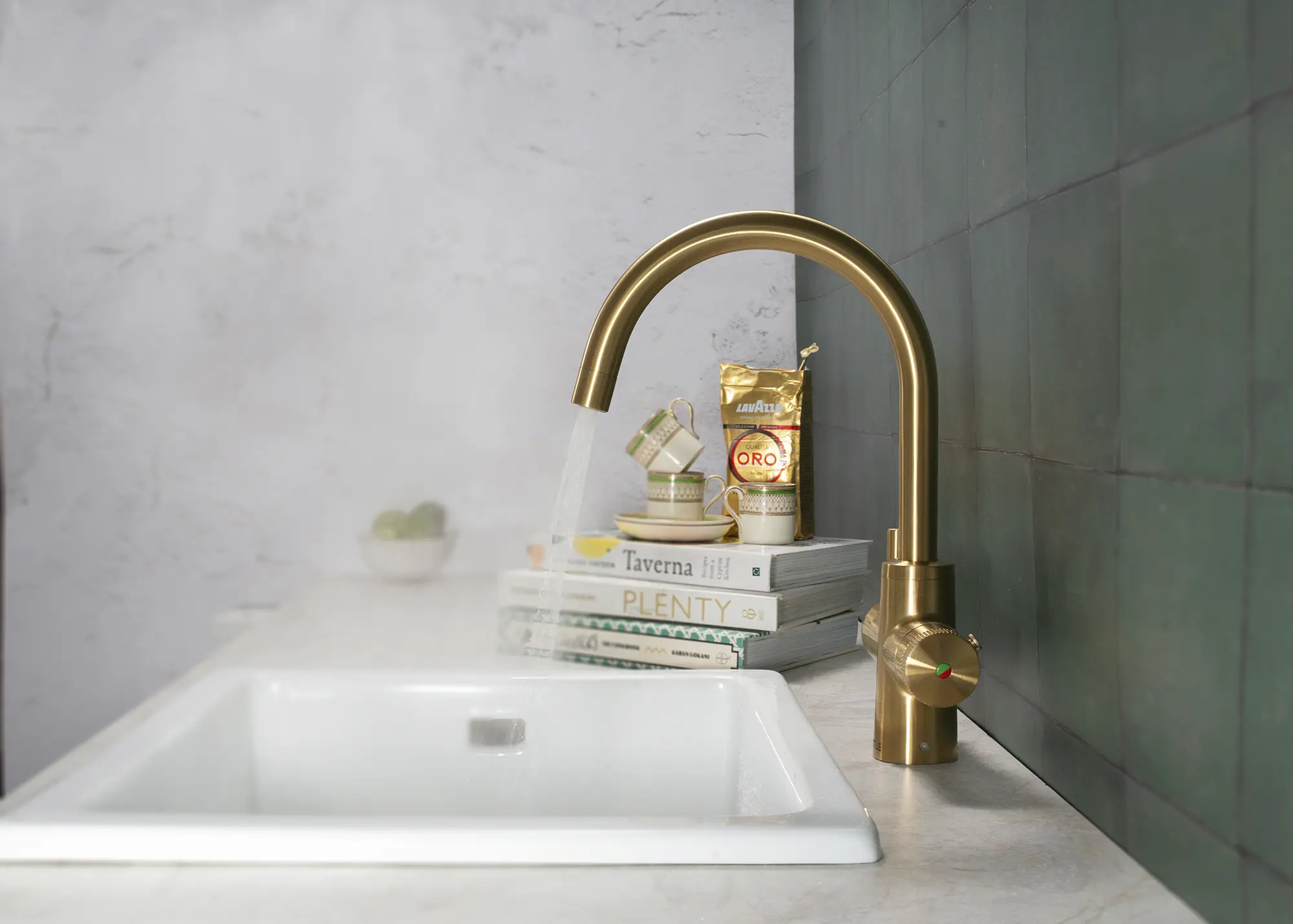
Qettle Original is a 4-in-1 tap that dispenses boiling water, filtered drinking water, plus normal hot and cold to save energy versus a standard kettle
Some versions offer the convenience of boiling, hot, cold and filtered water all from a single tap. Just remember that, whenever you are spending money on new consumer durables, you’re using resources as well as energy – so there is a balance to be struck.
How will lighting impact a kitchen’s energy efficiency?
Lighting is another important area to consider in your eco kitchen. Well-directed task lighting may be more efficient than high-output centralised fittings, but the best light of all is daylight. If you are building new or carrying out extensive renovations, do what you can to maximise natural brightness in the kitchen, such as by introducing rooflights where possible.
FAQs
How can you find the right kitchen supplier & when should I bring them on board?
Bring a kitchen designer on board during the architectural planning stage of your project. While this may seem early, assembling a team of experts in the initial stages will ensure good collaboration and a cohesive approach to the design.
An architect can plan a kitchen as part of their drawings, but a kitchen specialist will suggest ways the layout can enhance the property’s features or come up with ideas to change door and window placement to better suit cabinetry configuration.
How big should your kitchen counters and units be?
Always leave at least a metre of walkway space between runs of units, such as your worktop and island or peninsula counters. Kitchen counters and island heights typically match. The UK standard is 91cm from the floor, but bespoke options can be made to meet specific measurements. Standard appliances are 60cm in width and 60cm deep. Small-space versions are typically around 45cm, while larger appliances, such as range cookers and American-style fridge-freezers, can go beyond a metre. Bespoke kitchens can be designed to accommodate these models.
The standard worktop depth is 60cm, but this can vary greatly depending on the design and placement. You’ll typically see a standard thickness of 4cm. If you want a statement ultra-thin or ultra-thick option, they go either end of the scale, with 12mm as the slimmest option available. Islands should be a minimum 900mm deep for practicality, 1,200-1,500mm is ideal. The length depends on the space.
How much space do I need for a kitchen island?
When planning a kitchen island, allow at least one metre of clearance on all sides to ensure good flow and avoid cramped layouts. It’s also important to consider size – anything smaller than 2m x 1m may not offer enough storage or prep space to justify the investment. If the island feels squeezed into your kitchen plan, it probably doesn’t belong there. Instead, focus on creating a layout that supports functionality, rather than forcing an island into a space that can’t accommodate it comfortably.
How can I decide on a kitchen layout?
When deciding on a kitchen layout, it’s important to remember that you need to be able to move quickly in the main workspace – the area between the cooker, fridge and sink. This is often referred to as the ‘working triangle’ and will form the basis of your layout. The total walking distance between the points should be between 5-7m. Any less will feel cramped, any more is a waste of space. Based on the working triangle, there are four main options to choose from, including: galley, island, U-shaped and L-shaped.
Who should install my kitchen?
It’s wise to engage a specialist. Recommendations are a great starting point when trying to find the right service. Ask friends and family or online forums, research local businesses, read reviews and search directories such as Checkatrade, as well as those from trade bodies such as the KBSA and BIKBBI, where members are subject to a stringent vetting processes. The British Institute of Kitchen, Bedroom & Bathroom Installation (BIKBBI) recommends Protect My Install, which bridges the gap between you and the installer and provides recourse should anything go wrong.
Nigel Griffiths
You may be interested in