Learn more about permitted development with our next online training course!
June 30th at 7PM - use code BUILD for 20% off
BOOK YOUR SLOT HEREJune 30th at 7PM - use code BUILD for 20% off
BOOK YOUR SLOT HEREEstimate your project costs instantly with Build It's interactive self-build cost calculator
Calculate NowGet an accurate, detailed cost breakdown of your project
Submit plans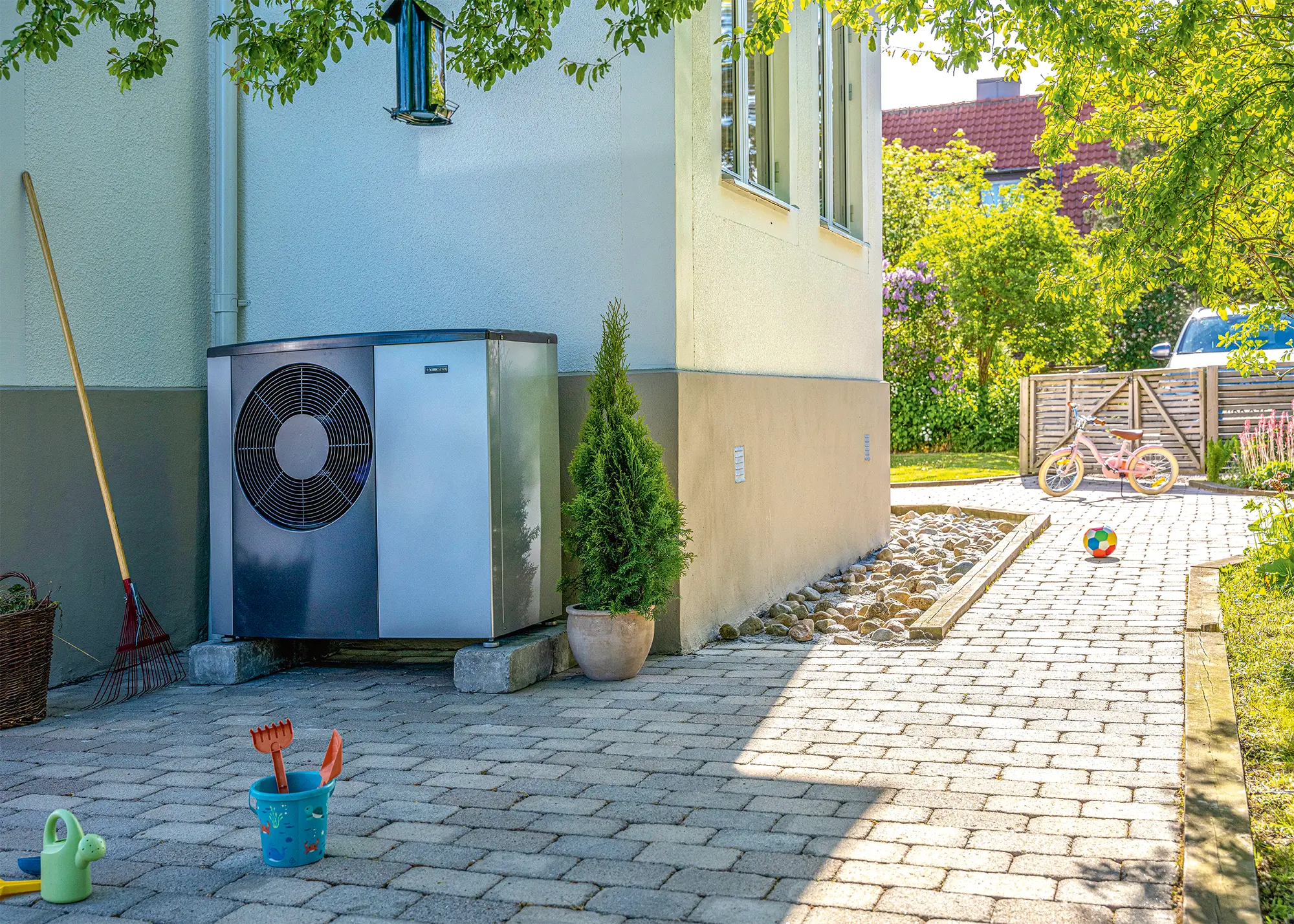

Heat pumps promise savings on both CO2 and heating bills. They work most efficiently at lower flow temperatures, which is why they’re usually best in well-insulated homes with underfloor heating or oversized radiators – but not every property is an obvious fit for that approach. A high temperature heat pump can help address some of the challenges, though it does come with compromises. So, is it right for you?
Unlike boilers, heat pumps don’t burn a fuel – instead, they use electricity to move heat from one place to another. In the process, they can achieve efficiencies of over 400%, meaning that for every unit of electricity consumed, four units of heat are delivered to the home heating system.
Heat pumps are named after their energy source: air source heat pumps draw this from the ambient air, while ground source heat pumps use buried pipework. Efficiency depends on the gap between the source temperature and required flow temperature – the smaller the better.
If the source is 10°C and the required flow temperature is 35°C, a heat pump system might deliver around 400% efficiency. If the source falls to -5°C and flow rises to 55°C, that could drop nearer 200%. These are indicative figures and vary considerably depending on the exact heat pump, compressor type, refrigerant and flow rate.
Most heat pump systems are designed to warm the home at a low temperature over long periods. The lower and slower the heat, the more efficient it is. But not all homes and distribution systems suit this approach. Some require much higher temperatures, especially when reheating the space or during colder weather. Different refrigerants, or combinations of them, can tolerate greater compression than others, enabling some heat pumps to reach those higher temperatures.
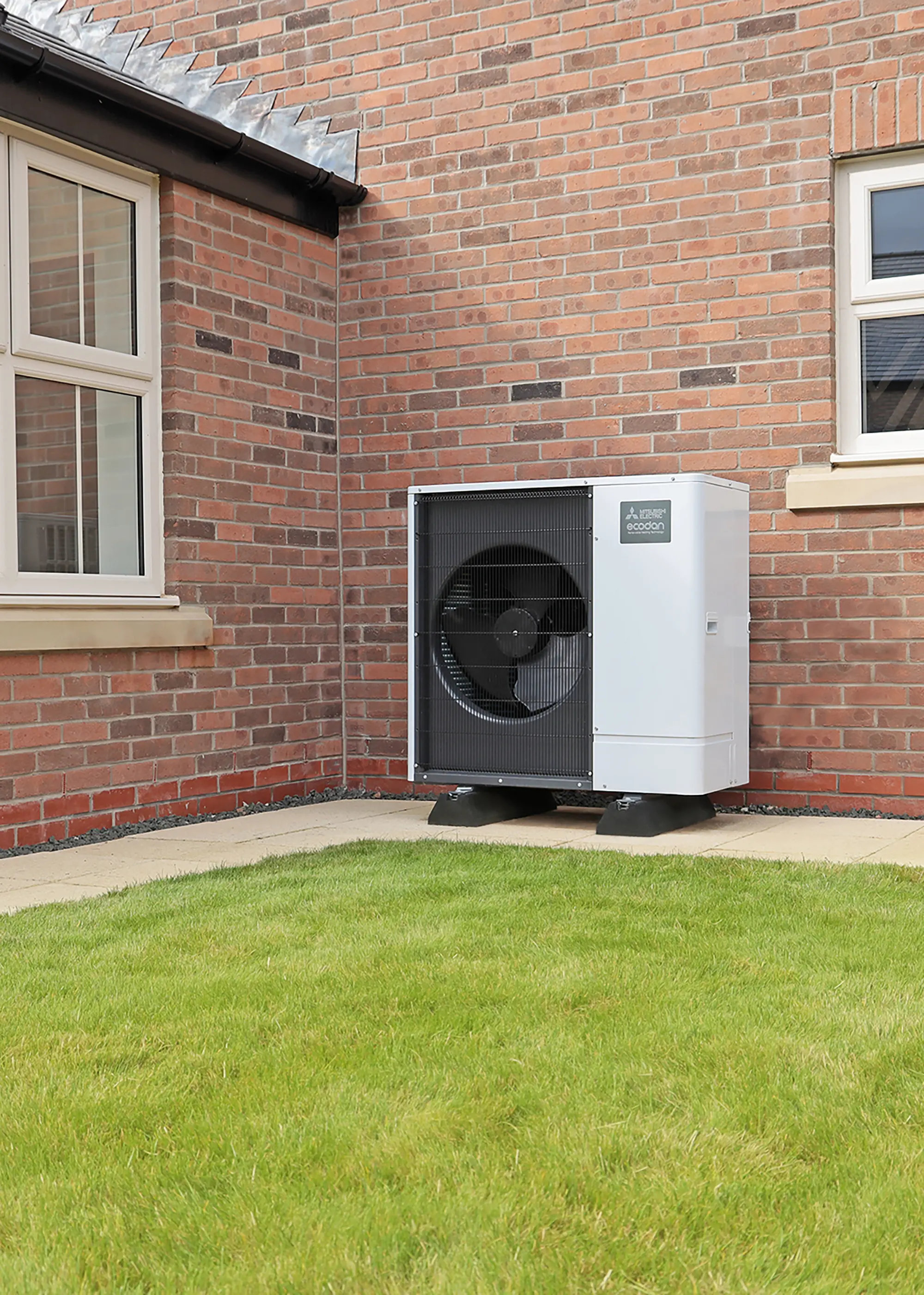
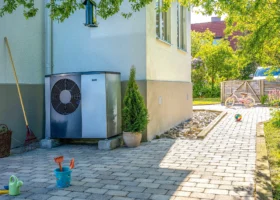
Available in outputs from 5kW to 12kW, Mitsubishi’s Ecodan monobloc is an R290 air source heat pump with a maximum flow temperature of 75°C, making it suitable for use with existing radiators
One important distinction: higher temperature simply means heat transfers into the water more quickly; it does not mean more power. Reaching hotter temperatures takes more energy, so it’s transferred into the distribution system less efficiently. A heat pump using 3kW of electricity might deliver 12kW into the home at 400% efficiency; but only 9kW if it drops to 300%.
In practice, what matters is the central heating flow temperature the refrigerant circuit can achieve, rather than the domestic hot water circuit. Low temperature models typically produce this at up to 55°C; medium temperature versions sit around 65°C-70°C; while a high temperature heat pump hits 75°C-80°C or more.
Low temperature heat pumps were very common up until around 2020, when hydro fluorocarbon (HFC) refrigerants such as R410a were favoured. These blended refrigerants are very good at producing lower temperatures efficiently, but they can’t be compressed too much without the risk of destroying the gas.
What’s more, R410a and other HFC refrigerants have a high global warming potential (GWP), so they are being phased out. Many manufacturers first switched to R32, which is a single component capable of low-to-medium temperatures. However, it’s still an HFC and – while lower than R410a – its GWP is relatively high.
R290, refrigerant-grade propane, is now being widely adopted. It’s a single component and can be compressed to achieve 75°C – the lower end of the high temperature spectrum. It’s usually restricted to 65°C-70°C in domestic heat pumps, but there are some R290 heat pumps with a stated flow temperature range of up to 80°C.
The highest flow temperatures are typically achieved in two ways. One is to use a single refrigerant gas such as R744 (carbon dioxide), which can be compressed to reach 80°C and above. It’s quite energy intensive to get to these temperatures due to the extreme pressures required, so this is better suited to large heat pump systems with a constant high temperature demand.
While some manufacturers historically produced smaller CO2 heat pumps, generally marketed as a direct replacement in older properties with boiler-driven central heating systems, many models have been discontinued. So, they’re difficult to get hold of, expensive and generally challenging to design. CO2 heat pumps are also best suited to low-temperature climates, where high flow temperatures and consistent loads are required.
Another route is a cascade heat pump system that uses two different refrigerants, operating at different levels. One raises the temperature to around 50°C, while the second lifts it to around 80°C. This means neither refrigerant has to do the full temperature lift alone, and the second stage has a smaller gap to bridge.
The NIBE S2125 air source heat pump range is Quiet Mark certified for exceptionally low noise levels. It delivers a supply temperature of up to 75°C, reaching as high as 65°C even when outdoor conditions drop to -25°C
Cascade systems have been successfully deployed in homes since around 2009. When high temperatures are needed, they can deliver fairly efficiently – but do note that performance can suffer in milder weather. For properties with a consistent higher temperature requirement, they can be a good solution.
In practice, with so many manufacturers now focusing on R290 refrigerant, for most projects maximum flow temperatures are currently around 70°C-75°C – which is often sufficient to retain existing radiators. The highest temperatures are now typically reserved for commercial-grade heat pumps (with capacities starting from 30kW). You would need a very big and poorly-insulated house to be considering this size of system.
High temperature heat pumps have often been presented as a direct replacement for a boiler. Unfortunately, this doesn’t always work in practice, as the physics of the two technologies is very different.
Because it burns a fossil fuel, a boiler can deploy between 24kW and 45kW of heat into the circulating water. Most domestic heat pumps have a maximum energy delivery of between 12kW to 16kW. Critically, the amount of energy required to heat water is the same no matter the source, so a boiler will always do it faster than a heat pump.
If a home’s heat loss is less than around 12kW to 16kW and the central heating system is designed correctly, this does not need to be an issue. But bigger heat loads and instantaneous hot water are not currently possible with heat pump systems – not even high temperature ones.
Producing hot water for taps, showers etc has historically been a bit of a challenge with low temperature heat pumps. So, does the current crop of high temperature models do it better?
Heat pumps always need a hot water cylinder, as they lift the water temperature slowly as it circulates through the heat pump – just a few degrees at a time as it builds up to the target temperature. Traditionally, the water in a heat pump system’s cylinder would be heated to just over 50°C, which then needs to be boosted to 60°C+ once per week to kill legionella (usually with an electric immersion).
Medium and high temperature heat pumps deliver much hotter water in the cylinder (60°C+) without the need for a backup heater. So, if hot water demand is significant in your household, this can prove to be an important specification factor.































































































 Login/register to save Article for later