

- Plan ItBack
- Design ItBack
- Build ItBack
- Homes
- ProductsBack
- CostsBack
- Self Build Cost Calculator
Estimate your project costs instantly with Build It's interactive self-build cost calculator
Calculate Now - Costs & Finance
- Contracts & Warranties
- Build It Estimating Service
Get an accurate, detailed cost breakdown of your project
Submit plans
- EventsBack


































 Login/register to save Article for later
Plasterboard Alternatives for Eco Home Projects – An Expert Shares His Advice

Wall linings are one of the major components of a new build, representing around 5% of the embodied carbon and 3% of the total cost. After WW2, plasterboard began to be used for ceilings and stud walls, while masonry walls were still wet plastered. Nowadays, plasterboard is now almost universally used to line both timber-built structures and masonry walls – in the latter case fitted via the dot and dab method and commonly known as drywall. This was driven largely by the need to achieve speed of construction and reduce labour costs. As it’s such a significant part of a building, we should examine the eco credentials of plasterboard and have a look at the alternatives.
If you’ve taken any plasterboard to your local tip in the last 20 years, you’ll have found that it must be placed in its own special skip. This is because, if it is in contact with organic waste as it decays, it releases hydrogen sulphide – which is toxic, corrosive and explosive. Added to this, many local tips will charge you for its disposal and some may even refuse to take it. So that’s another reason to re-examine our use of this very standard product.
What are the performance benefits of plasterboard?
If you just want to line a wall quickly and cheaply, gypsum-based plasterboard is not a bad material. However, it has very little inherent strength and can’t hold up heavy items on the wall such as mirrors. If plasterboard gets wet it loses all its strength, swells up, deforms and must be replaced. Houses lined with plasterboard often look tatty after a few years as it’s not as tough or resilient as wet-applied plaster on solid masonry (or laths) and any significant knocks tend to produce cracks or holes, rather than a simple dent in solid plaster. Old-fashioned lath & plaster is easy to repair, but broken plasterboards mean that a much larger area has to be fixed.
It’s also important to understand that plasterboard is a vapour-closed product. In many situations this doesn’t matter, but in construction types which are designed to breathe, plasterboard interrupts the passage of moisture and can lead to build-up of dampness within the wall.
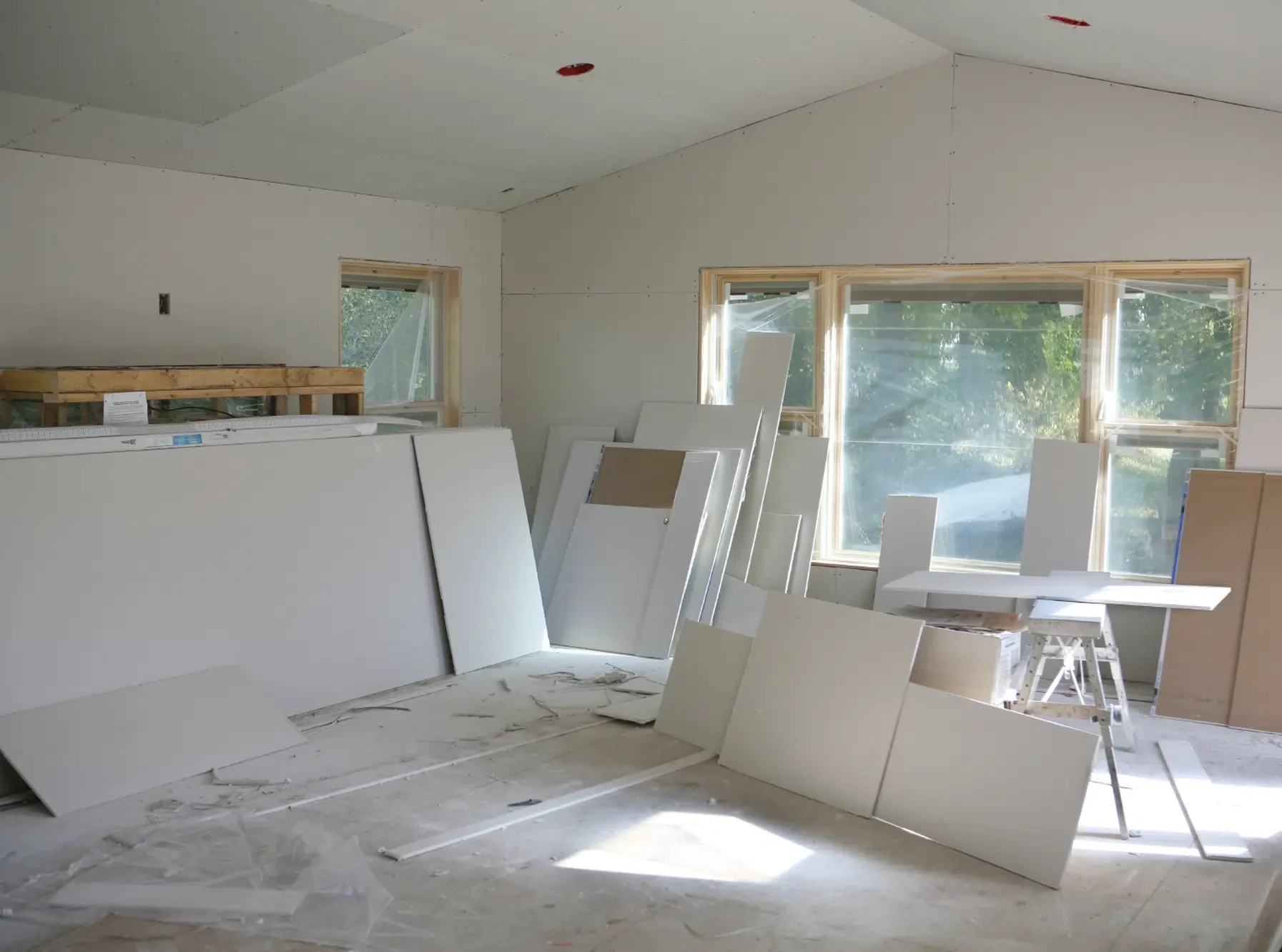
Photo: George Peters
In terms of source material, gypsum is plentiful and a significant proportion in plasterboard used to come from FGD gypsum – a by-product of coal-fired power stations. As these have been taken out of use, we have become increasingly reliant on virgin and recycled gypsum.
Natural gypsum is still mined in the UK but we also now import it from Spain, Morocco and the USA. The embodied CO2 of plasterboard is around 3.0kg/m². Given you might use 1,000m² of in a reasonably sized detached house, you can see how the embodied impact quickly stacks up (around three tonnes of CO2).
What are the best plasterboard alternatives to consider?
Alternative 1: Fibre-gypsum boards
The market leader in this area is Fermacell, which has been around since the 1970s and it puzzles me why it’s not used more. Knauf’s Vidiwall does much the same job as Fermacell but has a smaller market share. It’s made from a combination of gypsum and cellulose fibres from recycled paper. It’s available in a range of standard thicknesses from 9mm to 18mm and in the standard size of 1.2m x 2.4m (though other sizes can be produced to order). Most UK stock is made in the Netherlands.
Fermacell offers several advantages compared to standard plasterboard. One of the key benefits is that Fermacell is significantly stronger than plasterboard, particularly when it comes to fixings, making it better suited for supporting heavier loads. It is also more durable, with the ability to withstand a degree of wetting and drying without losing its integrity. In addition, Fermacell offers good acoustic performance, helping to reduce sound transmission between spaces.
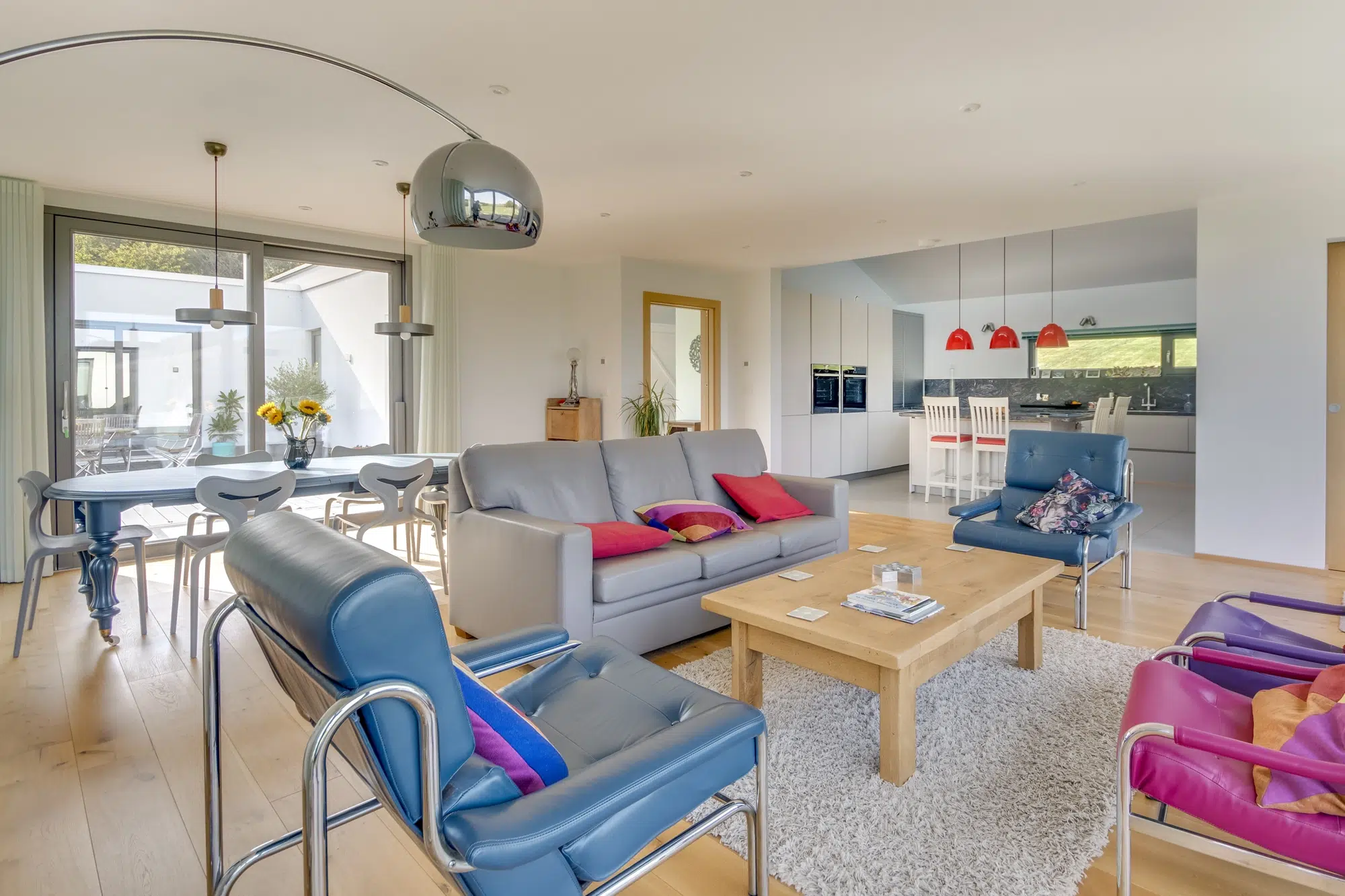
This cosy interior of a Meisterstueck-HAUS project in Dover was finished internally with 12.5mm Fermacell plasterboard
Its higher thermal mass is another advantage, as it can store and release heat, contributing to improved thermal comfort within a building. Finally, Fermacell is moisture permeable, which makes it especially well-suited to timber frame construction, where breathability of structural materials used is especially important.
However, there are some disadvantages to consider. Fermacell is heavier than standard plasterboard, although it is no weightier than equivalent acoustic boards. It is also more expensive than plasterboard, but if it is used in place of specialist acoustic boards or double layers of plasterboard, the overall cost is often broadly even. Another drawback is availability. Like many eco building products, Fermacell is not typically stocked by standard UK builders’ merchants, but it is readily available through specialist distributors located across the UK.
Fermacell can be finished with a standard gypsum skim, though this affects the vapour permeability of the structure and a primer is required as it doesn’t have the same paper skin that a plasterboard has. It’s much better to use Fermacell’s own fine surface treatment (FST) which can be applied by spray or trowel. For any waste board, the manufacturer offers a take-back service – the waste is crushed and made into new boards.
Alternative 2: Clay board
ClayTec clay board is a combination of clay, reed and hessian. One of the great advantages of clay as a wall lining is that it is not only breathable, but it can also absorb moisture and gradually release it, helping to regulate the internal environment. Like fibre-gypsum boards, its additional weight means that it can also store heat better than plasterboard, which helps to maintain a constant internal temperature, plus it’s an effective sound insulator. Clay has the added advantage that it can absorb odours, promoting healthy indoor air quality.
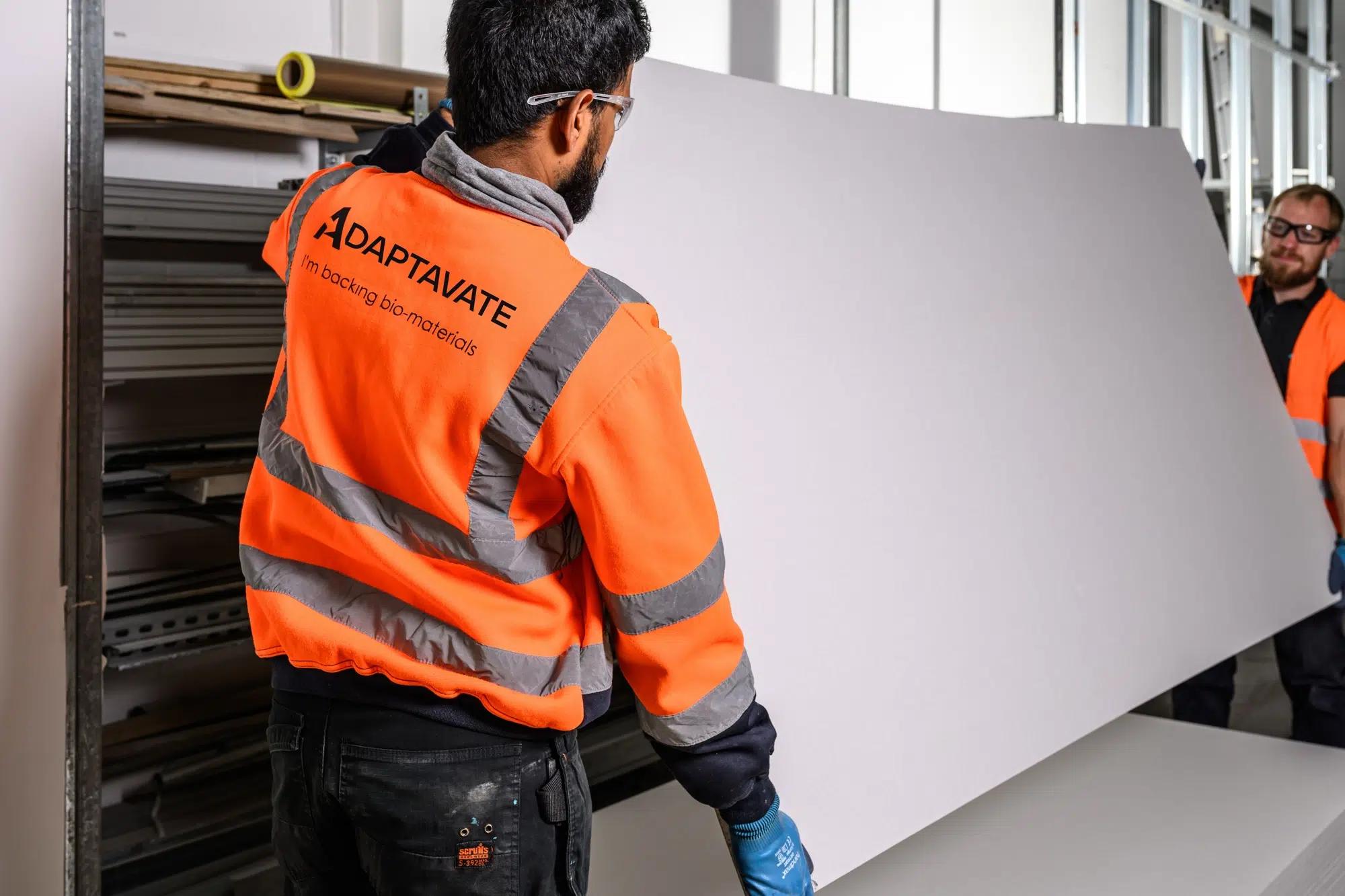
Highlighting the innovation that’s to come with eco plasterboards, Breathaboard by Adaptavate – currently in its pilot stage – is a carbon sequestering alternative that aims to save around 4kg of CO2/m²
Clay boards are mainly made in Germany – Claytec is not the only brand but is the most commonly imported into the UK. Standard thicknesses are 16mm and 22mm, though specialist boards are also available. The boards are finished with a clay plaster, either Claytec finishing plaster or Tierrafino for the skim coat – which will preserve the vapor-open character of the build.
If you’ve never experienced clay plaster, try to visit somewhere near you where it’s been used. It has a different feel compared to gypsum plaster and is warmer to the touch. I’ve also seen earth plasters finished with beeswax or other natural oils – they can be stunning and you’ll never need to paint.
Alternative 3: Other natural boards
Wood fibre boards have the great advantage that they lock up CO2 during the life of the building and are made from waste from forestry operations, so they can be considered a carbon-negative product. However, they’re not currently made in the UK and are significantly more expensive than Fermacell as an alternative to plasterboard. Eco-builders will already be familiar with thicker and softer wood fibre boards used as insulation, but these boards are designed to be direct alternatives to plasterboard – manufacturers include Gutex, Steico and Pavatex.
Usually available in 20mm thicknesses and upwards, they are able to be skimmed with lime or clay to preserve their breathable characteristics. There are also much thinner boards available, such as Steico Multicover (12/15/18mm) – note that these are dense boards more like MDF, but without the formaldehyde.
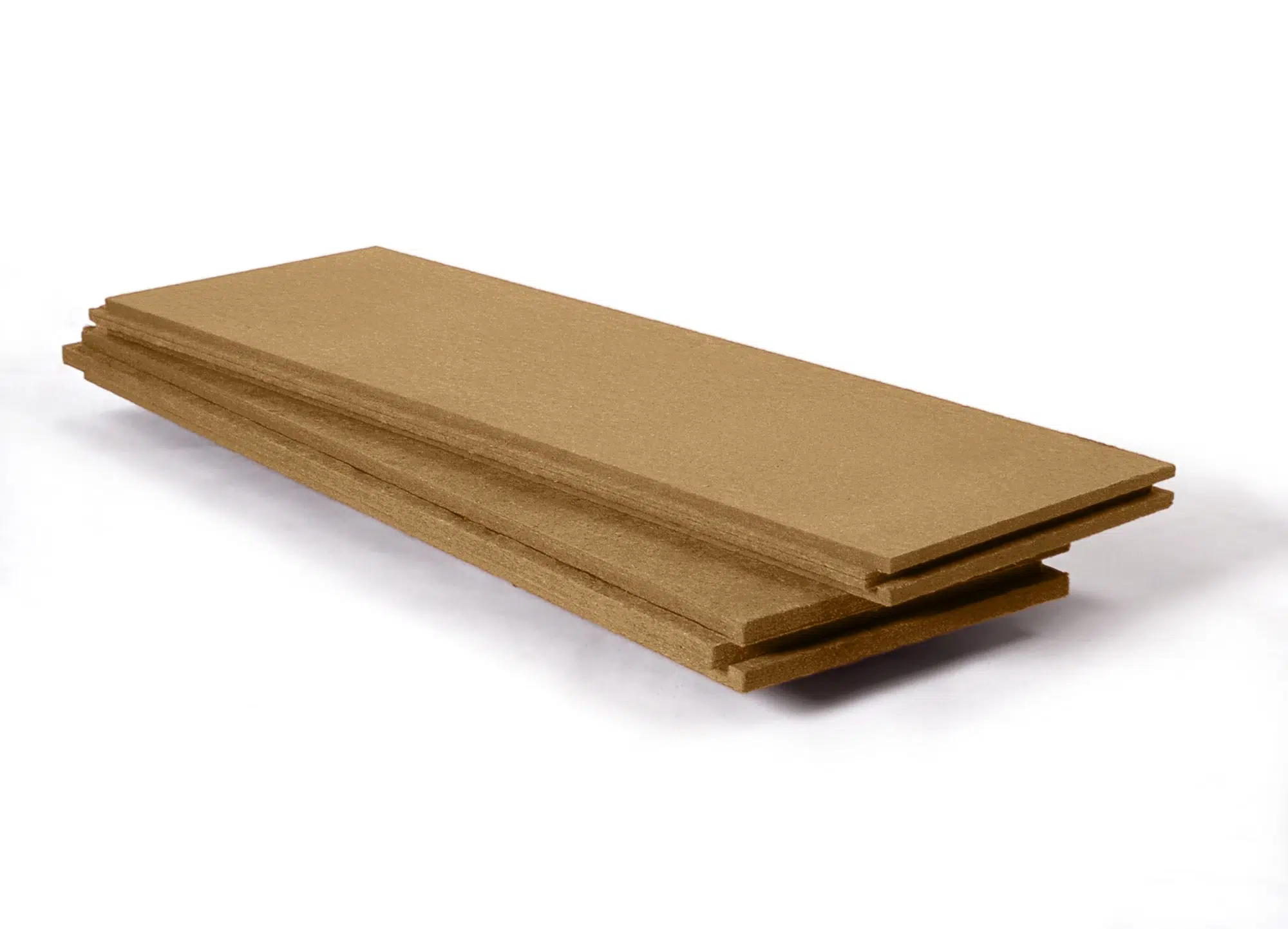
This wood fibre internal insulation board by Steico (from Mike Wye) is made from responsible forested wood and is PEFC certified. It offers natural moisture management to help regulate indoor air quality
Really keen eco-builders may also want to check out strawboard and hemp board. Strawboard is super-sustainable as it is bound together with natural lignins (similar to OSB). So, it’s fully compostable and carbon negative, and is available in thicknesses ranging from 15mm to 40mm. Like all natural products it is vapour-open, so is ideal for use with timber frame or other eco-construction methods. It can be finished with clay or lime plaster. Hemp boards are made from hemp waste and held together with lime, so still very low in embodied energy/carbon but thicker than strawboard, whist offering excellent fire resistance due to the lime content.
Lastly, don’t forget timber-based sheet materials, such as OSB and plywood. Plenty of utility rooms, workshops and the like are lined with plywood – it has the advantage of being tough and not needing any skim over the top – ideal for the DIY builder. For internal rooms, just cover joints with a hardwood strip. Many people like the appearance of plywood, which can be enhanced with stains or waxes/oils to create a durable and natural finish.
What are the key differences between the plasterboard alternatives?
| Material | Typical thickness | Embodied carbon (kg CO2e/m²) | Cost per m² | Recyclability | Fire resistance |
|---|---|---|---|---|---|
| Gypsum plasterboard | 12.5mm | 1.8-2.5 | £2-£4 | Recycling rates low | A2-s1,d0 |
| Fibre-gypsum | 12.5-15mm | 3.0-4.5 | £10-£14 | At manufacturer | A2-s1,d0 |
| Wood-fibre | 20-40mm | -4 to +0.5 | £18-£40 | Compostable | D - E |
| Clay | 16-22mm | 0.5-1.0 | £15-£28 | Biodegradable | A1 |
| Strawboard | 15-40mm | -2 to +0.5 | £20-£35 | Compostable | D |
| Hemp-lime composite | 30-120mm | -6 to-12 | £60-£95 | Recyclable | A2 |
Nigel Griffiths
You may be interested in