










 Login/register to save Article for later
Gareth Edmunds is design director at Welsh Oak Frame, a leading oak frame supplier specialising in bespoke oak frame homes, single storey and double storey extensions.
- Plan ItBack
- Design ItBack
- Build ItBack
- Homes
- ProductsBack
- CostsBack
- Self Build Cost Calculator
Estimate your project costs instantly with Build It's interactive self-build cost calculator
Calculate Now - Costs & Finance
- Contracts & Warranties
- Build It Estimating Service
Get an accurate, detailed cost breakdown of your project
Submit plans
- EventsBack
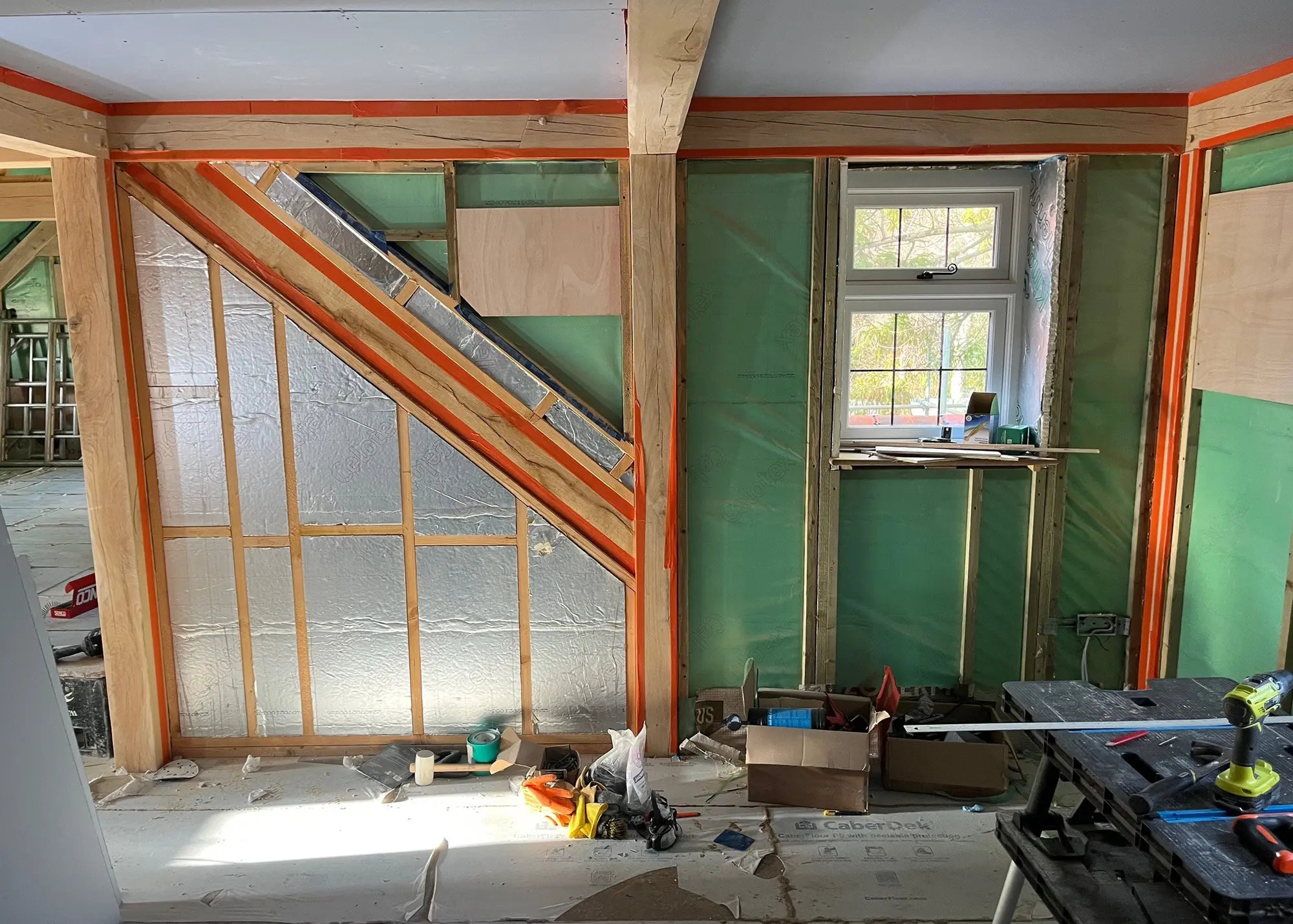
How to Insulate an Oak Frame House – What Are the Options for an Oak Self Build?
Most modern oak frame homes are wrapped in a continuous, breathable thermal envelope to create an energy efficient building. Emily Batesmith explores how this works and the insulation options available for oak self builds

Oak frame buildings are a sought-after option for many homeowners, with their exposed wooden beams offering warm honey tones and characterful details. Oak framing is an offsite construction method, meaning it’s created in a workshop or factory by a specialist supplier. The frame itself is a structural oak skeleton, typically joined with traditional pegged mortise-and-tenons.
Oak frame has been used to build homes in the UK for centuries, with surviving examples dating back to medieval times. This time-honoured construction method has, therefore, never gone out of fashion and continues to be as popular as ever thanks to 21st century energy performance innovations.
So, what are the insulation options for an oak frame self build? In this guide I’m looking at how oak homes are constructed, how the insulation is installed and how this impacts the design and build process.
Jump to oak frame construction FAQs
How are oak frame homes constructed?
In the past, the gaps between the oak posts were infilled with wattle and daub (made from natural materials, including woven sticks, mud, clay, straw and dung). “These historic buildings with external oak frames, typically black and white, had little to no insulation and relied on open fires and natural ventilation,” says James Morgan, head of panel design at Oakwrights. Modern building standards for energy efficiency and airtightness mean a different approach is now used. Today, the entire frame needs to be wrapped up to provide insulation, preserve airtightness and prevent thermal bridging – before being clad in materials of your choice.
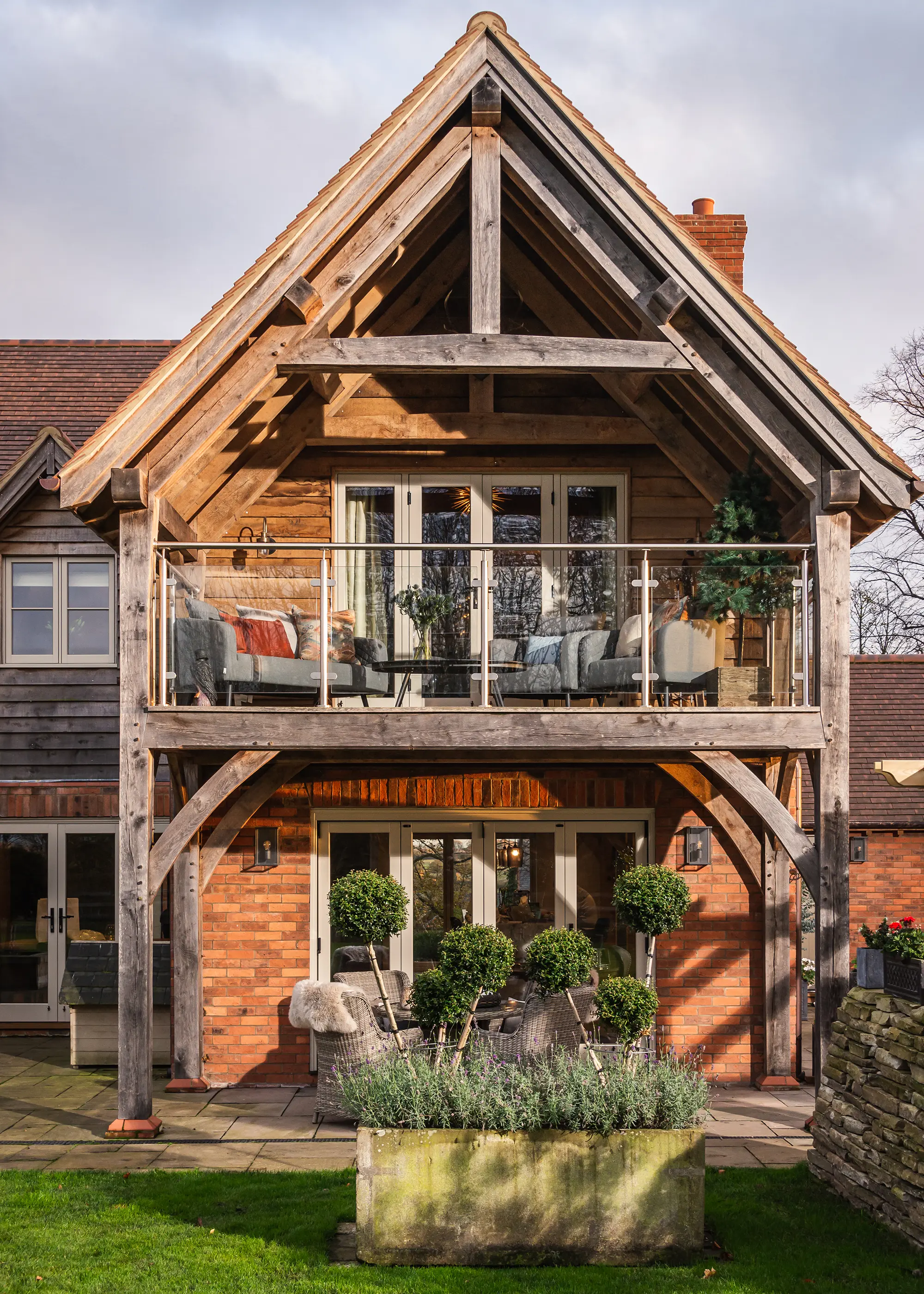
A covered balcony is a great way to include the look of exposed oak on the outside of your home, such as in this project by Oakwrights. Photo: Mark Watts
This is achieved using pre-insulated encapsulating panels, which form the external walls and roof around the oak skeleton – thus creating a thermal barrier that delivers on modern performance expectations. As the green oak frame shrinks over time (becoming stronger as it does so, and developing its characteristic shakes and splits), you need an experienced team who will factor the differential movement into the design.
What is oak frame encapsulation?
Your new home’s insulating panels wrap entirely around the oak skeleton, encasing the walls and roof, leaving no oak exposed externally. “Oak encapsulation systems provide the envelope/walls of the building,” says Gareth Edmunds, design director at Welsh Oak Frame. “In fact, they’re capable of supporting building loads on their own – but when combined with an oak frame structure they are normally just providing the thermal and weatherproofing elements, while also adding supplementary lateral support for the structural frame and building as a whole.”
Many oak suppliers partner their frames with SIPs (structural insulated panels), which consists of large pieces of insulation bonded and sandwiched between oriented strand boards that can form walls and roofs.
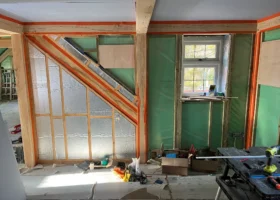
In this Welsh Oak Frame build, the prefabricated studwork wraps around the oak skeleton, with insulation added on site
“The main benefit of SIPs is that it is pre-insulated,” says Gareth. “When combined with the oak frame it might be considered a bit of an overkill, as there would be two structural elements to your property, when of course only one is really required. But SIPs walls alone would be plain. Combining the two means you get a structure that can be closed in and watertight in a quick space of time, with the benefits of seeing the beautiful oak frame elements internally.”
Oakwrights has invested in its own encapsulation systems – WrightWall & Wright Roof and the wood fibre insulated WrightWall Natural & WrightRoof Natural. “The latter can come in varying thicknesses depending on the home’s desired performance levels and structural requirements,” says James. “There’s a visibly deeper wall, displayed at the window openings and doorways, giving a more architecturally impactful feel to the house.”
Premium Content
Downloadable E-Guide
Looking for a helping hand with your self build? Employing the services of a package home company could prove to be the ideal solution. Build It's downloadable e-guide contains everything you need to know about this route to a new property.
find out more
Case study Oak frame home with a traditional stone and render facade
When Moira and Tony Cain settled on a self build project, they searched online and spotted a neglected piece of land in Ruthin, Wales – a pretty historical market town with a castle. The walled plot had once been the garden of a grade II listed church and already had planning consent for a four-bedroom red brick house, similar to the vicarage and sheltered housing on either side. Tony and Moira wanted to submit a revised planning application to the one that came with the land, but the sensitive location created an extensive list of stipulations. The couple had to submit a detailed landscaping plan to show how they’d preserve the ancient wall, as well as do a bat and tree survey.
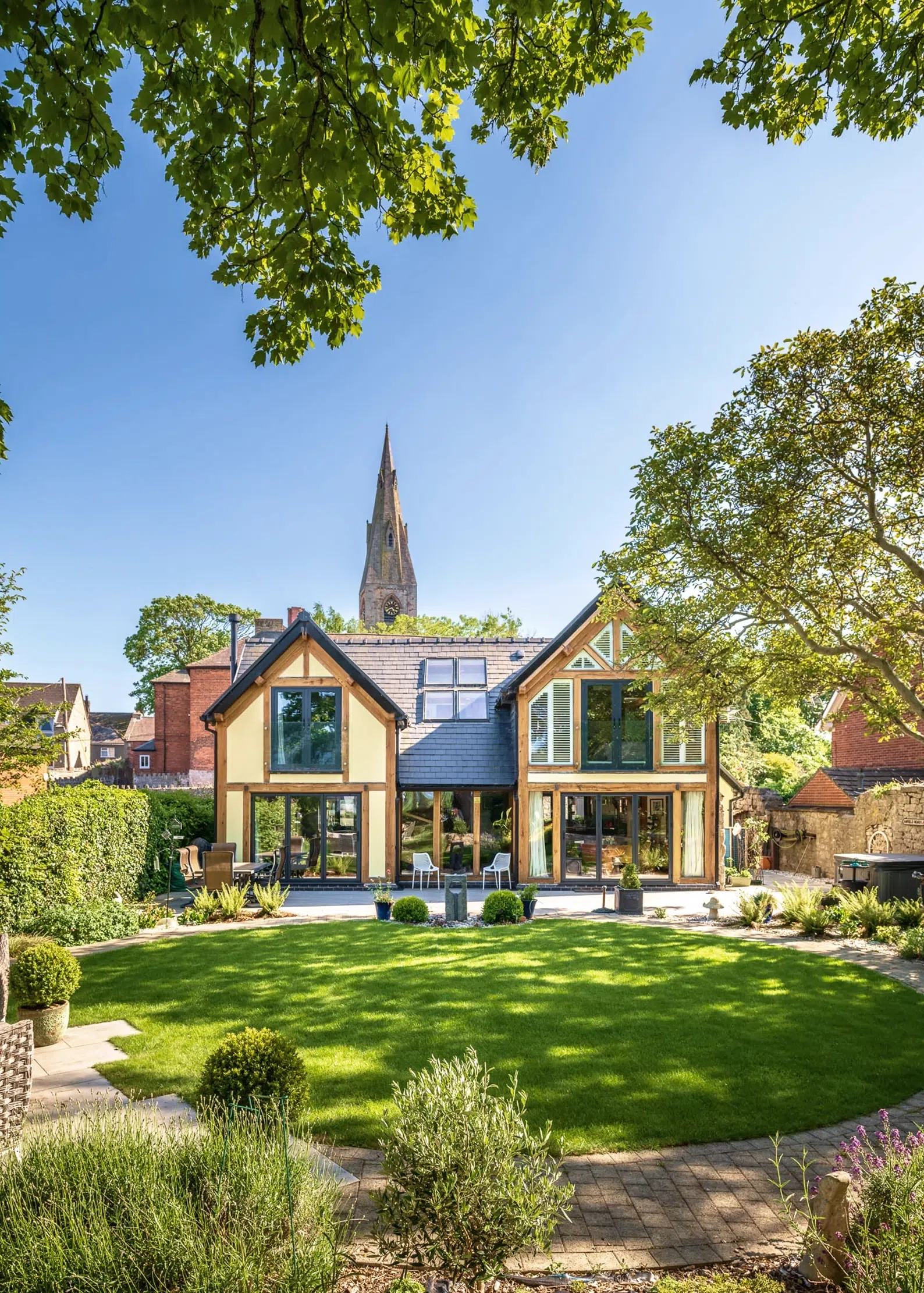
Photo: Nikhilesh Haval
The couple began thinking about the type of house they might build. Having lived in an Edwardian property for many years, they weren’t keen on a modern style. “We also felt red brick would stand out in a town with several old timber frame buildings,” says Moira. “An oak frame house seemed much more in keeping.” The couple went to a Build It Live show to investigate this method of construction, where they discovered what they’d assumed might be an expensive way to build was, in fact, within their budget.
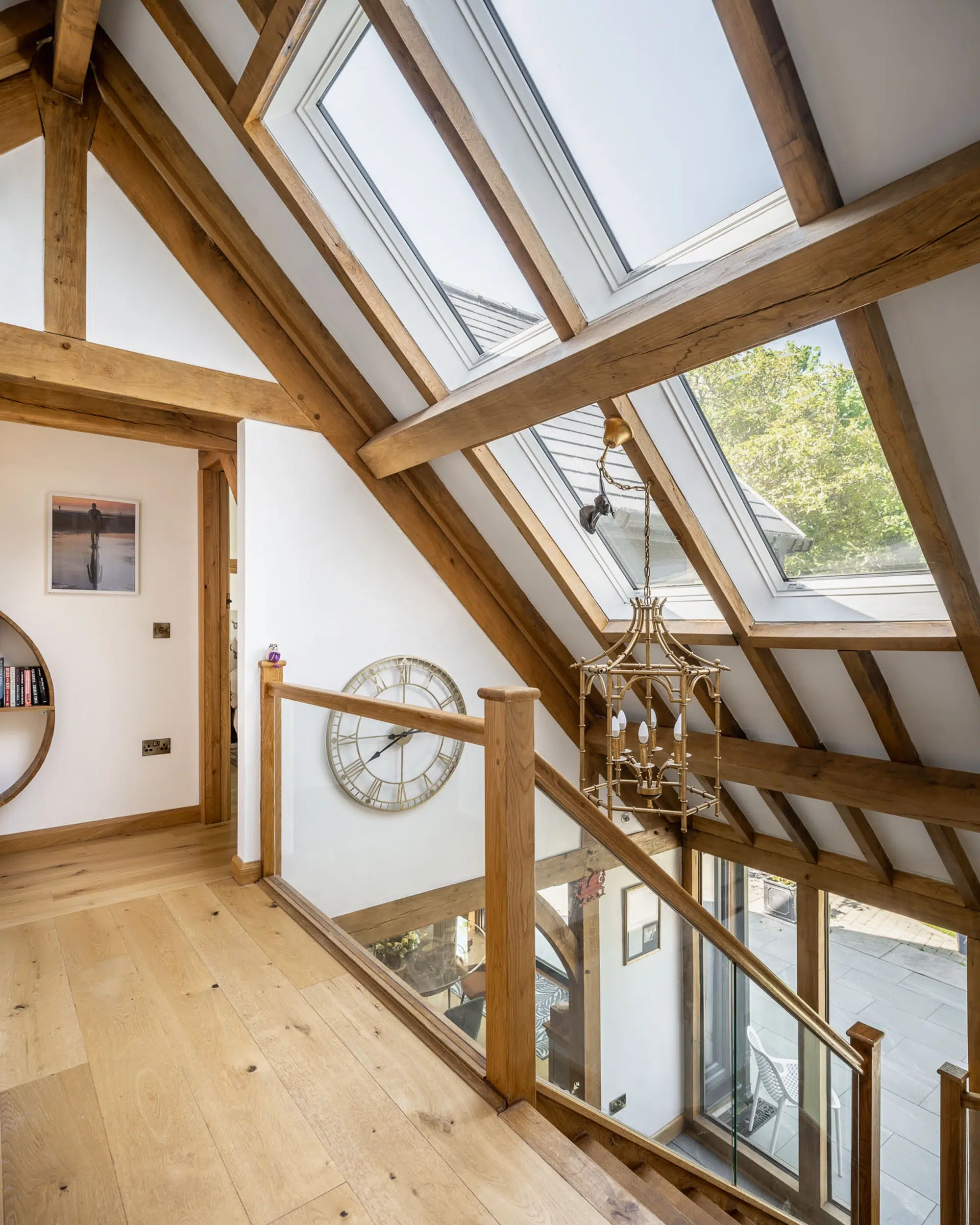
Photo: Nikhilesh Haval
Moira and Tony approached Welsh Oak Frame who were a natural fit for the project location. “We had so much trust in their work and the final design was far better than the first company we went to.” The couple settled on a double-height entrance hall with an oak staircase. Downstairs is largely open plan while upstairs bedrooms have vaulted ceilings with oak in the bathrooms.
Tony wrapped the oak frame with structural insulated panels (SIPs) and installed triple glazing supplied by Welsh Oak Frame – an airtightness test carried out just after completion confirms their home is close to airtight. He also installed a mechanical ventilation and heat recovery (MVHR) system and an air source heat pump.
“We both love the design, the oak is gorgeous, and it fits in very well with the historic site,” says Moira. “Sometimes visitors pass by and are surprised to hear it’s a new build. We’re absolutely delighted, we feel like we’ve won the lottery.”
| Location | Denbighshire |
| Plot size | 690m² |
| Land cost | £135,000 |
| House size | 182m² |
| Project cost | £250,000 (£1,374 per m²) |
| Building work took | 36 months |
How is an oak self build’s encapsulation system created?
Encapsulation systems will be fabricated offsite to the exact requirements of your bespoke building, meaning accurate assembly and guaranteed thermal efficiency. You can expect low U-values and computer-aided precision. “We use the same innovative 3D software employed to design your oak frame as your panel system,” says James. “Using 3D design software also allows us to carefully integrate plant requirements, service runs, bespoke architectural features and penetrations through the encapsulation system at the design stage.” Coordinating these elements digitally allows the team to maintain insulation continuity, airtightness and structural integrity while accommodating individual project requirements.
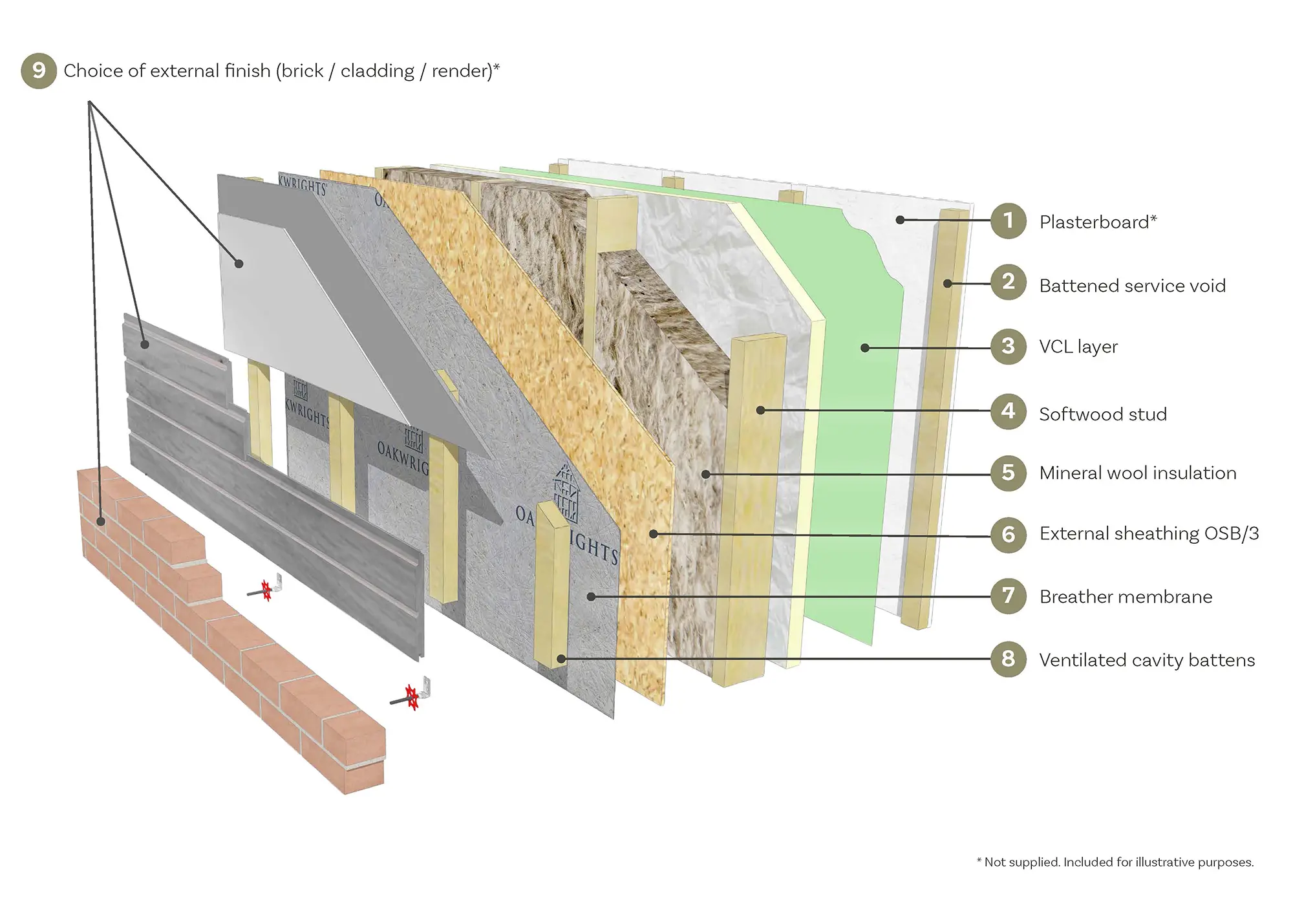
This cross-section of Oakwrights’ WrightWall system show how an encapsulation setup works
Do all oak frame suppliers provide the insulation?
Understand what’s included when you buy an oak frame package. Some specialists will only offer the structural skeleton, leaving coordination of the insulation up to you. This could mean getting in contact with a SIPs manufacturer separately, for instance. “Some oak frames will come with the prefabricated timber studwork panels either pre-insulated or to be insulated on site; others offer oak with SIPs,” says Gareth. “There is not one right answer for every scenario and we like to be flexible, offering a variety of options and solutions to match each customer’s specific requirements and budgets.”
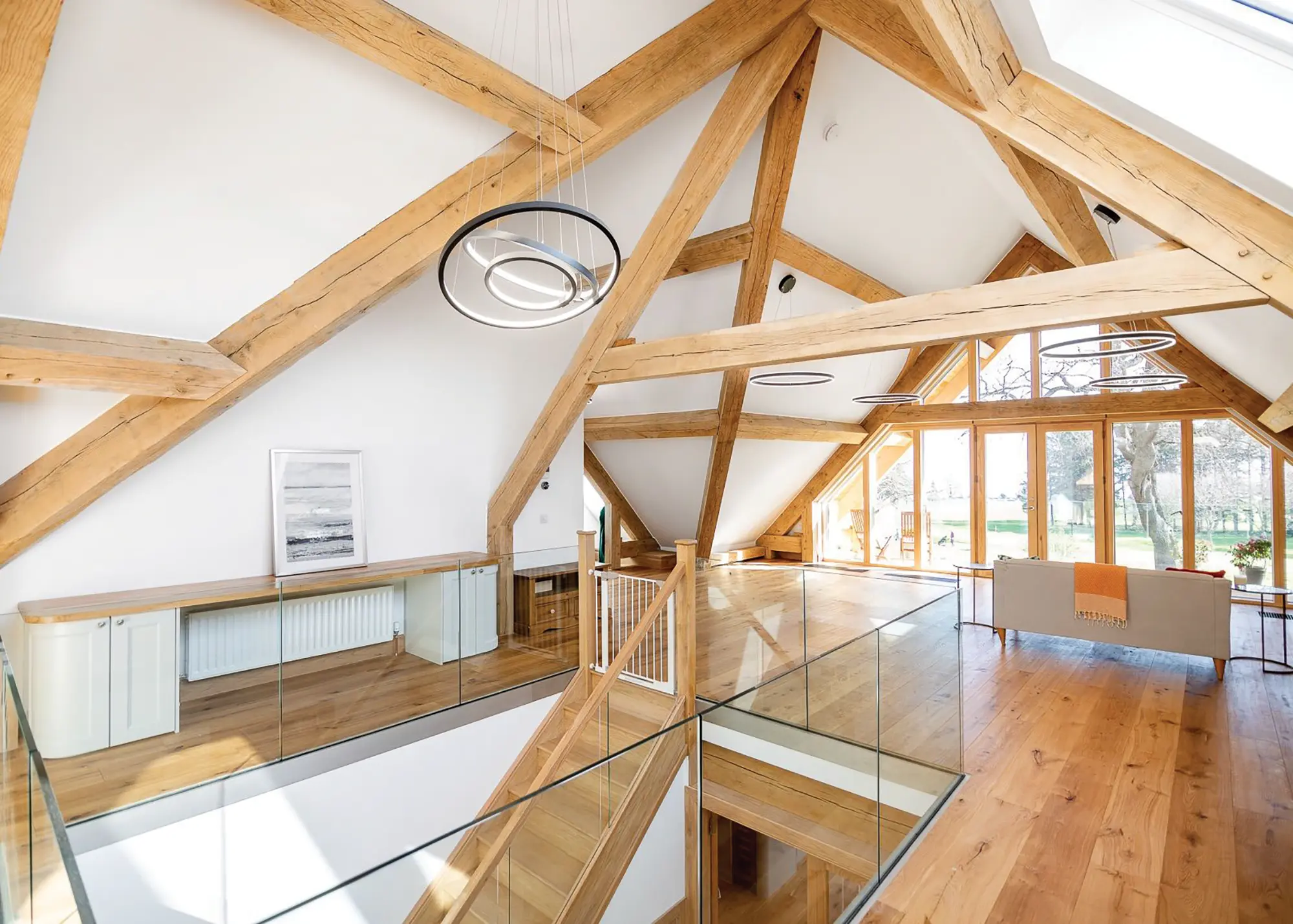
This stunning home by Westwind Oak demonstrates the wow factor that an oak frame can bring to your build. Photo: Patrycja Lipinska
What are the alternative insulation options for oak houses?
While prefabricated timber studwork panels or SIPs are prevalent options, other insulation routes are possible. “Less commonly you could have the oak frame sitting inside of an ICF construction or traditional masonry cavity wall construction. Less commonly still with a steel frame or cob wall/straw bales,” says Gareth.
Other natural insulation options include sheep’s wool, hemp or cork insulation. These will need to be employed alongside suitable breathable and waterproof membranes, sheathing boards etc – and bespoke calculations completed to prove Building Regulations compliance. “You’ll also need considerably more natural insulation compared to using conventional insulation methods, which can have a knock on effect for room sizes and wall thicknesses,” says Gareth. “It’s important to know if you want this early into the project planning so that we can allow for the additional depth of wall panels to provide the appropriate insulation values.”
While factory manufacture gives greater certainty over performance, some self builders choose to get hands-on, including with aspects such as fitting insulation on site. “Although it could be time fairly consuming, it is a relatively simple task and does not require expensive tools or anything more than basic DIY skills,” says Gareth. “This of course is not right for every customer, so it can be something which local trades can undertake on their behalf.”
How is glazing incorporated into an oak frame structure?
Large spans of glass are a wow-factor feature included in many oak frame homes, with glazed gables and large window spans sitting beautifully alongside the oak frame. Direct glazing, where the glass meets with the structural posts, is a popular style. Since the oak frame moves as it dries, this requires specialist techniques to protect both the glass and the building’s performance.
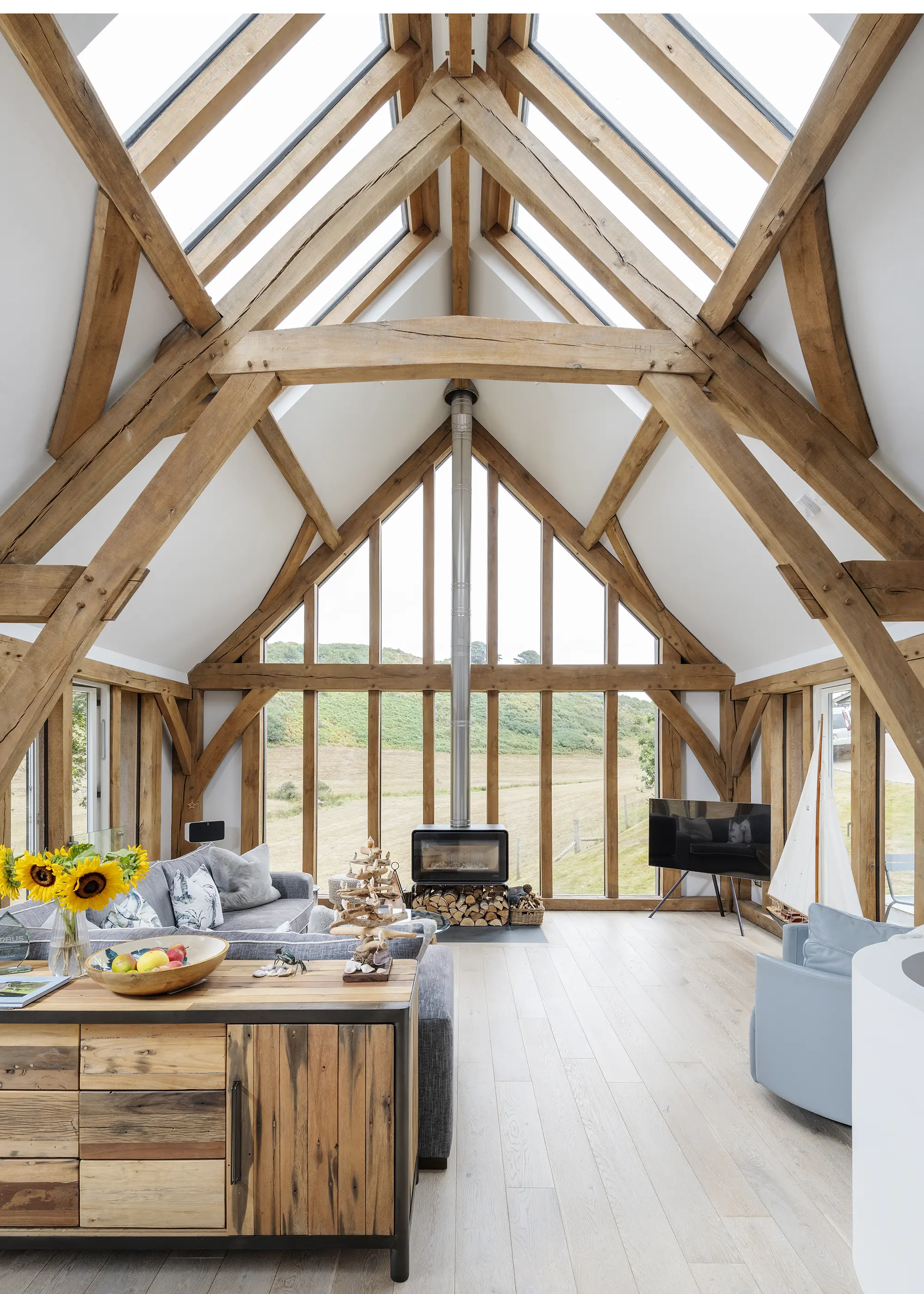
Striking glazing, such as in this project by Carpenter Oak, is often a feature in oak homes, but requires specialist knowledge to ensure performance over time
A popular solution is to fit sealed units on to the face of the posts and beams, as opposed to installing the glass panels in the frame itself. “The secret here is to have a flexible joint between the structural oak and the glass,” says David Grey, sales director at Oakwrights. This, coupled with flexible weather seal joints, and seasoned oak cover boards, allows the structure to move independently while maximising light levels and visibility of the oak framing.
Is it still possible to create a traditional-style oak home with modern insulation?
Building Regulations standards have pushed oak frame companies away from external oak frames and instead towards wrapping the full oak skeleton in a pre-insulated panel envelope so the frame itself is just an internal feature. To get the traditional look of exposed oak on the outside walls of a house, thinner, non-structural oak cladding can be mounted to the outside of the encapsulation panel. Other options include oak framed glazing, porches and balconies.
Oak frame FAQs

Will changes in temperature impact my oak frame house’s structure?
Fluctuations in the temperature and humidity of your home will contribute to the natural movement of the oak frame – you might even hear creaking sounds from the timbers as this occurs. To make sure your oak home doesn’t dry out too quickly, keep your heating low for the first 18 months, as a lot of high heat can exacerbate the natural drying process.
Will it be possible to change my oak home’s design once the project is underway?
Ideally, once your oak frame structural frame has been fabricated, you shouldn’t make any changes. This is why it’s so important to enlist the skills of a good designer, who by this point would have gone through all the different design options and who understands how you’ll want to use the rooms and space early on in the process. You can work with your oak frame supplier to make changes to the design right up to the point where it’s signed off and sent to the factory for manufacture. Any alterations to the design after that could be costly as you’d be paying for a structure that has already been manufactured and that won’t be needed anymore, on top of the cost of the new elements.
Is oak an expensive build method?
Contrary to popular belief, building with an oak frame isn’t as expensive as you might think. It generally adds around 20% to the overall structural costs, but there are multiple ways you can keep prices to a minimum. For example, working with an experienced designer from the start will help avoid issues further down the line and make the most of what oak can offer, both in terms of aesthetics and structural capabilities.
Another way to bring build costs down is to adopt a hybrid approach, using softwood framing in some areas and natural oak where you want to showcase the material for the most visual impact – such as when creating a double-height entrance hall, large vaulted ceiling or a luxurious, cosy living room with low beams.
Is there a difference between green and seasoned oak?
Green oak’s high moisture content allows the timbers to move when they’re first fitted. Over time they season and settle down, improving the structural integrity of the building as well as enhancing its natural character. Green oak is the only way forward when it comes to frames, roof trusses, beams and posts. The soft wood is easier to cut and shape to exact sizes.
Air-dried oak has already cured a little and developed the cracks and splits that occur during the drying out process. It works well if movement needs to be minimal and when thicknesses of 75mm or less are required – for example, lintels, glazed panels and window frames. It isn’t recommended for oak framing where timbers need to be 100mm thick or more.
What are the sustainable credentials of oak frame?
Cutting down trees might sound like a bit of a contradiction, but in a sustainably managed woodland, suppliers will plant more trees than they fell to create the frame. Look for oak with PEFC and FSC accreditations, which guarantee that the wood comes from a sustainable source.
Offsite manufacture combined with the skills of the craftspeople in the oak frame workshops ensure that – compared to traditional site-led methods – far less waste is produced when constructing your home. Workshop teams select the right piece of oak for the right job.
The frame is built with precision inside the workshop, labelled and erected on site. Off-cuts are sometimes used l in a workshop’s woodburner. Oak is also a biodegradable building material and will naturally be broken down at the end of its lifespan.
Another reason oak is sustainable is because it is a natural insulator. Self builders can also fill the walls with eco-friendly insulation such as sheep’s wool or cellulose. A warm house in winter and a cool house in summer means using less fossil fuel for heating and cooling and creating fewer CO2 emissions.
Emily Batesmith
You may be interested in
Our sponsors